


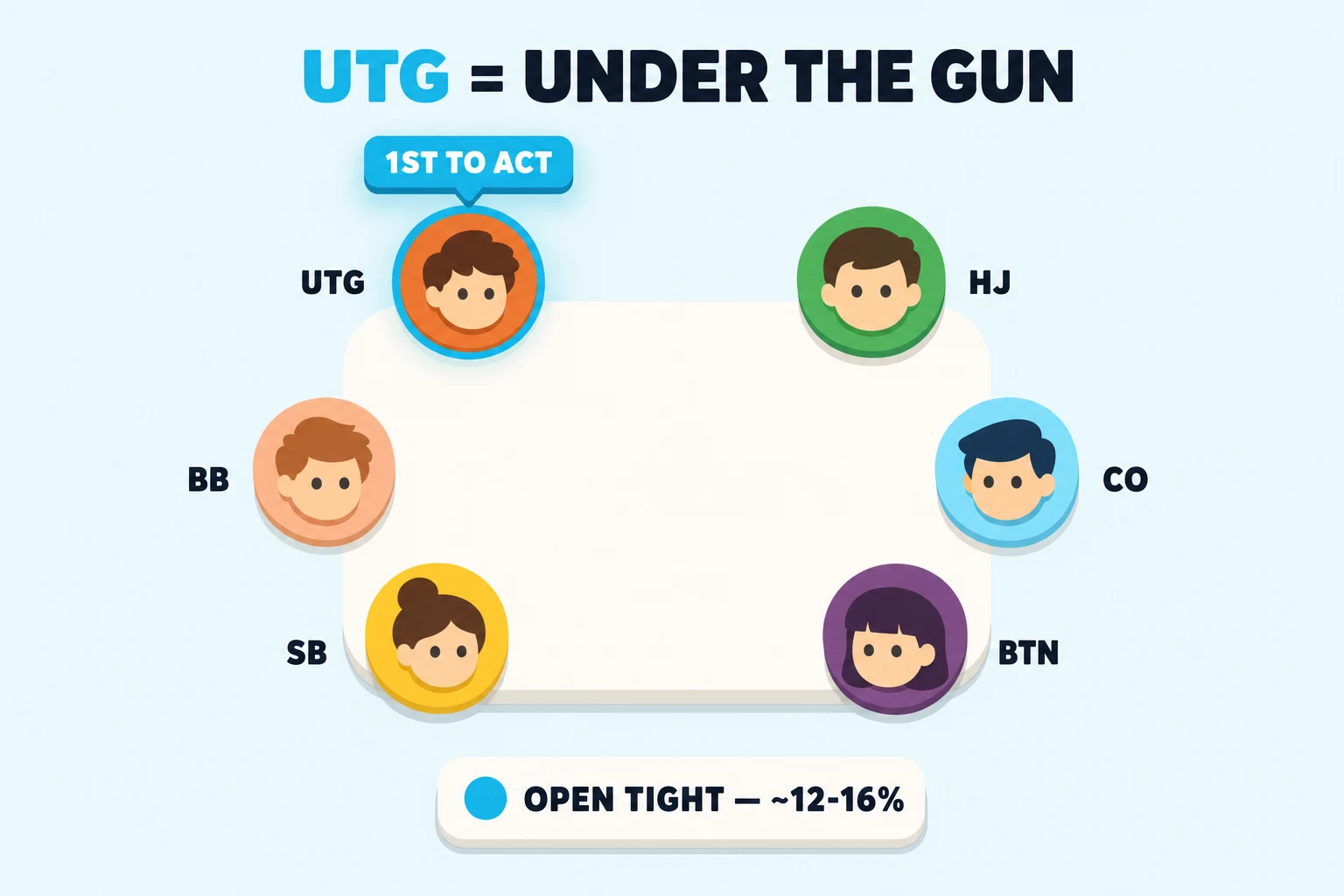
When you sit under the gun, you act first preflop and the entire table gets to react to whatever you do. Open tight, size to discourage cold callers, and play the rest of the hand expecting to be out of position. Most of the money UTG players burn comes from three specific leaks: opening too wide, mishandling 3-bets, and over-defending against squeezes. Get the opening range right, learn the 3-bet response, and the seat stops being a tax.
The shortcut, in one line
UTG is a value seat, not a steal seat. Open the strong pairs, the strong broadways, and the suited hands that flop both pairs and draws. Skip the offsuit junk, the small connectors, and anything that needs a multiway pot to pay off. When somebody 3-bets you, the right answer is almost always fold or call — not a hero 4-bet.
A UTG opening range you can actually use
The numbers below assume ~100bb effective stacks, no short-handed wrinkle, and no obvious table read in either direction. Adjust around the edges once you have one.
| Position | Roughly | Always open | Standard opens | Marginal (drop on tough tables) |
|---|---|---|---|---|
| 6-max UTG | 12–16% | AA, KK, QQ, JJ, AKs, AKo, AQs | TT, 99, AQo, AJs, KQs, KJs, KTs, QJs, JTs, T9s, AJo | 88, 77, 66–22, ATs, KQo, A5s–A2s, QTs, 98s |
| 9-max UTG | 9–12% | AA, KK, QQ, JJ, AKs, AKo, AQs | TT, 99, AQo, AJs, KQs, KJs, QJs | ATs, AJo, 88, 77, KTs, KQo, A5s–A3s |
Three things shrink the range as the table gets fuller. More players still to act means more chances somebody wakes up with a strong hand. More players in the pot means your one-pair hands lose value because somebody is more likely to flop two pair or a set. And acting first means you’ll be making most of your postflop decisions without information. The opening range respects all three. If you want to see how far the range widens once you are not first to act, the free preflop charts lay out every seat for 6-max and full ring, on the page and printable. To turn those seats into something you can recall without the tab open, the guide to memorize preflop ranges works seat by seat. Forum hand histories write all of this in shorthand, so if the letters are the problem rather than the ranges, the poker abbreviations decoder expands UTG, RFI and the rest.
Standard sizing at 100bb cash is 3bb. Bump to 4bb at loose-passive tables where two or three players will call anything, and 2.5bb when the seats behind you are 3-betting wide. Use one size for the whole range. Opening larger only with KK and smaller with AJo tells observant opponents exactly what you have.
Why first-to-act is so unforgiving
Every other seat at the table sees you act before they decide. They get to fold their junk, flat their playable hands in position, and 3-bet the strong slice of their range knowing exactly what’s open in front of them. You’re choosing in the dark.
That asymmetry is why UTG ranges look the way they do. The hands that survive first-to-act pressure are the ones that don’t need a multiway pot to make money and don’t need to see villain’s action to know whether they’re ahead. AA flops a strong overpair on most boards regardless of who’s in. T9s does not.
The three common UTG leaks
Most lost EV from UTG comes down to one of three places.
Leak 1: opening too wide
The most common shape is opening KTo from UTG because “it looks fine.” KTo and the offsuit broadways below KQo run badly against the calling ranges they invite — a button flatter is usually holding KQ, which dominates you, or AJ or 99, which start ahead of you. Q♥T♦ and J♣T♦ are both folds in Poker Skill’s under-the-gun lesson, while suited K♦Q♦ is a raise.
The cleanest test is to look at the hands you opened on the last twenty UTG hands you played and ask which ones you’d be unhappy seeing a 3-bet from. Anything you can’t continue against a 3-bet for either value or as a clean fold is a hand you didn’t have a plan for. That’s the leak.
Leak 2: mishandling 3-bets
The biggest single-decision leak from UTG is treating 3-bets like late-position 3-bets. Players in the cutoff or button get 3-bet light because their opening range is wide. UTG doesn’t. The typical 3-bet range against your UTG open is closer to QQ+ and AK at lower stakes, sometimes as tight as KK+.
That changes the right response. The value 4-bet range from UTG is just KK and AA. Calling AKo and QQ is fine. Folding most of the rest of your opening range is correct — there is no balanced 4-bet bluff that pays from UTG against a 3-bet range that rarely folds. The disaster move is 4-betting AKo to fold to a shove: it turns a hand with around 40% equity into a bluff that gets called only when it’s beat. 4-bet/folding AJs is the same mistake with worse equity.
Leak 3: over-defending against squeezes
When you open and one player flats and a third player squeezes, the pot odds tilt against the speculative hands you’d defend with against a heads-up 3-bet. The effective stack relative to the call is smaller (because the cold caller put dead money in), the implied odds drop because you have two opponents to navigate, and your position is still bad.
Continue with frequent-strength hands only: QQ+, AK, sometimes JJ and AQs depending on opponent. Fold the small pairs that wanted to set-mine and the suited connectors that wanted a flop. The math that justified flatting 88 in a heads-up flop pot does not survive a 3-way squeezed pot at a lower SPR.
Two hands that show the pattern
A♥K♠ UTG, cutoff 3-bets
You open A♥K♠ for 3bb from UTG at a 6-max cash table. The cutoff makes it 10bb. Action folds to you.
Call. Don’t 4-bet. The CO’s 3-betting range against an UTG open at 100bb is usually QQ+, AK, with maybe JJ or AQs on the looser end. AKo runs around 40% against that range — decent, but with almost no fold equity. A 4-bet to 22bb that gets shoved on commits you to a flip-or-worse spot you didn’t have to enter, and a 4-bet that folds out the bluff slice of villain’s range turns AKo into a hand that can only get called when it’s beat.
The cleaner line is to call and play postflop in a 21.5bb pot. AK flops a king or an ace about 32% of the time, and on the boards where it misses you can give up cheaply. You keep the equity, you don’t bloat the pot, and you stop telling the table that your 4-bets always mean KK or AA.
9♣9♦ UTG 6-max, button flats, big blind squeezes
You open 9♣9♦ to 3bb from UTG. The button cold-calls. The big blind makes it 13bb.
Fold. Or, if stacks are short enough that a jam looks workable, jam — but the default at 100bb is fold. The squeezer’s range is rarely lighter than TT+, AKs, AKo, AQs against an UTG opener and a button flatter. 99 is behind every overpair in that range and roughly a coin flip against the AK and AQ slice, which works out to around a third of the pot in equity for a hand that has to call 10bb more and play out of position against two opponents.
The seductive move is “I have to defend, I opened the pot.” That instinct is exactly the leak. The pot is no longer yours; it has been recaptured by a stronger range. Folding a hand that opened correctly is normal when the action behind makes the continuation unprofitable.
When the tight UTG range lies to you
Three table conditions justify deviation.
Very weak players in the blinds. If the big blind has a VPIP of 60% and never folds, your value range gets paid post-flop. Bump up your sizing to 4bb or 5bb to charge them and add a few hands at the bottom of the marginal column. The opening rationale shifts toward “I have a clear postflop edge against this specific player.”
Aggressive 3-bettors directly behind. If the cutoff or button is 3-betting you wide, drop your sizing to 2.5bb so the bluff math hurts them more than it hurts you, and tighten the marginal hands out of your range. ATs and KQo that were on the line at 3bb become folds at 2.5bb against a 3-bet-happy seat.
Tournament near the bubble. ICM compresses ranges. The marginal column folds; mid-stack jams replace small opens; and the calling ranges of the players behind tighten too, which can sometimes open up steal spots — but those are late-position decisions, not UTG decisions. From UTG with bubble pressure, tight stays tight.
Where this fits in your decision
UTG is the seat where positional discipline pays the most because the cost of a leak compounds across every later street you play out of position. It is also the first stop in the seat order, which the guide to poker positions walks end to end. Once your opening range is clean, the next questions get clearer: how to react when you’re on the call/raise side of the same situation in late position (the cold-call vs 3-bet decision), and how to size your 4-bets when you do find KK and AA.
FAQ
What does UTG mean in poker?
UTG stands for under the gun: the seat immediately left of the big blind that acts first before the flop. Acting first with the whole table behind you is the positional disadvantage that shapes everything about how the seat is played.
What hands should I open from UTG?
At 6-max with ~100bb stacks, open every pair, ATs+, A5s-A2s, KTs+, QTs+, JTs, T9s, 98s, AJo+ and KQo, which is about 14% of hands. At a tough table, drop 66 to 22, the small suited aces, KQo, QTs and 98s first. At full ring (9-max), open 77+, ATs+, A5s-A3s, KTs+, QJs, AJo+ and KQo, about 11% of hands. The first hands to drop there are 88, 77, the small suited aces and KQo.
Should I ever limp from UTG?
In standard cash games, no. Limp-folding to a raise just hands over the limp, and limp-calling drops you into a multiway pot first to act with a hand you didn’t think was strong enough to raise. The exception is a soft live game with a known limp culture where trail-limping behind earlier limpers happens — that’s exploitative, not standard. The default is open or fold.
Is UTG the same in 6-max and 9-max?
No. Six-max UTG has only five players left to act; nine-max UTG has eight. The structural pressure is the same shape, but the cost of opening too wide gets worse with each extra seat behind you. Six-max ranges are wider; full-ring ranges are tighter and weight more heavily toward big-card hands and overpair-makers.
Why is UTG considered the worst position?
You commit chips before anyone else has acted, and you’ll play the rest of the hand out of position against most of the seats. That’s the entire reason. Every other seat gets at least a partial information advantage. UTG gets none. The fix is to play a tight enough opening range that the disadvantage stays small, and to skip the spots where it compounds (light 3-bet calls, squeeze defenses with speculative hands). Tricky play from UTG is not the answer.