


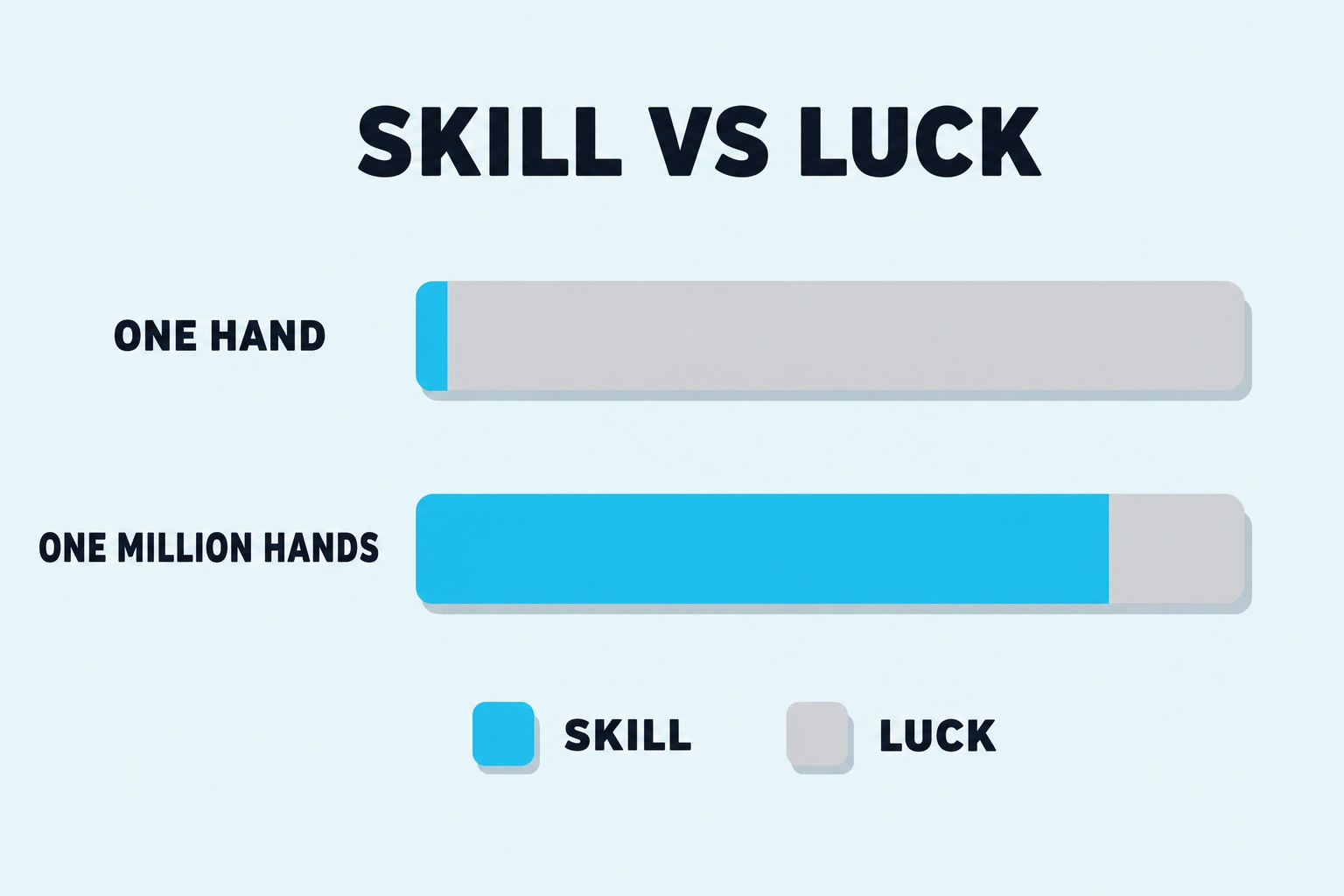
Yes, poker is a game of skill, with one caveat: it is skill plus a chance component that takes time to wash out. Researchers have measured poker’s skill component in ways that hold up: skilled players win at a measurably different rate than unskilled players over a large enough sample, and that, in plain English, is what makes a game a skill game. Results are slower to read: one Friday night can punish good play, while a million hands rarely do.
What this looks like when we measure it ourselves
The studies below answer “yes” to the headline question, but most readers reasonably want to see the skill gap instead of taking a researcher’s word for it. We can show one. In Poker Skill’s engine research we ran a paired test of two versions of our poker AI that share one blueprint strategy and differ in one way: one version also runs a live search on each decision after the flop. Each version played the same 150 deals from the same seat against blueprint opponents, and this is what the gap between their results looked like.
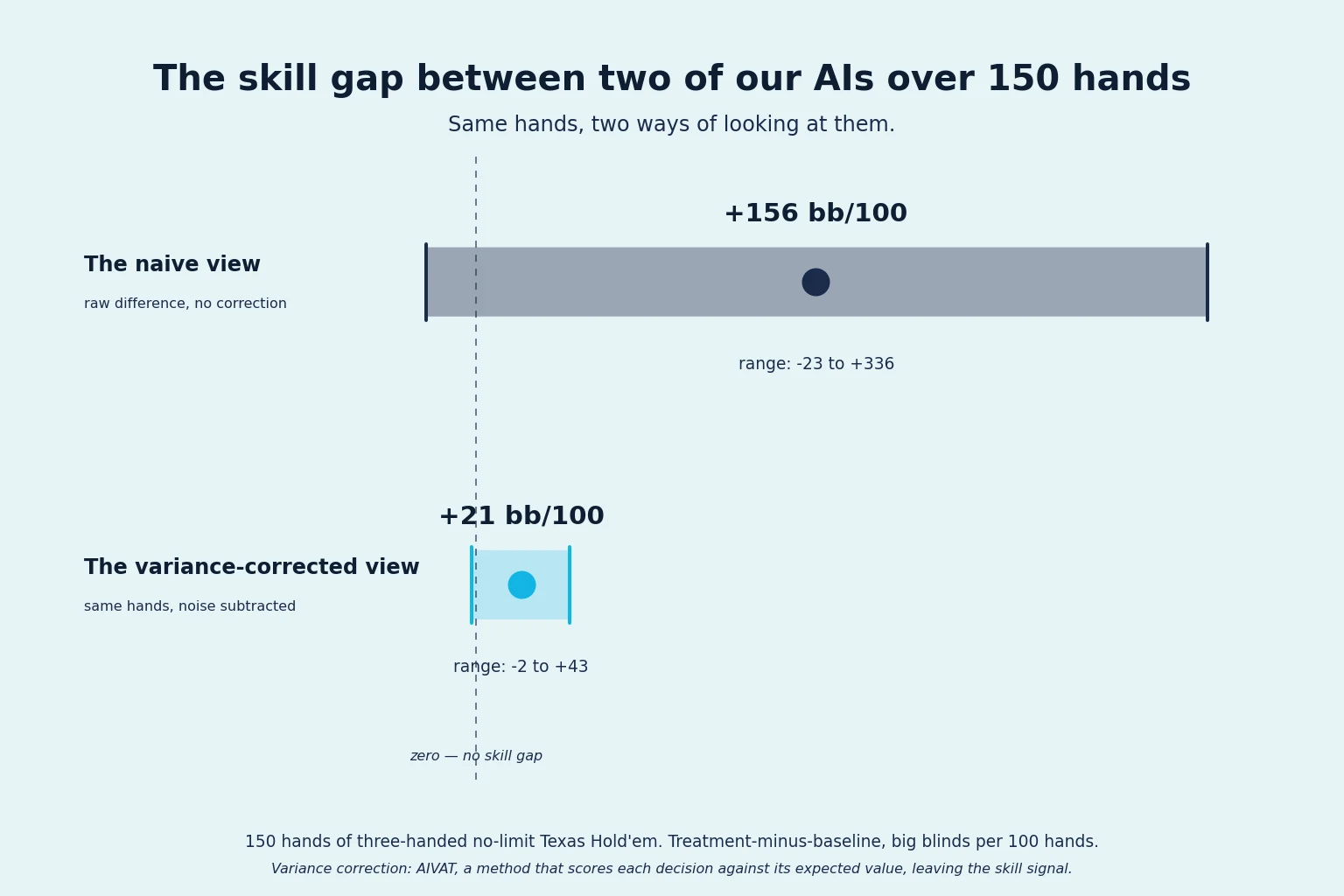
The skill gap between two of our AIs over 150 hands of three-handed no-limit Texas Hold’em. The naive view cannot tell them apart: the error band crosses zero by a mile. The variance-corrected view shows the searching version ahead by about 21 big blinds per 100 hands, with a much tighter range that sits almost entirely above zero.
The two bars are looking at the same 150 hands. The top bar takes the result at face value: on the same deals, the searching version finished 156 big blinds per 100 hands ahead of the blueprint, but the noise around that number is so wide it includes “23 behind” and “336 ahead.” That is what the cards-and-positions lottery looks like at this sample size. You cannot tell the two versions apart.
The bottom bar uses a tool that lets us measure each decision’s expected value and subtract out the part that came from what cards were dealt. What is left is the part that came from how the player played. That gap is about 21 big blinds per 100 hands, and the error band shrinks to about -2 to +43. Its low end still dips just below zero, so the fair reading is a likely edge for the searching version, short of a proven one. The tool has a technical name (AIVAT, a variance-correction method for poker hand histories), and the idea behind it is an old one: a working poker player judges a session by the decisions along the way, because over a few hundred hands the chips at the end mostly reflect the cards.
To be clear about the limits: these are versions of our own AI playing against blueprint copies of itself, with no humans at the table. The search settings were also the winning attempt of a tuning run scored on this same measure, so the chart shows the best of several tries. And 150 hands is a small sample for poker, orders of magnitude smaller than the hand databases behind two of the studies below, which run to hundreds of millions of hands. A longer measurement would tighten the bound further. What this small slice does show is the shape of the answer: the skill signal is there, and it takes careful tools to see it through poker’s noise.
This is what the studies measured at scale, in different ways.
The short answer
Poker is a skill game with a real luck component. The skill compounds over the long run, and the luck dominates the short run. The longer you play, the larger the share of your result that your decisions write.
What ‘a game of skill’ actually means
The legal and academic question is narrower than the bar argument. Researchers ask one thing: do skilled players win at a different rate than unskilled players over enough trials? If yes, the activity is a skill game. If the result is statistically indistinguishable from chance, it is not. That is the bar, and poker clears it by a wide margin once the sample is big enough to read.
This frame matters because it cuts past the bad-faith binary of “skill versus luck.” Both are present. The question is whether the skill component is real and measurable. Five studies, using different methods, found the same answer.
What five studies actually found
Most of the evidence below comes from records of real play.
The Cigital cash-game study
In 2009, software firm Cigital pulled 103 million hands of online cash poker from PokerStars and asked a simple question: how many of these pots were decided at a showdown, and how many by the betting? About 76% ended before showdown, meaning three out of four hands resolved on someone’s fold. Of the hands that did reach a showdown, the best hand won only about half the time, because the player who would have held it had already folded. The study says outright that it leaves luck unmeasured; what it measures is how often the betting ends a hand before a showdown can.
Hannum and Cabot’s simulations
Robert Hannum and Anthony Cabot took a different route in a 2009 paper: simulation. They pitted a skilled player against one who played at random over a billion simulated heads-up hands of Texas Hold’em, and the skilled player won about 97% of the hands. Full-table simulations of Hold’em and Seven Card Stud agreed: highly skilled players convincingly beat unskilled ones.
Levitt and Miles at the 2010 WSOP
Steven Levitt of Freakonomics fame, with co-author Thomas Miles, looked at the 2010 World Series of Poker. Before the series began, they flagged 720 players as high-skill using information such as the previous year’s top money winners and published player rankings, so the label could not lean on the results they went on to measure. Across the 57 events, those players returned about 30% on their buy-ins, while everyone else lost about 15%. A gap of about 46 points between groups defined in advance is the signature of a skill game, and roulette never shows one, since past results there predict nothing.
Croson, Fishman and Pope on persistence
Rachel Croson, Peter Fishman and Devin Pope asked a different question in 2008: do the same players keep finishing near the top? They tracked 899 players who reached the final two tables of 81 high-stakes Texas Hold’em tournaments between 2001 and 2005. Persistence is the skill-game signature, because chance does not persist, and they found it: players with strong earlier finishes tended to finish better again. Running the same test on professional golf, a sport nobody calls luck, they found skill differences among top poker players similar to those among top golfers.
Heeb on sample size
Economist Randal Heeb, testifying in a 2012 federal case, studied 415 million hands of online no-limit Hold’em. Dealt the same starting hand, players who did well on all their other hands also did better with that one, a pattern luck cannot produce. Sorting players with a skill index built from 240 statistics about their play, he found the more skilled half of the pool ahead of the less skilled half after about 900 hands with 90% confidence, and after about 1,400 hands with 95%. Pinning down one player’s own edge takes far longer than separating two groups, which is where the rule every cash-game grinder has heard comes from: you do not know you are a winner until the sample agrees.
The skill-and-luck mix in one chart
The longer you play, the bigger the skill share of your result, and the math of variance is the reason.
| Sample | Skill share of result | Luck share | What it means |
|---|---|---|---|
| One hand | tiny | overwhelming | The cards decide. Your skill barely registers. |
| One session of ~200 hands | small | dominant | A skilled player can lose. A weak player can win. |
| Ten thousand hands | meaningful | still loud | A winning player can still be flat. |
| One hundred thousand hands | dominant | quieter | Your win rate starts to look like your real edge. |
| One million hands | overwhelming | a wobble | The result is, statistically, you. |
The numbers are rough on purpose. Different game formats have different variance, and a hot run can stretch the wobble in either direction. The shape, though, is universal. Skill compounds; luck cancels. Poker Skill’s lessons work at the scale of a single hand and mark each answer on the decision, never on how the cards would have run.
What skill in poker actually looks like
Strip out the romance and the skill component is four mechanical things a winning player does that a losing player does not.
- Range thinking. Skilled players read the situation as “the set of hands the other player could have right now” instead of “the one hand they probably have.” That single shift is the difference between guessing and reasoning. The glossary entry on range walks the basics.
- Position discipline. Acting last is a structural edge. You see what others do before you decide. Skilled players widen their starting hands in late position and tighten up early, and playing the same hands from every seat gives that edge away.
- Pot odds literacy. Every call is a price. Skilled players check the price before they pay it, and the math is one division.
- Bet-sizing instinct. Knowing when to bet small, when to bet big and when to check is the part of the game that takes the longest to learn.
All four can be trained.
Why one Friday night feels like luck
Variance is the technical name for the gap between what happens and what should happen. In poker, that gap is wide on a single session. A skilled player with a real edge can sit down on a Friday night and play every hand right yet lose every all-in. The math survives; the bankroll bleeds.
The reason lies in the deck. Even an 80% favorite loses one time in five, and over five all-ins as an 80% favorite, a strong player loses at least one about two-thirds of the time. That is the math working as designed. Tournament players see it most sharply, because tournament chips cannot be cashed and one lost flip late can undo weeks of buy-ins. Cash-game players feel it too, in stretches that can run forty thousand hands of breakeven before the long-run edge shows.
The honest answer to “I had a bad night, is poker even skill” is: one night was never going to tell you. It is the wrong sample size for the question.
Where this fits in your decision
If you accept that poker is a skill game with a luck component, the next question is the practical one: how do you build the skill without paying the variance to discover whether you have it? The traditional answer is to play tens of thousands of hands and pay tuition to the deck. In Poker Skill you practise the decisions instead, with lessons that start at hand rankings, the Daily Puzzle’s one spot a day and a free Practice vs AI game every day, until the break-even equity math, the range reads and the bet-sizing reflexes are in place. The skill is real, and the open question is how cheaply you train it.
Frequently asked questions
Is poker more skill or more luck? Both, weighted by the time horizon. Over one hand, luck. Over one session, mostly luck with a thin skill layer. Over a hundred thousand hands, mostly skill. The short version: luck has the bigger say in any single hand, and skill has it over the long run.
Has any court ruled poker a game of skill? Yes, though the ruling did not last. The best-known US case is US v. DiCristina: in 2012 a federal judge in the Eastern District of New York found that skill predominates in poker, which put it outside the federal Illegal Gambling Business Act. In 2013 the Second Circuit reversed, holding that the statute covers a poker business whether or not skill predominates. The US Supreme Court has not taken up the question. Legal classification varies by jurisdiction, and the legal question is narrower than the academic one.
Does online poker have more luck than live? No, and this surprises people. The game is the same. Online tables deal hands faster, and a bigger sample in the same hours shrinks the swings, so skill shows up sooner online while the share of skill in the game stays where it was. A live player and an online player with identical edges reach a readable sample at very different speeds, and the online player gets there first.
How many hands does it take for skill to show? It depends on the question. For whole groups, Heeb’s analysis found the more skilled half of an online pool ahead of the less skilled half within about 1,400 hands at 95% confidence. One player’s own edge takes far longer to pin down: one book example shows a winning cash player breaking even for about 40,000 hands before the edge came through. Most amateur players cannot tell from one summer of home games whether they are winning or losing players, because that sample is too small for the question.