
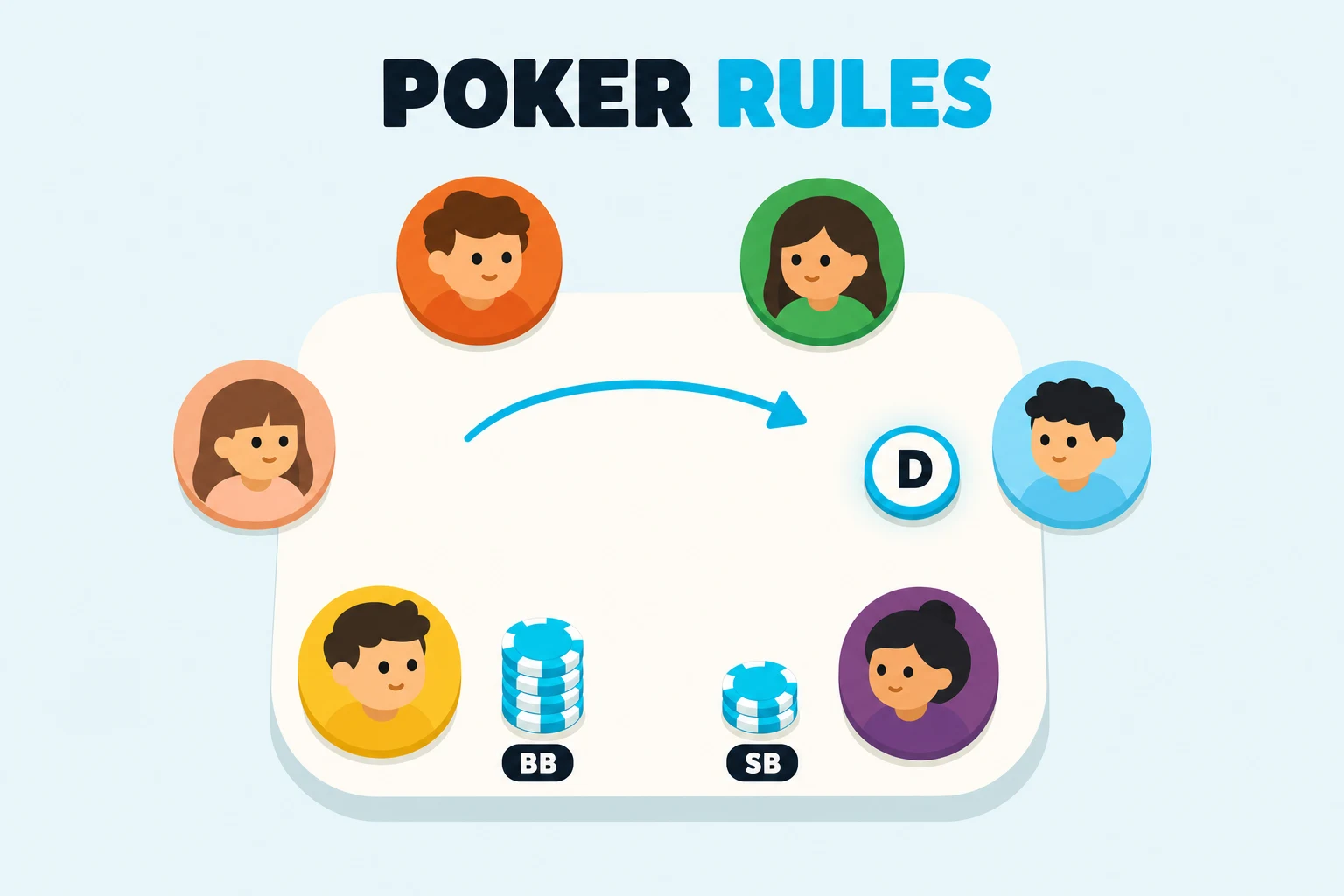
The dealer button rotates clockwise one seat each hand. The two players left of the button post the blinds, small blind first and big blind second, before any cards come out. Action moves clockwise; on each turn you fold, check, call, bet, or raise. A betting round ends when everyone still in has put the same amount in and has had a chance to act. If stacks are uneven, an all-in can create a side pot. At showdown, the best five-card hand wins, and a tie splits the pot.
The five actions, and when each is legal
Every decision at the table is one of five actions. The legal ones depend on what’s already in front of you.
| Action | Legal when… | What it costs | Effect |
|---|---|---|---|
| Fold | Always | 0 | Your cards go to the muck and you give up the pot. |
| Check | No bet has been made on this street | 0 | You stay in the hand without putting more in. |
| Call | A bet is in front of you | The bet amount | You match the bet and stay in. |
| Bet | No bet has been made yet on this street | One big blind up to your stack | You become the aggressor and the pot has a price. |
| Raise | A bet or raise is already in front of you | At least the previous raise on top of the call | You force everyone else to call your new total or fold. |
Two rules to memorize. You cannot check when there’s already a bet in front of you. You cannot raise less than the previous raise; that’s the minimum raise rule, and it’s the one beginners trip on most often.
The forced bets
Hold’em starts with money in the pot before anyone sees a card, so you have something to fight for. The player immediately left of the button posts the small blind, and the player two seats left posts the big blind. The big blind is normally twice the small blind: $1/$2, $2/$5, $5/$10. In a tournament those amounts go up over time. In a cash game they stay the same.
Some games also use an ante, a small extra forced bet from every player or from the big blind seat alone. Antes are common in tournaments past the early levels and rare at the lowest cash stakes. When in doubt, ask the dealer what the structure is.
The order of action
Preflop, action starts with the player left of the big blind, the under-the-gun seat, and moves clockwise. Because the big blind already counts as a bet, the under-the-gun player can’t check; the choices are call, raise, or fold. The big blind acts last preflop and gets the live-blind option: if everyone before only called, the big blind can still raise. If the action was already raised, the big blind plays normally.
Postflop, the order changes. The first active player clockwise from the button acts first on the flop, turn, and river. That’s usually the small blind if still in the hand. The same rotation runs every street, and the round closes when everyone left in has equal money in and has had a chance to act. The glossary entry on closing the action walks the edge cases.
How big a raise has to be
In No-Limit Hold’em, a raise must add at least the size of the previous raise on top of the previous total. The math is simpler than it sounds.
Take a $1/$2 cash game. Preflop, the big blind is a bet of $2. If a player makes it $6, the raise size is $4. The next reraise has to add at least $4 on top of $6, for a total of $10 or more. Make it $20, $50, or shove all-in. What you can’t do is make it $8.
Postflop the same logic runs from the first bet. Bet $20 on the flop, a raise has to make it at least $40. A raise to $50 lifts the bar again; the next reraise has to add at least $30 on top, so $80 minimum.
The one exception is an all-in for less than a full raise. A short-stacked partial-raise jam doesn’t reopen the betting for players who already acted. They can call, but they can’t reraise unless someone else makes a full legal raise.
All-ins and side pots
Going all-in means betting every chip in front of you. You can only win chips other players match against your stack. Deeper players can keep betting against each other; extra chips go into a side pot.
Heads-up, unmatched chips come back and the hand plays for the smaller stack.
With three or more players and uneven stacks, the dealer builds a side pot. Ignoring earlier-street chips:
- Bob bets $200 on the flop.
- Hero calls all-in for $120.
- Alice calls $200.
The main pot collects $120 from each player. The remaining $80 from Bob and the $80 from Alice form a side pot of $160. Any further bets between Bob and Alice on later streets also go into the side pot.
At showdown, the dealer awards the side pot first. Bob and Alice show; the better hand wins the $160. The side-pot winner’s hand is then compared to Hero for the main pot. Hero can only win the main pot. Side pots stack: three different all-ins build a main pot plus two side pots, and only the players who put chips into a given pot can win it.
Showdown: who shows, and what wins
When the river betting closes and more than one player is still in, the hand goes to showdown. Order of showing matters.
If there was a bet on the river, the last player to bet or raise turns over their cards first. Everyone else clockwise either shows a winner or mucks. If the river checked through with no bet, the first active seat left of the button shows first.
Cards speak. The dealer reads the actual cards, regardless of what anyone announces. Claim a flush all you want; if your hand is two pair, that’s what you have. Say “two pair” while holding a flush and the dealer reads the flush and awards you the pot. To collect, you have to show both hole cards; mucking one forfeits the hand. If you want to play only the five community cards, say “playing the board” before you let go.
Identical hands chop the pot. Same five cards on both sides means the pot splits evenly. Suits never break a tie.
The rule mistakes beginners make
These are the ones that get a new player a quiet talking-to from a dealer or, worse, a costly ruling.
Acting out of turn. Folding before the player on your right has acted gives them information they had a right to keep. Watch the dealer’s eyes; speak only when it’s your turn.
String betting. A string bet is reaching into your stack more than once: first for a call, then again to add a raise. Most card rooms rule that as a call only. Two habits fix it. Announce the action verbally first (“raise to forty”), or push out all the chips in one motion.
Flashing cards while folding. Flicking your hand face-up tells everyone what you held. Push folds forward face down. Sighing or thumping the table when a card hits gives the same kind of read.
Splashing the pot. Throwing chips directly into the pile makes it impossible to verify the bet. Stack your bet in front of you and let the dealer pull it in.
Talking about your hand in play. While you still have cards, talking about what you’re holding or what someone else might have is unfair to whoever is still deciding. After you fold, stay quiet.
A live-play habit you can run every hand
Three beats every time it’s your turn. Wait for the player on your right. Decide on your action before you touch a chip. Announce verbally if you’re raising (“raise to thirty”), then move chips; otherwise push out the call or fold cleanly. Keep your hole cards on the table all hand, with a chip on top so they can’t be swept by accident.
Where this fits in your decision
The rules tell you what’s legal. The next layer up tells you what’s smart: when to fold a marginal hand to the under-the-gun raise, when action order lets a free card slide through, when a short stack’s all-in changes the math for everyone behind. With the rules in muscle memory, the table stops feeling like a test and starts feeling like a game where you can think about the decision instead of the dealer.
Frequently asked questions
What are the basic rules of poker for beginners? Each player gets two hole cards. The two players left of the dealer button post the small and big blinds. Action runs clockwise across four betting rounds, with each turn offering fold, check, call, bet, or raise. After the river, the best five-card hand wins. Identical hands split the pot.
How do the small blind and big blind work in Texas Hold’em? The small blind sits left of the dealer button. The big blind sits left of the small blind. They post forced bets before any cards come out. The big blind is normally twice the small blind. In tournaments those amounts go up on a clock; in cash games they stay fixed.
What is the minimum raise in No-Limit Hold’em? A raise has to add at least the size of the previous raise on top of the previous total. If the bet was $20, the smallest legal raise makes it $40. If someone then raises to $60, the next raise has to make it at least $100. A short-stacked all-in for less than a full raise doesn’t reopen the betting.
How does an all-in work and what is a side pot? Going all-in means betting every chip in front of you. Anyone with more chips can still call, but only for your all-in amount. With three or more players, the excess chips form a side pot only the deeper-stacked players can win. The dealer awards side pots first, then the main pot.
Who shows their cards first at showdown? If there was a bet on the river, the last player to bet or raise shows first. If the river checked through, the first active seat left of the button shows first. Cards speak: the dealer reads the actual hand rather than the verbal claim, and you must show both hole cards to collect.