


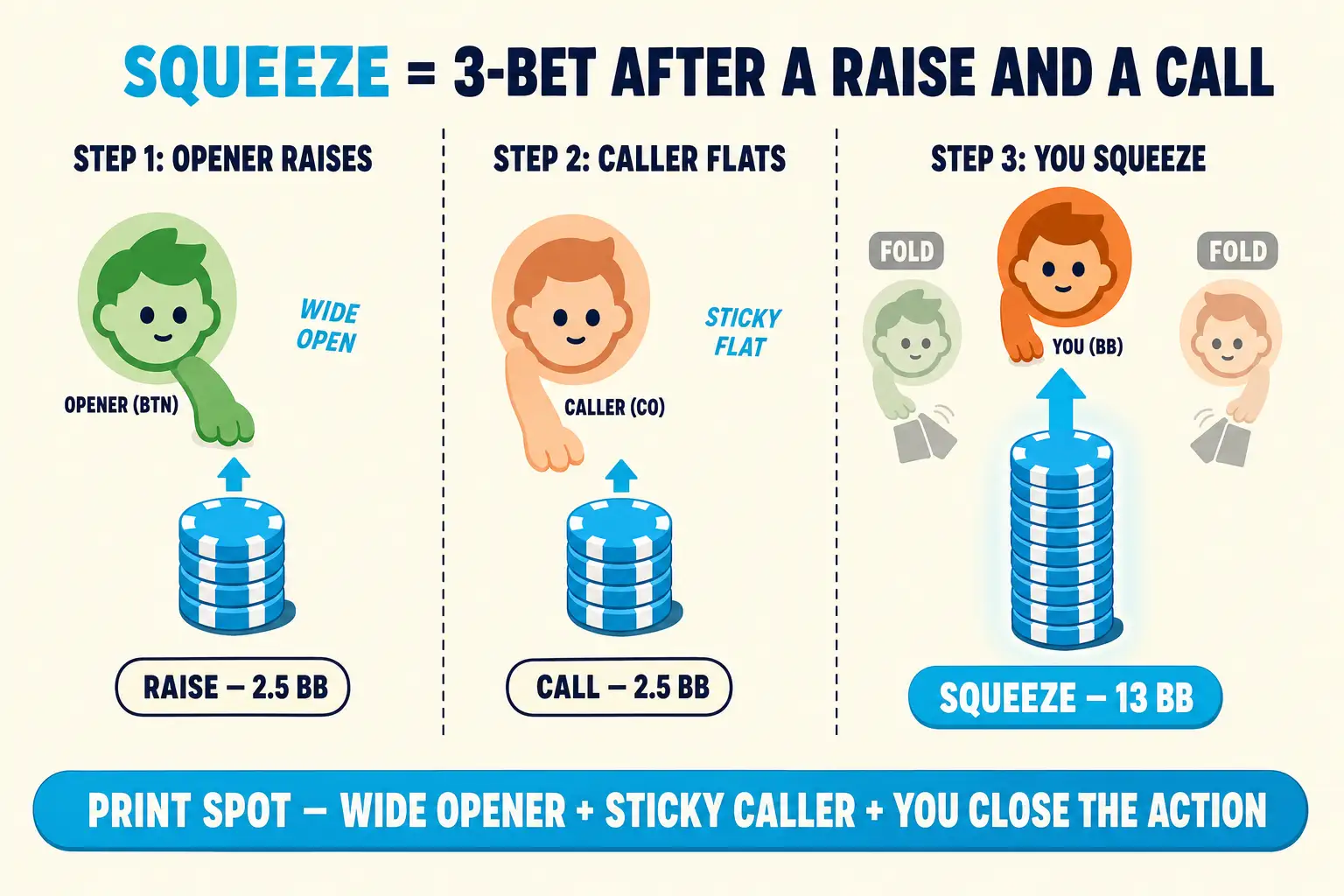
A squeeze is a 3-bet over an opener and at least one cold caller, and it forces two players to fold to one preflop raise. The play prints when three switches line up: the opener is wide and folds to 3-bets, the caller is sticky but not strong and your seat closes the action. Miss any one switch and the squeeze leaks chips. High-EV when the conditions stack, slow stack-drain otherwise.
The shortcut, in one line
If the opener is a wide late-position raiser, the caller is a flatter who can’t take heat and your seat closes the action, squeeze. If the opener can 4-bet you light, the caller has a strong cap on his range or you’ll be playing a bloated pot out of position with a marginal hand, fold or 3-bet some other spot.
When the squeeze prints
The defaults assume about 100bb effective stacks at 6-max no-limit hold’em cash, opens around 2.5bb and one cold caller behind. Adjust when you have real reads.
| Spot | Opener | Caller | Your seat | Verdict |
|---|---|---|---|---|
| Late vs late, you in BB | CO 2.5bb | BTN flat | BB | Print spot |
| Late vs late, you on BTN | HJ 2.5bb | CO flat | BTN | Print spot |
| Mid open, you in SB | MP 2.5bb | CO flat | SB | Conditional |
| UTG open, you in BB | UTG 2.5bb | MP flat | BB | Tight value only |
| Calling station behind | Anyone | Station flats | Anywhere | Value only |
| Active 3-bettor left to act | Wide opener | Sticky | You + 1 left | Skip and wait |
The pattern is consistent. You want a wide opener you can attack, a caller you can fold off and the action almost over so the squeeze does not get squeezed back. Size the squeeze bigger than a heads-up 3-bet, since it has to fold two players, and bigger again out of position.
Why the squeeze works
A normal 3-bet asks one player to fold. A squeeze asks two, and that is the entire edge. The opener’s range is shaped by his seat: a cutoff open covers about 25% of hands on Poker Skill’s six-max chart against about 14% under the gun, so a big re-raise folds out the bottom slice of a wide range. The caller seldom has AA or KK at 100bb, because most players 3-bet those hands instead of flatting them. The caller’s range is the medium, sticky, hard-to-3-bet middle: small pairs, suited connectors, broadway bluff-catchers. A 3-bet much larger than a heads-up 3-bet folds that middle at a meaningful clip while also sometimes folding the bottom of the opener’s range. Two folded-equity sources, one bet. In Poker Skill’s squeeze lesson, the 3-bets go after the chips a raiser and a caller have already put in, against fewer players.
Three squeezes, walked end-to-end
A5s in the BB vs CO open + BTN flat
Effective stacks 100bb. The cutoff opens to 2.5bb. The button cold-calls. You have A♠5♠ in the big blind. Squeeze big.
This is the textbook blocker squeeze. The cutoff’s opening range is wide, about a quarter of all hands on the six-max chart: every pair, every suited Ace, suited kings down to K5s, suited connectors down to 54s and the big offsuit hands. The button’s flat narrows it. Not JJ+ (those 3-bet), not AK (3-bets), so the flatter leans on pairs 22-TT, suited aces and broadways, suited connectors and offsuit broadways such as KQo and AQo. Both villains are folding plenty against a big preflop raise that asks them to bloat the pot with a hand they declined to 3-bet themselves.
A5s does three things at once. It blocks AA, A-K, A-Q, the value-4-bet combos. It plays well when called: nut-flush draw potential, a wheel straight draw, an Ace that flops top pair often enough to matter. And it has equity that otherwise leaks from the BB if you fold.
If the cutoff 4-bets, fold, because your fold equity is gone. If both call, c-bet small on A-high or K-high boards; check on a flop like 9♥8♥7♥ that smashes the flatter’s range and misses yours.
KQs on the BTN vs HJ open + CO flat
Effective stacks 100bb. The cutoff flats a 2.5bb hijack open. You have K♠Q♠ on the button. Squeeze, a little smaller than you would from the blinds.
Same shape, more direct value. KQs holds up well against a typical hijack open and dominates the meat of the cutoff’s flat, hands like KJ, KT and QJ. You have position post-flop and initiative, and only the blinds are left to act behind you. Flatting hands KQs the worst of both worlds: a capped range, no fold equity, a three-way pot where your top-pair-good-kicker hand shrinks against two opponents.
The smaller size reflects two things. You are in position, so you do not need to discourage action as hard. And the hijack opener does not carry the range strength a UTG opener does, so you are not 4-bet-bluff-baiting yourself.
If you get called and the flop comes K-high or Q-high, keep betting. Fold to a check-raise unless the board is bone-dry. On a low connected board (8♥7♣6♣), check back; bloating a pot with two overcards and no made hand is the leak.
TT in the SB vs UTG + MP flat
Effective stacks 100bb. UTG opens to 2.5bb. MP cold-calls. You have T♥T♦ in the small blind. The squeeze is awkward, and that is the point.
This is the spot where a reflexive squeeze bleeds chips. UTG opens about 14% of hands on our six-max chart: every pocket pair, the big aces, the suited wheel aces from A5s down, the suited broadways, a few suited connectors and KQo. That is a tight range that flats or 4-bets your squeeze with the top half of itself. MP’s flat is concentrated: he could 3-bet on his own and chose not to, so his range is JJ-77, KQs, AJs, weak suited Aces. You have TT: behind QQ+/AK, ahead of MP’s flat, not ahead enough to want a 4-bet war.
Two clean lines: squeeze big intending to fold to a 4-bet, or flat the 2.5bb and try to flop a set. The trap is the in-between, a small “feeler” 3-bet that folds nobody and bloats the pot out of position with a one-pair hand. If you squeeze, commit to the size and the fold-to-4-bet plan in advance. If you flat, accept the multi-way pot and lean on set-mining odds. Squeezing halfway is the leak.
When the squeeze lies to you
The defaults above assume four things. When any of them breaks, the play flips.
The opener does not fold. Some regulars 4-bet much wider than the population. A bluff squeeze with A5s into that opener just hands him chips. Tighten to value-only (QQ+, AK) against him until you have seen him fold to a 3-bet at least once.
The caller is a calling station. Fold equity on the caller is what makes the second fold profitable. A player who calls your squeeze because “he has a pocket pair” turns it into a bloated pot with no fold equity left. Switch to value squeezes only against him, and use a bigger size when you do.
There is a competent 3-bettor behind. If a player who knows what a squeeze is sits left to act, your squeeze gets squeezed back. The play disappears against that dynamic. Either tighten to value-only or pass the spot.
You are much shallower than 100bb. At 50bb effective, a squeeze sized for 100bb stacks leaves little more than a pot-sized bet behind if it gets called, which forces you to commit on most flops and turns the squeeze into a partial all-in. Short-stacked, lean toward value squeezes; the bluff-with-blockers play needs depth to recover when it doesn’t work.
A live-play pattern you can run in three seconds
Under the clock, walk these four questions in order.
- Opener seat. Late position (CO/BTN)? Squeeze candidate. Early position (UTG/MP)? Tighten the range or skip.
- Caller profile. Sticky but not strong? Squeeze candidate. Calling station? Value squeezes only. Known trapper? Skip.
- Players left to act. You closing the action, or only one passive player left behind? Squeeze candidate. Two or more competent players left? Skip; you are the next squeeze target.
- Your hand. Top of range (QQ+, AK)? Value squeeze. Blocker hand with playability (A5s through A9s, KQo, KJs)? Bluff squeeze. Middle of range (TT, AJs, KQs out of position)? Pick a clean squeeze-or-fold plan, or flat. The in-between is where chips disappear.
If three of the four answers point to “squeeze,” squeeze. If even one structural answer (seat, caller, players left) points to “skip,” skip.
Where this fits in your decision
The squeeze sits between a cold call and a heads-up 3-bet, the third option that turns “they raised, somebody called, now what” into a way to win the pot without ever seeing a flop. Once you can pick the squeeze cleanly, the next questions get easier: how to defend when you face one, how to size against a sticky caller and how to read which opener profile gives the play the most fold equity.
FAQ
What is a squeeze in poker? A squeeze is a preflop 3-bet made after the opening raiser has been called by at least one other player. The name comes from the mechanics: the squeezer puts both the opener and the caller in a vise, raising the price for both at once. A 3-bet over a single opener with no caller is just a 3-bet; the squeeze label specifically requires the open-plus-flat-plus-reraise sequence.
How big should a squeeze be? Bigger than a heads-up 3-bet, because it has to fold two players, and bigger again from the blinds. Our 3-bet charts put a heads-up 3-bet at about three times the open in position and four times out of position, so start a squeeze above those and go bigger again with each extra caller. The out-of-position size is bigger because a multi-way bloated pot from the blinds is the worst outcome the squeeze can produce.
Should I squeeze with bluffs or only premiums? Both, but the bluff side needs blockers. Suited Aces (A5s through A9s), big offsuit broadways (KQo, AQo) and suited big-card hands (KJs, KTs) make the cleanest bluff squeezes: they cut villain’s value-4-bet combos, they have post-flop playability if called and they unblock the folding range. Skip small pairs and weak suited connectors at 100bb; they don’t block value combos and play poorly in 3-bet pots.
When should I never squeeze? Never bluff-squeeze a known calling station or an opener who does not fold to 3-bets, and never squeeze without a post-flop plan for the times you get called. A bluff squeeze is a fold-equity play. If your two villains never fold, you bought yourself a bloated pot with a marginal hand and no real edge.