


Razz
Seven-card stud played for the lowest hand. The best low is A-2-3-4-5; straights and flushes do not count, and the ace plays low.
Razz: lowball seven-card stud
What Razz is and how the rules work
Razz is seven-card stud played for the lowest five-card hand. You receive seven cards across five betting rounds (three face down, four face up, no community cards), and at showdown you build the best five-card low from any five of those seven. Hand ranks are inverted on the ace-to-five scale: ace is the lowest card in the deck, and straights and flushes have no value at all on the low side. The best possible Razz hand is the wheel, A-2-3-4-5, read as a five-low. Each round is dealt and bet in order, third street (your first three cards), fourth, fifth, sixth, and seventh street (the river), and in fixed-limit Razz the bet size doubles starting on fifth street.
How to play Razz: full rules and strategy walks through every street, the bring-in, hand reading, and starting hands.
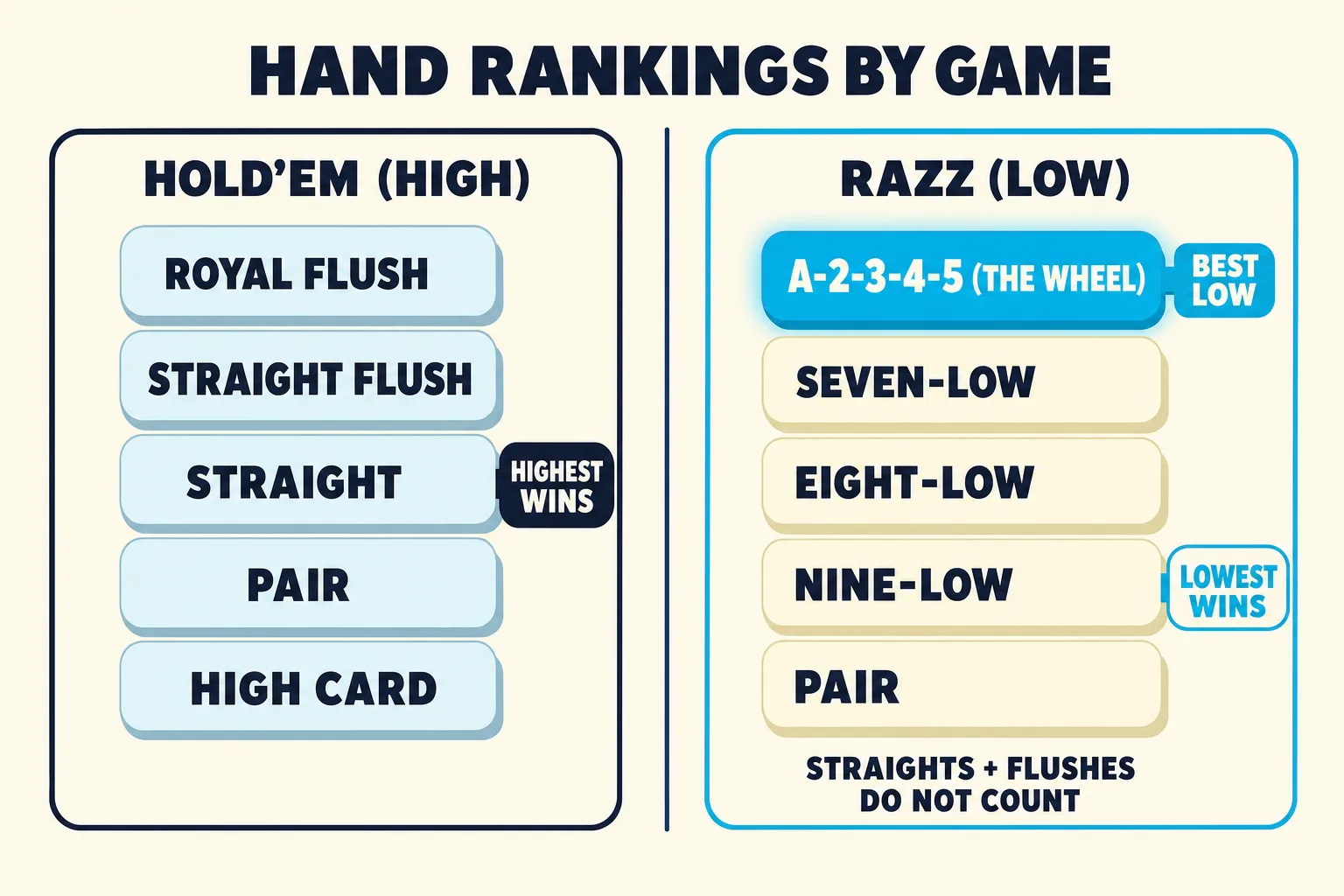
Razz vs Stud High vs Hold’em at a glance
The rules look small on paper. The strategic gap they open is wide enough that good Hold’em players routinely play Razz badly the first time they sit down.
| Trait | Razz | Seven-Card Stud High | Hold’em |
|---|---|---|---|
| Goal | Lowest five-card hand wins | Highest five-card hand wins | Highest five-card hand wins |
| Cards dealt | 7 (3 down, 4 up) | 7 (3 down, 4 up) | 2 hole + 5 community |
| Community cards | None | None | Five (flop, turn, river) |
| Hand construction | Best 5 of 7 | Best 5 of 7 | Any 5 from 7 |
| Ace plays | Low only | High or low (for straights) | High or low (for straights) |
| Straights and flushes | Do not count for the low | Standard high values | Standard high values |
| Bring-in | Highest up-card brings in | Lowest up-card brings in | No bring-in (blinds instead) |
| Betting structure | Fixed-limit (almost always) | Fixed-limit (most common) | No-limit (most common) |
The two-card-combo math everyone uses for Hold’em ranges is gone in Razz: there are no community cards, so equity is decided by your seven cards versus their seven cards, with most of the up-card information visible the whole way. That makes Razz a memory-and-arithmetic game first and a betting-line game second.
When Razz changes your decisions
The structure shifts that matter most are easy to miss if you only know Hold’em.
- A pair is a disaster, not a building block. Pairing any of your low cards on a later street usually wrecks the hand. If you start 3-2-A and catch a 3 on fourth street, your strongest five-card low can no longer use both 3s, and one of your three best low cards has just turned into a hole.
- Up-card reading replaces position. You see four of the seven cards your opponents will use. Whether 8-6-3 is a raise, a call, or a fold depends almost entirely on what is showing on the rest of the table. The same starting hand is a clear raise behind a board of king up-cards and a clear fold behind two threes and an ace.
- Straights and flushes are free. A wheel is the nut low and is also a five-high straight; that straight is a feature, not a problem, because Razz ignores straights and flushes for the low. Hold’em players sometimes fold the wheel to a board they read as scary; in Razz it is the strongest five cards you can hold.
- Antes and the bring-in shape every starting decision. Razz is paid into preflop by everyone. The dead money is meaningful relative to the bring-in, and a big chunk of long-run profit comes from contesting unprotected antes when your three starting cards are smooth and the table’s up-cards are high.
Example: reading two Razz hands at showdown
Two players are at the river. Player A’s four up-cards are 4-7-2-J. Player A’s three down cards are A, 5, and 8. Player B’s four up-cards are 6-3-9-Q. Player B’s three down cards are A, 4, and 2.
You have to find the best five-card low for each player from those seven cards.
Player A. The seven cards are A, 5, 8, 4, 7, 2, J. The five lowest unpaired cards are A-2-4-5-7. That is a seven-low, read 7-5-4-2-A. The 8 and J are higher than the 7 and are discarded for the showdown.
Player B. The seven cards are A, 4, 2, 6, 3, 9, Q. The five lowest unpaired cards are A-2-3-4-6. That is a six-low, read 6-4-3-2-A. The 9 and Q are higher than the 6 and are discarded.
To compare the two hands, line up the highest card in each and walk down: B’s 6 is lower than A’s 7, so B wins on the top card and the rest never gets compared. Player B’s six-low scoops the pot. The shorthand a Razz player uses out loud is “six-four beats seven-five”: top card first, then the next-highest, and so on, until one hand is lower than the other.
Notice the structural lesson: Player A had a strong low draw, but the J on sixth street did nothing for it because Razz never needed five cards smaller than 8; it needed five cards lower than what Player B could produce. Five low cards is the qualifier in Razz Hi-Lo formats; in pure Razz, the lowest five wins regardless.
Common Razz mistakes
- Ignoring opponents’ up-cards. A hand like 8-6-3 is a clear raise into a high board and a clear fold behind two threes and an ace. Razz beginners memorize starting-hand charts; Razz regulars memorize the four exposed cards on every other player.
- Drawing past fifth street with a pair. Pairing any of your low cards on fourth or later usually means you are drawing too thin to continue, especially against an opponent whose up-cards are smaller than your highest. The discipline is to fold pairs early; the leak is calling once “to see what comes.”
- Treating made nines as strong. A made 9-low loses to any made 8-low, any made 7-low, and any made 6-low. Brunson’s framing is the right one: a smooth four-card draw to a seven is often a favorite over a rough complete nine on fifth street. Pat 9s win less often than they look.
- Confusing Razz with deuce-to-seven. In 2-7 lowball, the ace plays high and straights and flushes count against you (so the nuts is 7-5-4-3-2). In Razz, the ace plays low and straights and flushes do not count (so the nuts is the wheel). Reading a Razz hand as if it were 2-7 will cost you the pot.
- Bluffing into open boards. Razz is a fixed-limit game with antes, and your opponents see four of your seven cards. A bluff against a board of three smooth low up-cards is rarely going to scare anyone off; a represent-the-low semi-bluff against a board of broken-up high cards is the only spot bluffing pays.
Where Razz fits in the variant family
Razz is the R in HORSE, the mixed-game rotation of Hold’em, Omaha hi-lo, Razz, Stud high, and Stud Eight-or-better, and it is the canonical seven-card lowball game. Its draw cousins are Ace-to-Five draw lowball, which uses the same low ranking on five cards, and Deuce-to-Seven draw lowball, which uses an opposite scale. Its split-pot relative is Stud Eight-or-better (also called Stud Hi-Lo), where players split the pot between the best high and any qualifying low; the qualifier in those games is a low five-card hand 8-or-lower, which is exactly the kind of hand a Razz player is trying to make every time. Five-card pot-limit Omaha hi-lo variants like Big O push that low half into the four-card-board family, but the Razz reading rules (ace low, straights and flushes ignored, compare from the highest card down) carry across all of them.
Razz hands are won by two skills: starting-hand selection that respects the opponents’ up-cards, and disciplined folding when your low cards pair on a later street. That is the whole game in two sentences.
FAQ
Is Razz played with community cards?
No. Razz is a stud variant, so each player gets their own seven cards across five betting streets (three face down, the first two and the river, and four face up), and the deal looks the same as Seven-Card Stud High. There is no flop, no turn, and no shared board. The only public information is the four up-cards on each opponent and any folded cards you can remember.
Do straights and flushes hurt me in Razz?
No, and reading them as if they did is one of the most common Hold’em-to-Razz transfer errors. Razz uses the ace-to-five scale: the ace plays low, and straights and flushes have no value beyond the spots. A wheel (A-2-3-4-5) is also a five-high straight, and that straight is irrelevant to the showdown, because what matters is that A-2-3-4-5 is five unpaired cards five-or-lower, which is the lowest possible five-card hand. The next-best hands are a six-low, a seven-low, an eight-low, and so on; the lower the top card, the better the hand.
Can I play Razz on Poker Skill?
Poker Skill’s lessons and AI feedback focus on No-Limit Hold’em today. Use this entry to learn how Razz’s hand-formation and bring-in rules differ from Hold’em, then read the dedicated hand-rankings entry for the high-side ladder Razz inverts and the low-hand entry for how the ace-to-five scale ranks competing lows.