


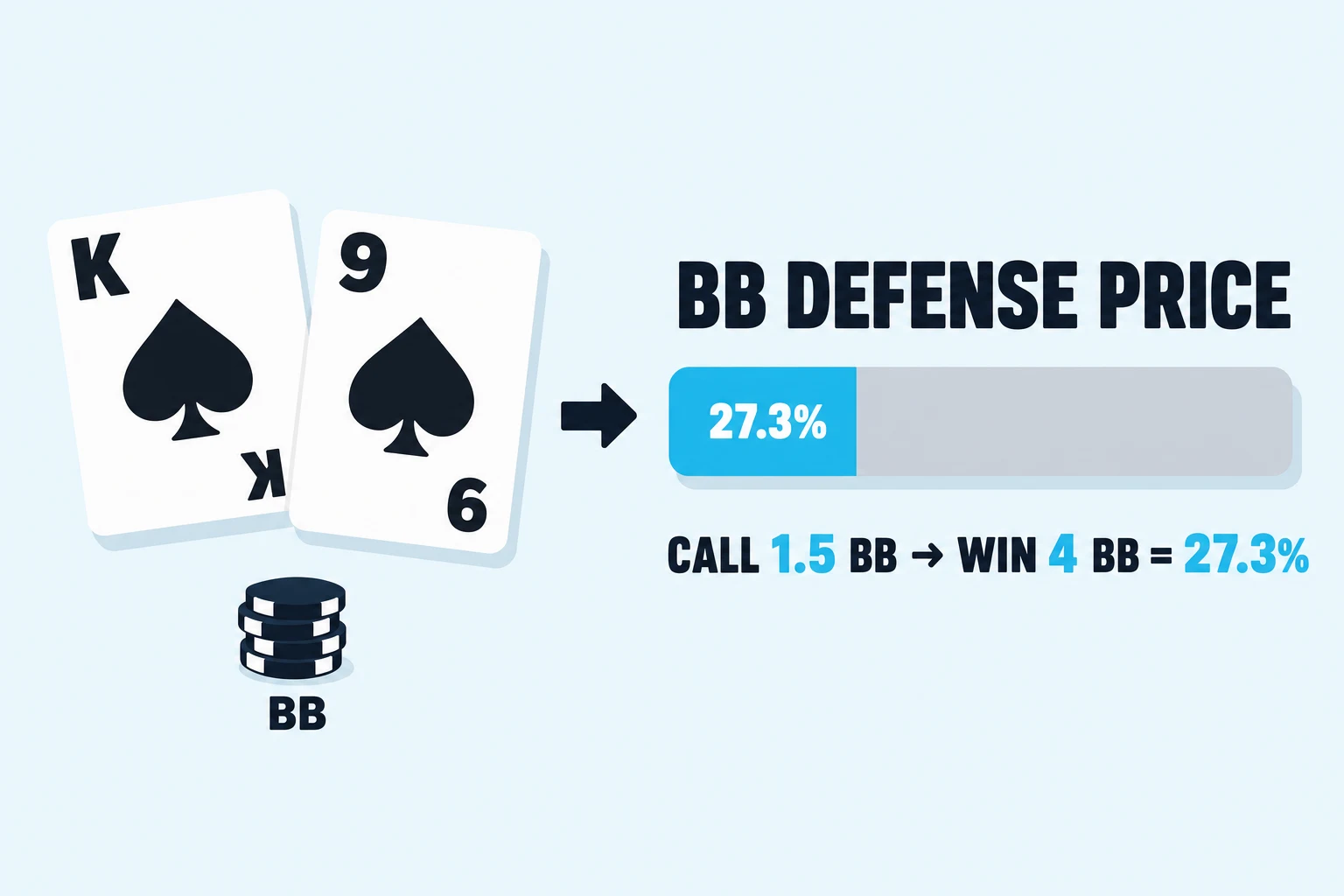
Facing a 2.5x button open from the big blind, you need 27.3% equity to call. That is a low bar, and most reasonable hands clear it on raw equity alone.
The trap is what happens after: you are out of position for three streets, you check into c-bets, and the equity you start with is not the equity you actually win. Big blind defense is two questions: is the price right, and can this hand realize what the price is offering.
Both questions have numbers, and both are drawn below. The big blind and out of position entries carry the plain definitions if you want them first.
The shortcut, in one line
Calculate your pot odds, compare to your hand’s realistic equity (raw equity times a realization factor), and choose call, 3-bet, or fold. The price is wider than most players defend. The realization is narrower than most players think.
The seat opening on you sets the range you are up against: the opening ranges by position chart is the reference for what a button open and a lojack open actually contain.
BB defense math by open size
| Open size | Pot before your call | You call | Pot odds | Break-even equity | Practical defense range |
|---|---|---|---|---|---|
| 2.0x (min-raise) | 3.5 bb | 1.0 bb | 3.5 : 1 | 22.2% | very wide; close to any two suited |
| 2.5x | 4.0 bb | 1.5 bb | 2.67 : 1 | 27.3% | wide; suited two-gappers and up |
| 3.0x | 4.5 bb | 2.0 bb | 2.25 : 1 | 30.8% | trim the offsuit junk |
| 4.0x | 5.5 bb | 3.0 bb | 1.83 : 1 | 35.3% | suited connectors, broadways, pairs only |
The practical defense range column is a defaults sketch. The exact range depends on the opener’s position and how often they c-bet flops you can’t continue on.
Where the equity number comes from
The pot before your call is the dead money already in: the small blind’s 0.5 bb, your big blind’s 1 bb, and the opener’s raise. To call, you put in the difference between the open and what you’ve already posted. Break-even equity is the call divided by the final pot. For a 2.5x open the math is 1.5 ÷ 5.5 = 0.273. For a 3x open it climbs to 2.0 ÷ 6.5 = 0.308. Each 0.5 bb the opener adds to their sizing costs you 3 to 5 percentage points of equity required, which is why open size matters more from the BB than almost anywhere else at the table.
MDF: the ceiling on how much you can fold
Pot odds tell you whether one specific hand can call. Minimum defense frequency tells you how much of your range has to keep going so the opener can’t print money raising any two cards. The formula is the same risk/reward equation, just inverted:
MDF = 1 - (Risk / (Risk + Reward))
The opener’s risk is their raise. Their reward, when you fold, is the dead money in the blinds. Worked at a 2.5x open, that is 1 - (2.5 / 4.0), which is 37.5%.
| Open size | Opener risks | Wins on a fold | MDF (range floor) |
|---|---|---|---|
| 2.0x | 2.0 bb | 1.5 bb | 42.9% |
| 2.5x | 2.5 bb | 1.5 bb | 37.5% |
| 3.0x | 3.0 bb | 1.5 bb | 33.3% |
| 4.0x | 4.0 bb | 1.5 bb | 27.3% |
MDF is a ceiling on how much you can fold, not a floor on how much you must call. In practice, equity realization out of position drags the actual defense width down, which is why most live big-blind ranges sit a few points under the MDF line. If you’re folding more than the MDF column says, you’re handing back the blinds; if you’re defending much more, you’re calling with hands that can’t realize their equity.
Three big-blind defenses, walked
The 2.5x button open you should call
Your call is 1.5 bb into a 4 bb pot, so you need 27.3% equity. The button’s opening range is wide, weighted toward suited connectors, broadways, and the pocket pairs they don’t 3-bet. K♠ 9♠ has about 50% raw equity against that range and realizes well: it makes top pair on K-high or 9-high boards, second pair when a queen or jack tops the flop, a flush draw on two-spade boards, and a straight draw on connected ones. Call. If villain c-bets a low rainbow flop, check-call once and re-evaluate the turn.
Suited K-x earns a defend where offsuit K-x doesn’t. The flush outs cover the kicker problem; strip the suit and the same hand turns into a check-fold magnet by the turn.
The 3x lojack open you should fold
The lojack opens to 3 bb. Pot before your call is 4.5 bb; the call is 2 bb; you need 30.8% equity. The lojack’s range is much tighter than the button’s: heavy on big pairs, big aces, and broadways. Q♥ 8♣ has about 34% raw equity, just over the line, and that is the whole margin you get before realization eats it. On a queen-high flop you have second-best top pair with a kicker that loses to AQ, KQ, and QJ. On low connected flops you have nothing. On most turns you’re folding.
Fold. The shape of the hand and the shape of the opener’s range both fight you. The same Q8o vs a 2.5x button open is much closer to a defend, because the button’s range has so many weaker hands and the price drops by 3.5 points; vs early position, the hand can’t pay the surcharge. J♠ 8♣ folds for that reason in Poker Skill’s big blind lesson against an under-the-gun open: one face card with a gapped, weak kicker realizes poorly out of position against a tight opener.
The 3x small blind open you should raise
The small blind opens to 3 bb. Pot before your call is 4 bb; the call is 2 bb; pot odds are 2-to-1 and you need 33% equity. AJo has about 60% equity vs a normal SB opening range, easily over the bar. But this is the spot where a flat is the wrong move.
Two things flip in your favor in blind-vs-blind play: you have position, and you close the action when you raise. AJo plays badly as a flat because the SB c-bets most flops and you don’t have the initiative to fight back; it plays great as a 3-bet because the SB calls with weaker aces and broadways and folds the rest. Make it 9–10 bb. When the price is right and the position favors you, the call is rarely the highest-EV defense.
What to defend, by price
Facing an oversized open, the instinct is either to fold everything or to defend out of spite, and both are wrong. A bigger raise means a worse price, so it means a narrower range, and the answer to the player who keeps opening to 4x is to keep the hands that can play a big pot and 3-bet the top of them so the size stops being free.
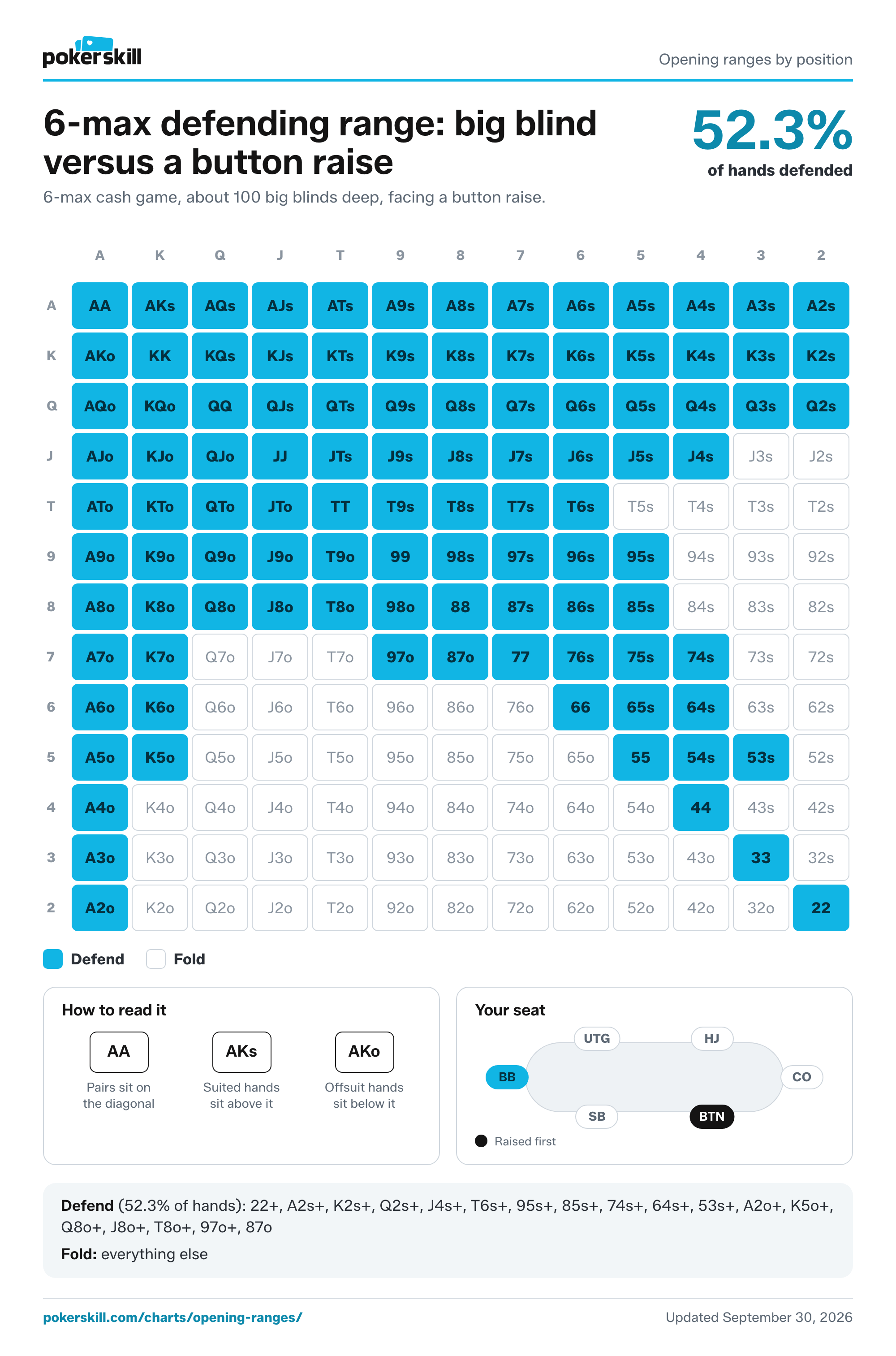
The math sections above give you the bar. This is which hand categories clear it as the open size moves, and here is the shape they make, from the free opening ranges chart library.
| Open size | What stays in | What leaves first |
|---|---|---|
| Min-raise | The widest defence you will ever have: suited hands, connected hands, pairs, and most offsuit broadways | Disconnected offsuit rags that flop one pair and no plan |
| 2.5x | Books single this size out: at 2.5 big blinds or less you can splash around more than against a 3x. Suited connectors, suited aces, suited gappers, offsuit broadways | The weakest offsuit aces |
| 3x | Pairs, suited broadways, suited connectors | Weak offsuit broadways, weak offsuit aces, and the most disconnected suited hands |
| 4x and up | Pairs, suited broadways, the better suited aces, strong offsuit broadways, with the top of that group 3-betting rather than flatting | Most other hands. If the size is being used to run you over, the correction is a wider 3-betting range, not a wider calling range |
One adjustment sits across all four sizes: when the opener is tight, defend tighter than the price alone suggests, because a dominated hand does not realise the equity the pot odds promised it.
The big blind mistakes that cost the most
Folding too much to small opens
Against a min-raise or a small raise, the price is good and folding most of your range gives that price away every orbit. If your habit is to fold anything that is not a broadway or a pair against a 2x open, that habit is the leak, and the MDF table above says exactly how big it is.
Defending like it is “just one blind”
The opposite leak, and both are live at the same table. The blind you posted is gone whether you call or fold, so calling with weak offsuit hands because you already have chips in the pot is not defence. Against a tight opener it is the most expensive habit on this page, because your hand is behind rather than merely getting a mediocre price.
Calling, then folding every flop
Defend a hand preflop and then fold it to the first continuation bet unless you hit, and you have given back the price you just fought for. The fix is not calling more flops with nothing. It is knowing before the flop how the hand continues: which turn cards you can attack, which pairs you can call two streets with, which hands you can raise as a bluff. Books make the same point from the defending side: against small bets, continue more often and keep some bluffs rather than giving up every time.
Never 3-betting
Flatting your whole defence caps your range: the strongest hands you can have are the ones you would have raised, and skilled openers will bet at you accordingly. Against a wide opener from a late seat, a 3-bet with the top of your range plus a few suited hands that block their continues wins the pot before the flop. Against a tight opener, most of your defence is calling or folding, and your premiums still 3-bet for value. The judgement is about their range rather than about aggression for its own sake.
When this lies to you
The pot-odds number is honest about one street. It cannot see the four ways your equity leaks before showdown.
| The leak | What it does to the number |
|---|---|
| Equity realization out of position | You check first into bets, you fold when the c-bet is too high, and your draws do not always get the turn price they need. A hand with 30% raw equity might capture 22% of the pot in actual EV |
| Multiway pots | When the small blind cold-calls first, the pot odds improve and the equity gets worse. Your “above 27.3%” hand might be at 18% three-way. Suited connectors and small pairs gain here; weak offsuit hands lose hard |
| Squeeze risk | Flat too wide against an open and a cold call and you are a squeeze magnet. A late-position player can 3-bet large and turn a light defend into a 6 bb mistake |
| Stack depth | At 100 bb the implied odds on suited connectors and small pairs make the call work. At 30 bb effective they collapse: you cannot get paid the stacks you would need on the rare flops you hit big |
That first row is the one that bites. Pot odds said you needed 27.3%, and you are losing money on the call even though the math looked clean.
A live-play pattern
Three rules you can run at the table without a calculator.
Run this at the table
Treat the BB like a position, not a contribution. You posted the chip; you don’t owe the pot a defense. You owe it correct math.
Where this fits in your decision
Big blind defense is the most common spot in cash poker, and the leak that costs the most range-equity over a session. Pair the price math here with the call-vs-reraise decision tree and the raise-first-in discipline that decides what range is opening into you. The two together cover most of the preflop decisions you’ll see at a 6-max table.
Frequently asked questions
What is minimum defense frequency in poker?
Minimum defense frequency, or MDF, is the share of your range you need to keep going so the opener cannot profit from raising any two cards. The formula is 1 minus Risk divided by (Risk plus Reward). For a 2.5x preflop raise the opener risks 2.5 bb to win 1.5 bb of dead money, so MDF is 1.5 divided by 4.0, which is 37.5%. It is a ceiling on folds, not a floor on calls; equity realization out of position usually means your real defense range sits a few points under MDF.
What hands should I call from the big blind facing a 2.5x raise?
Most suited hands, all pocket pairs, suited connectors and gappers, suited aces, suited broadways, and the better offsuit broadways. The 27.3% bar is low, but the realization tax is real, so prefer suitedness and connectedness over pip count. Skip the offsuit junk: Q8o, K4o and J5o look like price calls and play like check-folds.
Should I 3-bet or call from the big blind?
Default to call against the button and the cutoff, because their ranges are wide enough that flatting captures more value than reraising. Default to 3-bet against the small blind, because you have position and close the action. Against tighter early-position opens, polarize: 3-bet your big pairs and broadway aces for value, plus a few suited blockers as bluffs, and fold the speculative middle.
Why is defending the big blind harder out of position?
You act first on every street, which means you check into bets, fold when the price gets too steep, and miss free turns that in-position players can take. The same hand realizes more of its raw equity in position than out, sometimes by a 10 to 15 point swing. Two-card connectedness and suitedness help most; offsuit gappy hands suffer most.