


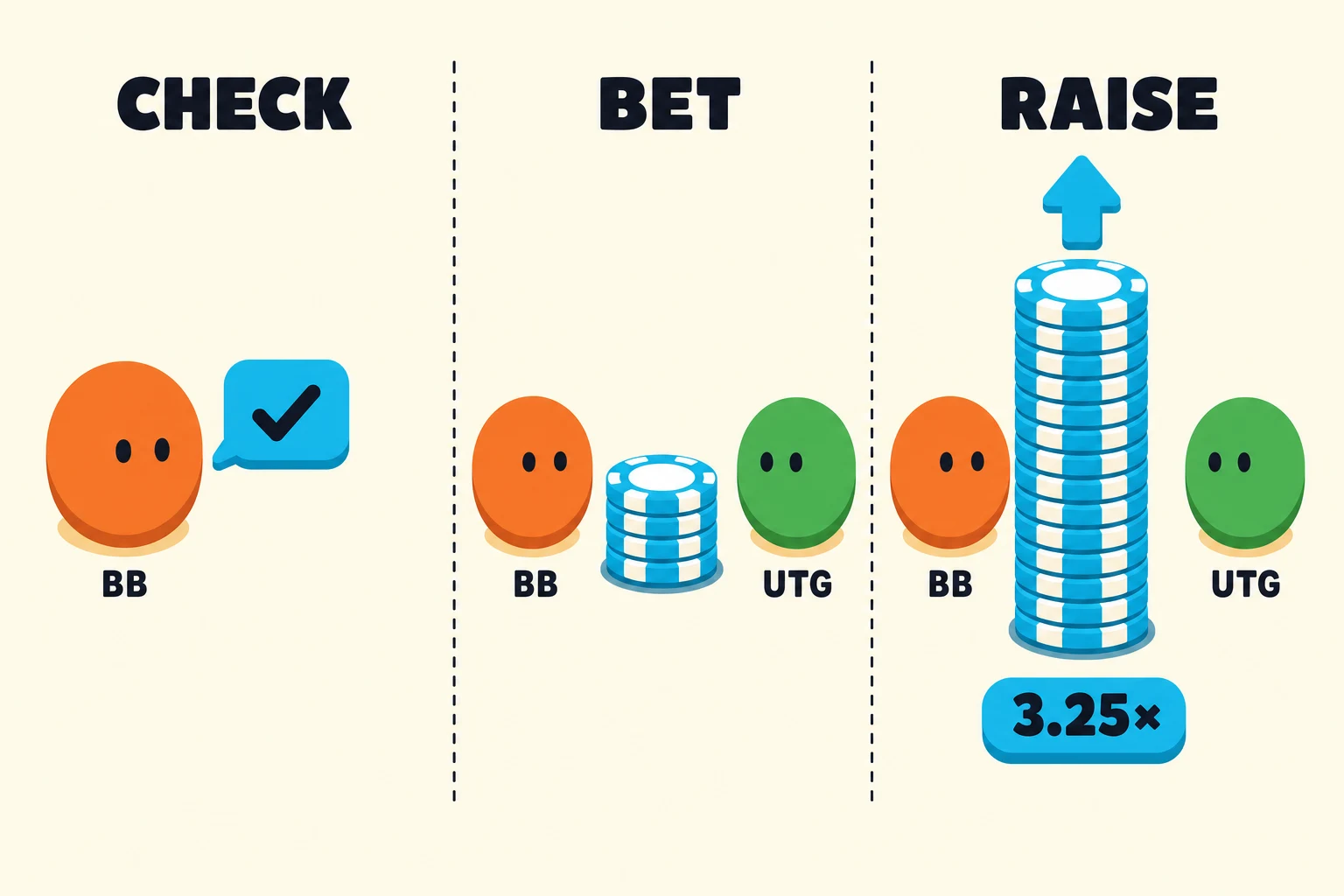
A check-raise is a check followed by a raise of someone else’s bet on the same street. It splits into two camps: a value play, where you flopped strong out of position and let the opener walk into your hand, and a fold-equity bluff, where the texture punishes the opener’s range and your check invites the bet you wanted to attack. The trap is the tempo. Your check looks like surrender, their c-bet commits them, your raise reverses the script. Pick the wrong texture or the wrong opponent and the trap closes on you.
The shortcut, in one line
Check-raise when you flopped strong out of position and the opener will c-bet wide. Check-raise too when the texture lets your range hit harder than theirs and you have a draw or blocker to back the raise. Otherwise, check-call or check-fold.
Quick-reference table
Defaults: ~100bb effective stacks at 6-max no-limit hold’em cash, you defending the big blind heads-up, opener c-betting between 1/3 pot and 2/3 pot. Read the c-bet size first; your raise is sized off it.
| Street | Raise size | Frequency | Best textures |
|---|---|---|---|
| Flop | Big enough to charge the draws, larger on wet boards | Selective; single opponent only | Wet boards where your BB range hits well, low connected, two-tone |
| Turn | A smaller multiple, because the bet you face is bigger | Rare; mostly value | Boards that turn wet (a second card of a suit, a card that fills in straight draws) |
| River | Sized to leave them committed | Very rare; almost always nuts | Bricked rivers where opener bets thin |
The flop is the only street where bluff check-raises are a meaningful share of your range. By the turn, opponents need a real hand to call, and your bluff frequency drops. By the river, you check-raise almost only with the nuts because there is no draw left to give a bluff equity.
Why check-raises work
Three mechanics do the work. First, range advantage flips the sequence. On a low connected board where your big-blind defense range is full of small pairs, suited connectors and pair-plus-draw combos, the opener’s range is not stronger and a small c-bet into your wider hit pattern is a structural mistake to attack. Second, fold equity is larger after a check than after a lead, because the bet they made looks committed but is often a defensive c-bet that folds to a raise. Third, the raise denies free river cards, which is what equity denial means in practice. Against a hand like Q-J with two overcards and a backdoor draw, every free street is equity you donate. The check-raise charges the price. In the last lesson of Poker Skill’s defense section, the check-raise works on 6♦ 5♠ 2♥ with 8♣ 4♣: it is the flop the raiser usually missed, so the raise can win the pot now, with eight outs as the backup.
Three hands that show the pattern
Flop semi-bluff: 8♠7♠ in the BB on T♠ 9♠ 2♣
Cutoff opens to 2.5bb. You defend the big blind with 8♠7♠. Pot is 5.5bb. Flop comes T♠ 9♠ 2♣. You check, cutoff c-bets 2bb (about 1/3 pot) and you check-raise to 7bb.
This is the textbook semi-bluff. You hold a flush draw plus an open-ended straight draw. Spade outs: nine left. Straight outs: any 6 or J, eight cards. The 6♠ and J♠ overlap the flush, so the unique-out total is fifteen, roughly 54% equity by the river. Even if cutoff calls every check-raise, you are coin-flipping on an inflated pot.
The fold equity is the upside. Against a small c-bet, your raise folds out the cutoff’s pure bluffs immediately. If they call, you can barrel the turn on any spade or straight card and check the rest. If they 3-bet jam, fifteen outs gives you about 52% equity against a top-pair-or-better range, so the call is an easy one.
Flop value-raise on a wet board: 9♠9♥ in the BB on K♣ 9♦ 4♣
UTG opens to 3bb. You defend the big blind with 9♠9♥. Pot is 6.5bb. Flop comes K♣ 9♦ 4♣ and you flop middle set. UTG c-bets 4bb, about 60% pot, and you check-raise to 13bb (3.25× the c-bet).
This is the value side. You have a near-locked hand on a wet board with a club flush draw out there and a couple of straight ideas live (Q-J and J-T each hold a gutshot). UTG’s range is loaded with K-x because the king is the top card, and K-x will call a single raise without much thought. Flush draws will call. The only worse set is fours, and the only better set is K-K, a small slice you can live with stacking off against.
Raising beats slow-playing because of the texture. Every free street hands the flush draw and the gutshots a card you cannot afford to give. The 3.25× sizing builds the pot and prices in only the strongest draws, which is fine because you are a 65 to 70% favorite even against the combo draw.
Turn check-raise after flat-calling the flop: 7♥7♠ in the BB on K♠ 7♦ 2♥, turn Q♠
UTG opens to 3bb. You defend the big blind with 7♥7♠. Flop comes K♠ 7♦ 2♥, middle set. UTG c-bets 2bb (1/3 pot) into the 6.5bb pot, you flat-call. Pot is now 10.5bb. Turn is Q♠. You check, UTG fires 7bb, you check-raise to 22bb (about 3.1×).
The flat-call on the flop was a trap with a known cost. A rainbow K-7-2 has no flush draw and no straight draw on it, so a raise there charges almost nobody, while a call lets UTG keep betting the hands a raise would fold. The cost is letting the turn come without a raise, and the turn can change the hand. The Q♠ does: it puts a second spade on the board, fills in straight draws for J-T and gives K-Q two pair. Now the draws hand 2 warned about exist, so the raise charges them. Say UTG calls 22bb with K-K, Q-Q, K-Q, K-J suited, A-K and the spade draws in their range: you are about 78% to win against that, and about 92% without the two sets that beat you, kings and queens.
The raise works because the turn brought something to charge. If the turn had paired the bottom card instead, say the 2♣, nothing new would need charging, and calling again keeps UTG betting. Look for a turn that brings new draws. Without one, hold the trap until the river or just call down.
When the rule lies to you
Four breakers make the check-raise the wrong move even when the texture looks right.
Your opponent is a calling station. The engine of the bluff check-raise is fold equity. Against a player who calls top pair down on every board, you are inflating a pot you cannot win without a real hand. Switch to thin value bets and do not bluff.
The c-bet is small (1/3 pot or less). A bet that small often comes from a wide range with plenty of pairs in it, and when those pairs call a single raise, the fold-equity math collapses. A check-call beats a check-raise here.
Your stacks are short. A flop check-raise on a wet board can leave you facing a 3-bet jam, and your fold-equity-driven hands hate that math. Lean toward check-calling the flop or check-raise-jam lines with combo draws specifically, not stand-alone check-raises that leave you guessing on the turn.
The texture changes against you on the turn. A flop check-raise often gets called, and a turn brick leaves you barreling into a range that calls turn bets. The flop play looked good in isolation; the two-street plan is what matters. Picture the turn before you raise the flop. If the runout has more bad cards than good, check-call instead.
A live-play pattern you can run in three seconds
Before you check with intent to raise, run the three-question check.
- Texture. Does the board hit my big-blind defense range better than the opener’s? Low connected (8-7-4, 7-6-5), two-tone with my suit, paired runouts: yes. Ace-high dry, king-high dry, broadway boards: usually no.
- Opponent. Does this opener c-bet wide on this kind of board? Calling stations do not fold to a single raise; nits c-bet only when they hit.
- Hand fit. Strong made hand (top pair top kicker or better, two pair, set), draw with equity (flush draw, OESD, combo draw or semi-bluff with overcards and a backup) or pure bluff with a real blocker. Those check-raise. Anything in between is a check-call or check-fold.
Two yeses and a hand fit, fire. One yes or any “I’m not sure,” check-call instead.
Where this fits in your decision
The check-raise is one move in the larger postflop tree. It presupposes you have already picked your preflop defense correctly and read the board texture honestly, and it hands off into turn play once the flop bet-raise sequence ends. Master the flop version first; the turn and river check-raises become simpler when the flop logic is clean.
FAQ
Is a check-raise always a strong hand? No. A balanced range mixes the strongest made hands (sets, two pair, top pair top kicker) with semi-bluffs (combo draws, flush draws with a blocker) and the occasional pure bluff. Strong players use both buckets so the move stays unreadable, while weak players check-raise only with monsters and become trivial to play against. Both buckets turn up among the raises Poker Skill marks right: a set and top two pair raise for value, and an open-ended straight draw with no pair at all raises as a semi-bluff.
Can you check-raise the river? Yes, but rarely. River check-raises mostly want the nuts or near-nuts because there is no draw left to give a bluff equity. The exception is against an opponent who bets thin with second pair or a worse flush; a pure bluff check-raise with a strong blocker is sometimes profitable. At most stakes, treat river check-raises as a value-only line.
What size should a check-raise be? No fixed multiple is standard. On the flop, lean larger on wet boards, where you want to charge draws and need fold equity, and smaller on dry boards, where the price already does the work. On the turn, a smaller multiple is enough, because the bet is bigger and the stacks are shallower. On the river, size the raise to leave the opponent uncomfortably committed.
Is check-raising profitable in low-stakes games? The value version, yes. Low-stakes opponents call too wide, which is exactly what you want when you have the goods. The bluff version, less so: most low-stakes regs do not c-bet wide enough or fold often enough to make the play pay, and the calling-station problem is at its worst at the lowest stakes. Default to value-only until you have a clear read that the opponent folds to flop pressure, then layer in the semi-bluffs.