


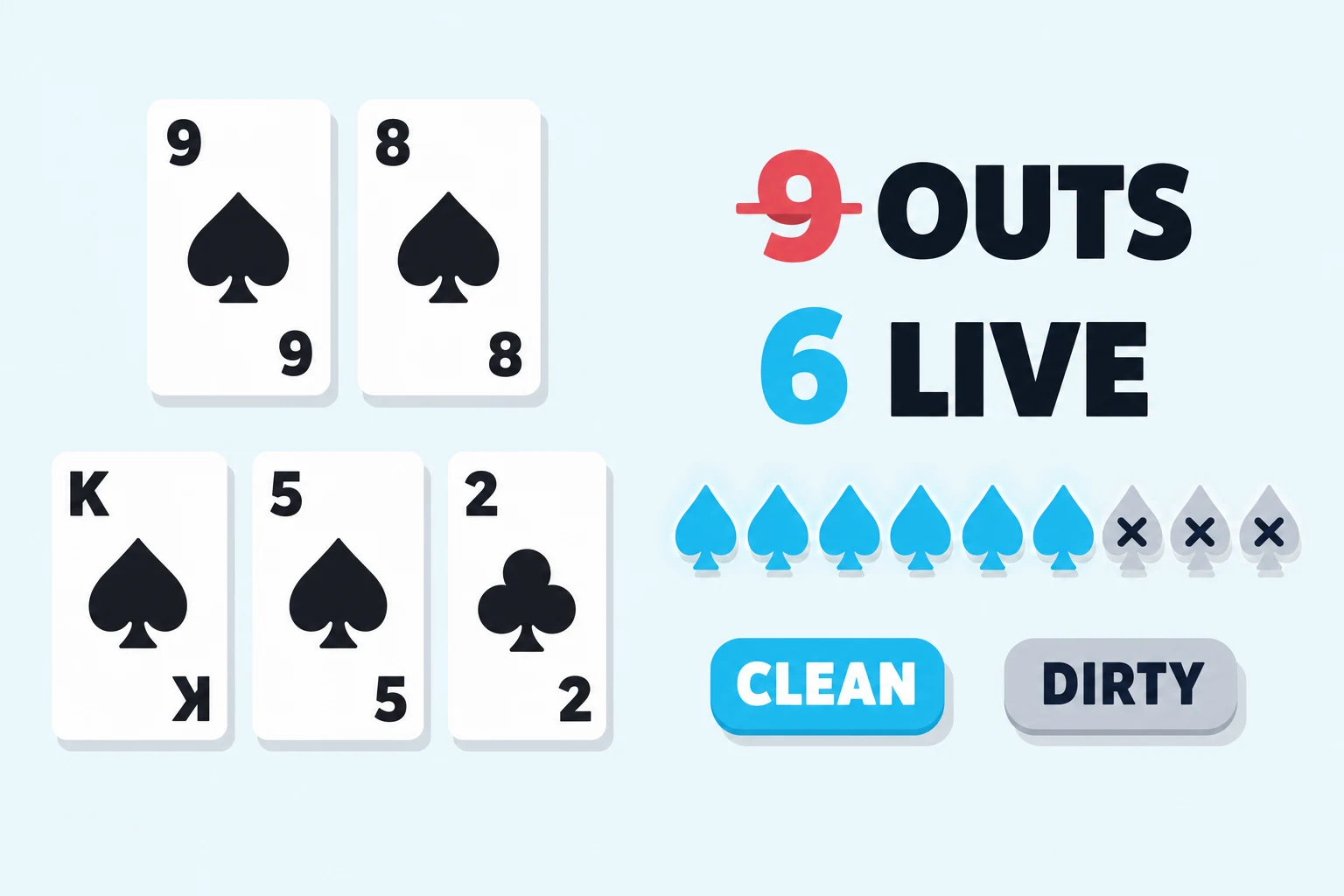
Counting outs is the easy part. The hard part is knowing which of those outs actually win the hand. A flush draw can have nine cards that complete it and only six that win. A straight draw can have eight outs and lose to a flush on two of them. The gap between raw outs and live outs is the gap between a call that holds up and a call that quietly bleeds chips.
The shortcut, in one line
Outs come in three flavors. Clean outs win the pot when they hit. Dirty outs improve your hand but also improve villain’s, or leave you second-best. Dead outs change the cards in front of you without changing who wins. Discount the dirty and dead outs before you multiply by 2 or 4, not after. The number you trust is your live-out count, not your textbook count.
Quick-reference table
| Draw | Raw outs | Common discount | Live outs | True equity by river |
|---|---|---|---|---|
| Open-ender on a rainbow flop, 9♥ 10♣ on 7♦ 8♠ 2♣ | 8 | none | 8 | 31.5% |
| Non-nut flush draw when villain’s range holds some higher flush draws | 9 | subtract 2 to 3 dirty outs | 6 to 7 | 24% to 28% |
| Open-ender where two of your straight cards bring villain’s flush | 8 | subtract 2 dirty | 6 | 24.1% |
| Flush draw against a set on a board that can pair | 9 | subtract reverse-implied tail | ~7 effective | about 26% |
| Gutshot when villain already has the made flush | 4 | all 4 dead | 0 | 0% |
The bottom row is the trap row, the spot where the textbook count is right and the answer is still fold.
Why outs go dirty
Three structural reasons your textbook count overstates your equity.
The first is range domination. You hold a real draw, but villain’s range contains a stronger version of the same draw. The textbook case is a non-nut flush draw against a higher one. You have nine clubs that make a flush. Villain has two clubs that make a higher flush on the same nine cards. The cards that complete your draw are the cards that complete theirs, and theirs is bigger.
The second is cards that play double duty. Two of the cards that make your hand also make a hand that beats your hand. The classic spot is an open-ended straight draw on a two-tone board where two of the eight straight cards are the suit that completes a flush. You hit your straight, villain hits their flush, you bet the turn, you lose the river. You count one of these on a board from Poker Skill’s draw lessons: 7♥ 10♠ on 9♦ K♥ 8♦ is an open-ender, a six or a jack for eight outs, and two of those eight, the 6♦ and J♦, would also put a third diamond on the board.
The third is runner-runner board pairs and reverse implied odds. You hit your draw on the turn, you bet, villain calls. The river pairs the board, and a set in villain’s hand becomes a full house. You hit your card, you put more money in, you still lose. This is the reverse implied odds trap, and the live-out count alone does not capture it. The cost is the extra money the dirty out costs you when you stack off thinking you got there.
Three hands you’ll recognize
Non-nut flush draw against a range with higher draws (9 raw, ~6 live)
Hero has 9♠8♠ in the big blind, calls a button raise, and the flop is K♠5♠2♣. Villain bets two-thirds pot. You count nine spades, run the Rule of 4 and get 36% equity, which beats the 29% the bet demands if the call puts you all in and both cards come.
Now look at villain’s range. A button raise that c-bets two-thirds pot on this two-tone board is connecting with broadway and ace-rag suited combos, several of which hold a higher spade: A♠Q♠, A♠J♠, A♠T♠, even Q♠J♠. Against any of those hands, every remaining spade makes you a 9-high flush, and a 9-high flush loses to every higher flush in the range.
You don’t know villain has the higher draw; you know they sometimes do. The honest count is to discount your nine raw outs by roughly a third, call it six live and recompute. Six outs by the river is 24%, under the price the bet demands. The all-in call that looked like 36% becomes a fold once you discount. That is the read every winning player makes without thinking about it.
Open-ender where two outs complete villain’s flush (8 raw, 6 live)
Hero has T♠9♦ in the big blind. The flop is A♣7♥8♥, villain raised pre and bets the flop. You hold an open-ended straight draw: any 6 or any J makes a straight. Eight raw outs.
Two are problematic. The 6♥ and the J♥ both bring in any heart flush draw villain might hold, such as A♥K♥, A♥3♥, K♥Q♥ or any top-pair-plus-flush combo. On those cards, you hit the straight and villain hits the bigger flush. Subtract them. You have six live outs: three sixes and three jacks in the non-heart suits.
Six outs by the river is 24.1%, not the 32% the Rule of 4 promised on eight. If the call put you all in, a half-pot bet would ask 25%, right on the edge; with betting still to come on the turn, the next card alone is about 13%, so the call leans on what you win after you hit. Either way the margin is thinner than the textbook count suggested, and the river is a problem if a heart lands and you have to fold a made straight.
Flush draw against a set on a pairable board (9 raw, ~7 effective, with a tail)
Hero has A♣4♣ on the button. The flop comes K♣T♣7♦, villain check-raises. You have the nut flush draw plus an ace overcard, and your first instinct is that nine clubs and three aces means twelve outs and a profitable call.
The aces are dead. If villain’s check-raise range is sets, two pair and the occasional bigger draw, an ace on the turn does not give you the best hand against any of those. Subtract three. You are back to nine flush outs.
Now subtract for the boat. If villain has a set like K♦K♥ or 7♠7♣, any K, T or 7 on the river fills villain up after you hit your flush on the turn. Ten of the 44 unseen river cards pair the board. The clean-flush math drops your effective equity from the naive 36% into the mid-20s once you weight the runouts where you make the flush and still lose.
The bigger leak is reverse implied. When you hit on the turn, you don’t fold to villain’s continued aggression. You raise, you stack off, and on the rivers where the board pairs you have just lost three streets to a hand that was always ahead. The discount covers the equity number and also how willing you are to commit chips when the hand you completed is still drawing thin to a full house.
When the count lies to you
Past the three structural cases, the discount has to handle two more failure modes.
The first is dead outs hiding in plain sight. You have a pair plus an overcard, naive count five: three cards pair your overcard and two more give you trips. Against top pair that holds your overcard as its kicker, pairing the overcard only gives villain a bigger two pair, so A♠ 9♠ against A♥ K♣ on K♦ 9♥ 4♣ wins on the 9♣ and the 9♦ and on no other turn card. Live count: two. Against a set the count is zero, because the two trips cards pair the board and fill the set into a full house.
The second is phantom outs you stop seeing because the line of play moved on. You had a flush draw on the flop, the turn brings the third card of a different suit, and you are still mentally counting nine spades while a heart flush is now a real possibility on the river. The fix is to recount from scratch on every street, not roll forward the flop count.
Both failures share a shape. The textbook count answers “what improves my hand?” The right question is “what improves my hand to the best hand against villain’s range?” The first is deck-counting. The second is the read.
A live-play discount routine you can run in five seconds
Three steps, in order, before you commit any chips.
First, count the raw outs. Use the standard numbers: nine for a flush draw, eight for an open-ender, four for a gutshot, three for one overcard to top pair. The textbook count is your starting line, not your answer. Poker Skill asks for those counts on real boards: with A♠ J♣ on 10♣ K♣ 5♦, only a queen fills the gap, four outs.
Second, flag the bad runouts. Look at every out and ask whether it also helps villain. Two cards that complete a higher draw subtract two. A card that pairs the board into villain’s full house subtracts one and adds a reverse-implied tail. A card that improves you to a hand villain is already beating subtracts one.
Third, multiply the live count, not the raw count. Apply the Rule of 2 and 4 to whatever number survived step two. Compare that to the price the bet is asking. If the live equity covers the price, the call works. If it doesn’t, the textbook count was lying.
The routine is not perfect. It does not fully price reverse implied odds, a separate judgment about how much you’ll commit when you hit. But the live count gets you most of the way there in two breaths, and the rest is the read.
Where this fits in your decision
Counting outs is half a decision. The other half is your pot odds, the price the bet is asking. The Rule of 2 and 4 is the multiplier. The clean-versus-dirty discount is the input. Get the input wrong and the multiplier amplifies the error.
Frequently asked questions
What’s the difference between a clean out and a dirty out? A clean out wins the hand for you when it hits. A dirty out improves your hand but also improves villain’s, or leaves you second-best to a hand villain already had. The classic dirty out is a card that completes both your straight and villain’s flush.
How do I discount outs at the table without a calculator? Count the raw outs, flag the cards that also help villain, subtract them and only then run the Rule of 2 and 4. A heuristic that works under time pressure is one out for clearly good, half an out for marginal and zero for dead or actively bad. Multiply the live count, not the textbook count.
Are non-nut flush outs always dirty? Often, though not always. Against a single opponent on a dry board where villain rarely has the higher draw, a small flush draw is mostly clean. In multiway pots, on coordinated boards and against ranges that contain the nut flush draw, the same draw becomes mostly dirty. The smaller your flush would be, the harder you should discount.
What is a phantom out? A card that looks like an out but doesn’t actually win the hand. It shows up when villain’s range already beats your improved hand: pairing your ace against a set, hitting your flush against a higher flush or completing your straight on a board that has just made a flush possible.