


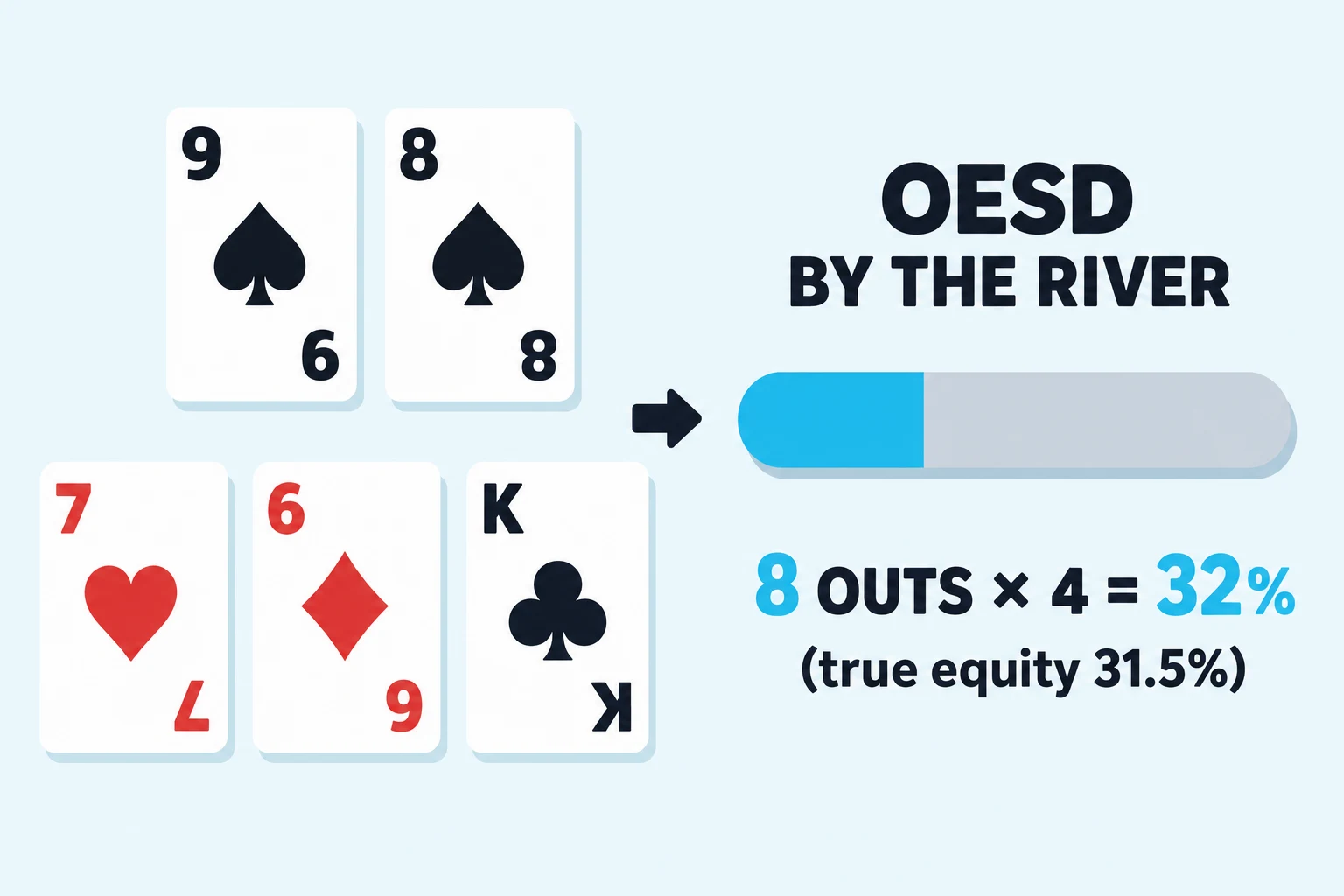
An open-ended straight draw is eight outs, and from the flop you have about a 31.5% chance of hitting it by the river. On the turn alone the chance is closer to 17%, and on the river alone (after the turn missed) it nudges up to 17.4%. Those three numbers are the whole math, and the rule of 2 and 4 lands on them within a percent or two. The interesting part is when the 31.5% is honest, when it overstates, and what to do about it at the table.
The headline numbers, in one place
Eight outs. About 17% to hit on the turn from the flop. About 17.4% to hit on the river if the turn missed. About 31.5% to hit by the river when you’re sitting on the flop and willing to see both cards. Memorize the third one and the rest fall into place.
OESD probability by street
| Street | Outs left | Unseen cards | Exact equity | Rule of 2 / 4 |
|---|---|---|---|---|
| One card to come on the turn (from flop) | 8 | 47 | 17.0% | 8 × 2 = 16% |
| One card to come on the river (from turn) | 8 | 46 | 17.4% | 8 × 2 = 16% |
| Both cards to come (by river, from flop) | 8 | 47, then 46 | 31.5% | 8 × 4 = 32% |
The shortcut column is so close to the exact column that the rule earns its keep on this draw. Where it starts to wobble (overcounting big draws, the dirty-outs penalty) is the rest of this article.
Where the math comes from
You have two hole cards and three flop cards in front of you, leaving 47 unseen cards in the deck. Eight of them complete your straight. Eight out of forty-seven is 17.0%, your turn equity. If the turn bricks, you’re down to 46 unseen cards on the river, still with 8 outs, and 8 / 46 is 17.4%.
The by-river figure isn’t simply 17% plus 17%. The cleanest way to count it is the complement: figure out the chance of missing both streets, then subtract from one. Missing the turn is 39 / 47, and missing the river after that is 38 / 46. Multiply those (0.830 × 0.826) and you get 0.685. That’s a 68.5% chance of missing both. Subtract from one and you’re left with 31.5% to hit at least one of them, your by-river equity from the flop. No calculator, no formula, just the count.
Three worked OESD hands
Classic outside draw
Hero opens 9♠ 8♠ from the cutoff. The big blind defends. Flop: 7♥ 6♦ K♣. You have 9-8-7-6 in your hand and on the board, which means any 5 or any 10 makes a straight: 5♣ 5♦ 5♥ 5♠ and 10♣ 10♦ 10♥ 10♠. Eight outs, no overlap, no flush risk on a rainbow flop.
Run the rule of 4. Eight times four is 32%. The exact number is 31.5%. Both say the same thing: you’re a 2-to-1 dog to make this straight by the river, and any flop bet up to about 85% of the pot is a price you can pay when it puts you all in, because then the call buys both cards.
OESD with dirty outs against a flush board
Hero has 9♦ 10♠ in the big blind. Flop comes A♣ 7♥ 8♥. You still have eight straight outs — any 6 or any J — but the 6♥ and the J♥ also bring a third heart, completing villain’s flush if villain has two hearts. Two of your eight outs are dirty when villain holds a flush draw, and they pay you a straight that loses.
Strip those two cards. You’re left with six live outs, not eight. The complement math, redone with 41 / 47 × 40 / 46, gives 75.9% to miss both — so about 24.1% to hit a clean straight by the river. That’s more than seven percentage points off the canonical number, and it gets worse if you’re worried about a fourth-street heart pairing the board on you. The headline 31.5% is the ceiling. Live equity is what you actually play.
Overcards alongside the OESD
Hero has Q♦ J♦ on the button. Flop: 10♠ 9♣ 3♥. Any K or any 8 makes a straight (eight outs), and a Q or J on top would give you the highest pair on a board that does not have a queen or a jack. The straight outs are still 8, the by-river straight equity is still 31.5%, but you also have roughly six paint-card outs that often win the hand on their own. Count only the straight and the rule of 4 understates your real equity; count all 14 raw outs and it overshoots, 56% against an exact 51% for hitting one of them by the river.
The fix is not to push the rule past where it works. Use 31.5% for the straight. Treat the overcards as a separate, smaller equity bonus when villain’s range is narrow enough that pairing your queen wins. The two pieces of equity stack; they just don’t multiply.
When the number lies to you
Three failure modes. Notice them, and the 31.5% becomes a tool instead of a slogan.
Dirty outs. A card that completes your straight but also completes a better hand for villain — usually a flush. The classic example is the one above: 9-T on a two-flush flop where two of your straight cards bring the flush in. Subtract them before you multiply, and the equity drops by about four percentage points for one dirty out and about seven for two.
Blocked outs. Less common in Hold’em, but it shows up. If you hold 7♦ 6♦ on a 5♣ 8♥ 2♠ flop, your straight outs are any 9 or any 4. The blocked-out version is when villain’s likely range contains one of your needed cards. A loose preflop caller who turned over pocket fours at showdown last orbit is signal worth using: if they flat-called and showed up with 4-4, two of your eight outs were dead before the flop hit. The adjustment is judgment, not arithmetic, but it’s real.
Reverse implied odds. You make the straight on the river, and lose to a bigger one. Open-ended draws on a connected board have a real chance of running into a higher straight when villain holds the next two ranks up. Say you hold 5-4 on a 7-6-K flop and an 8 comes: a 10-9 in villain’s hand makes 6-7-8-9-10, a straight that beats your 4-5-6-7-8. The 31.5% says you’ll make a straight that often. Whether that straight wins is a separate question, and on connected, draw-heavy boards your winning equity can be five to ten points lower than your raw equity. The rule cannot see ranges; you have to.
A live-play pattern
When a flop bet puts you all in, the call buys both remaining cards, so pair the 31.5% with the pot odds you’re being offered and the call-or-fold decision turns into a one-line comparison.
- Half-pot bet: call needs 25% equity. OESD with two cards to come is 31.5%. Call.
- Two-thirds-pot bet: call needs 28.6%. Still under 31.5%. Call, with care.
- Pot-sized bet: call needs 33.3%. Just above the OESD’s by-river equity. Fold without help.
- Overbet (1.5x pot): call needs 37.5%. Far above 31.5%. Fold unless two or more extra clean outs close the gap.
The trap is the turn. With one card to come, your equity is 17.4%, not 31.5%. A half-pot turn bet asks for 25%, already a fold by raw odds. The flop call is the spot where the rule of 4 carries the math only when the call puts you all in; otherwise the flop call, like the turn call, almost always needs implied odds or a real read to justify itself, and immediate fold equity argues for a check-raise instead.
Where this fits in your decision
The 31.5% is one number in a comparison. The other side is the price you’re being charged. Compare them, decide. If the equity is higher than the break-even equity the pot odds imply, you call. If it’s lower, you fold or you raise and add fold equity to the math. The raise is Poker Skill’s answer with eight straight outs on a low, ragged flop that missed the preflop raiser, where it can win the pot now and the outs are the backup. Eight outs is also the line where a gutshot at four outs feels meaningfully different from an open-ender. Twice the outs is about twice the chance, and the difference between drawing thin and drawing live shows up in every spot you play.
Frequently asked questions
What are the odds of hitting an OESD by the river? About 31.5% from the flop with both cards still to come. About 17% on the turn alone, and 17.4% on the river alone if the turn missed. Eight outs, 47 then 46 unseen cards, complement of the miss-both probability.
What is the rule of 2 and 4 for an open-ended straight draw? Eight outs times two is 16% on the turn; eight times four is 32% by the river. Both shortcut answers are within one percentage point of the exact math, which is why this draw is the textbook case for the rule.
Is an OESD better than a flush draw? A flush draw is nine outs, about 35% by the river, slightly more than the OESD’s 31.5%. The straight is sometimes better disguised, which can win extra bets when it hits, but the raw equity is a touch lower. On a wet board where dirty outs hit both draws, the live equity gap can shrink to nothing.
When should you fold an OESD? When the price is wrong and you don’t have implied odds to make up the gap. Pot-sized turn bets fold most of the time on raw odds; pot-sized flop bets are close, and the answer depends on stack depth and how often villain pays you off when you hit. A flop overbet on a board with a flush draw is a near-automatic fold once you discount the dirty outs.
How is an OESD different from a double belly-buster? A double belly-buster (sometimes called a double gutshot) is the same eight outs, just arranged differently. You have an inside-straight draw on either side instead of a single connected stretch. The math is identical to the regular open-ender; the only difference is that it tends to be harder for villain to read, which can pay off when the straight comes in.