


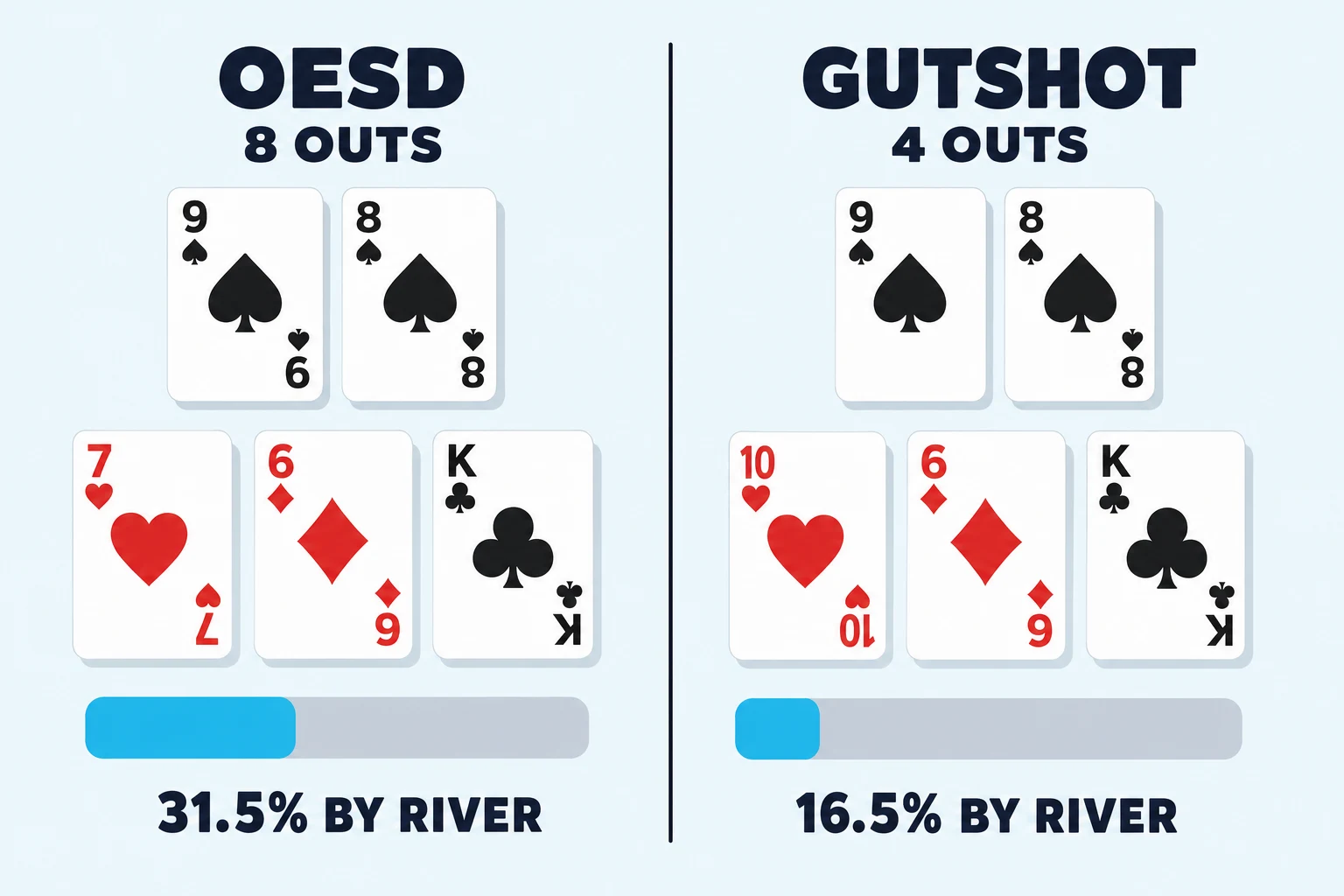
An open-ended straight draw is eight outs and about 31.5% by the river. A gutshot is four outs and about 16.5%. That’s almost exactly twice the equity, and it changes which draws you call, which you raise, and which you fold without thinking. The interesting part is the spots where the gap closes (combo draws, double belly-busters, gutshots with overcards) and the spots where it widens, where an OESD plays worse than a gutshot because most of the outs are dirty.
The shortcut, in one line
Open-ender, eight outs, 31.5% by the river: call most reasonable bets, semi-bluff into fold equity. Gutshot, four outs, 16.5%: fold most bets on raw odds, call only with implied odds, semi-bluff only with real fold equity. Same family of draw, twice the difference.
OESD vs gutshot equity by street
| Draw | Outs | Turn (one card) | River from turn | By river (both streets) | Rule of 2 / 4 |
|---|---|---|---|---|---|
| Open-ended straight draw | 8 | 17.0% | 17.4% | 31.5% | 8 × 4 = 32% |
| Gutshot (inside) straight draw | 4 | 8.5% | 8.7% | 16.5% | 4 × 4 = 16% |
The rule of 2 and 4 lands on both rows within a percentage point. That’s the shortcut row earning its keep on every spot you’ll see in a session. Poker Skill’s lesson on straight chances gives both rates in round numbers: 3♠ 6♠ on 4♣ 5♦ K♣ is an open-ender at about 31% by the river, and 3♠ 5♠ on 2♣ 6♦ 10♥ is a gutshot at about 16%.
Why the equity gap is the whole story
The equity gap doesn’t matter on its own. It matters because it changes what bet sizes you can profitably call.
A pot odds call against a half-pot bet needs 25% equity. The OESD has 31.5%, so it calls. The gutshot has 16.5%, so it folds unless implied odds cover the gap. A two-thirds-pot bet needs 28.6%. The OESD still calls; the gutshot still folds, and now the implied-odds gap is twelve points wide, which is a lot of future money to be confident about. A pot-sized bet needs 33.3%. The OESD is now a hair short and needs implied odds itself. The gutshot is sixteen points short and the call is mostly a leak.
The turn changes the picture again. With one card to come, the OESD drops to 17% and the gutshot to 8.5%. A half-pot turn bet still asks for 25%, which both draws fail on raw odds. The flop is the spot where the OESD carries the math without help; the turn is where every straight draw needs implied odds, fold equity, or a real read to justify itself.
Three worked hands
Same hole cards, two different flops
Hero opens 9♠ 8♠ from the cutoff and the big blind defends. Two parallel flops, two completely different spots.
Flop A: 7♥ 6♦ K♣. You have 9-8-7-6 between your hand and the board. Any 5 or any 10 completes the straight. Eight outs, no flush risk on a rainbow flop. Run the rule of 4: eight times four is 32%, and the exact figure is 31.5%. Villain bets two-thirds pot. You need 28.6%; you have 31.5%. Call.
Flop B: T♥ 6♦ K♣. Same hand, same villain, the only change is the ten in place of the seven. Now your straight needs exactly a 7 to make 6-7-8-9-10. Four outs, no other rank works in one card. Gutshot. Villain bets two-thirds pot again. You need 28.6%; you have 16.5%. Fold without implied odds.
One card on the flop turned a flop you should call into a flop you should fold. That’s the size of the gap when you only see the headline number.
When the gutshot plays like an OESD
Hero holds K♣ Q♣ on the button. Flop: J♥ 9♣ 4♠. The straight wants a 10: only that rank makes K-Q-J-10-9. Four outs. Pure gutshot.
Now look again. The 9♣ on the board plus your two clubs is a backdoor flush draw, worth roughly one extra effective out. Both your hole cards are overcards to the J-high board, and some of those overcard outs are live against villain’s c-bet range on a non-paired, dry-ish flop.
Add it up honestly: four straight outs, one effective out for the backdoor, two or three live overcards depending on what you put villain on. The four-out gutshot is closer to seven or eight effective outs, and the by-river equity climbs from 16.5% to somewhere near 28–30%. That isn’t quite OESD territory, but it’s close enough that the call works against most flop bets. A “pure” gutshot is rare; most gutshots have at least one helper, and counting it is the difference between a fold and a profitable call.
When the OESD plays like a gutshot
Hero defends 9♦ 8♦ in the big blind. Flop: 7♥ 6♥ 2♥. Cards in play give you 9-8-7-6, and any 5 or any 10 makes a straight. Eight outs by the textbook count, 31.5% by the river by the headline number.
Look at the flop again. It’s monotone hearts. If villain has any two hearts in their preflop range, and most defending ranges contain some, villain has a made flush right now. Worse, two of your eight straight outs are 5♥ and 10♥, both of which complete a fourth heart on the board. On those cards, you make the straight and lose to either the existing flush or to villain’s runner heart.
Strip the dirty outs. You have six live outs to a clean straight, and even those win only when villain doesn’t already hold the flush. With villain holding two hearts even a small slice of the time, your live equity drops from 31.5% toward twenty, sometimes lower. The OESD just collapsed into something close to a clean gutshot’s 16.5%, and on a monotone flop against any sensible defending range, this is a fold to almost any meaningful bet.
When the gap closes
Three structural cases turn a four-out draw into something worth playing.
Double belly-busters. When two distinct ranks each make you a straight from inside, the count adds back to eight. Hold Q♠ 10♠ on an A♣ J♥ 8♦ flop. A 9 makes 8-9-10-J-Q; a K makes 10-J-Q-K-A. Two ranks, four cards each, eight outs total. Same equity as an OESD by the river, with the bonus that opponents read the connection less easily.
Gutshots with backdoor draws. A gutshot plus a backdoor flush draw is worth about five effective outs, and the by-river equity moves from 16.5% to around 20%. That’s still under most bet-size break-evens, but it tightens the call enough that position, bet sizing, and read can push the spot to a defensible call.
Combo draws. A gutshot plus a real flush draw is the spot every drawing hand wants to be in. You have A♥ T♥ on K♥ Q♣ 4♥. Your gutshot to a J is four outs, your flush draw is nine more, and the J♥ counts once for both. Twelve unique outs by the river is roughly 45% equity. That’s a semi-bluff raise hand, not a call hand. The “gutshot” framing stops being useful and the combo-draw framing takes over.
When the gap widens
Two situations make the OESD’s eight-out advantage smaller, sometimes much smaller, than the table suggests.
Dirty outs on the OESD. As the third worked hand showed, a two-tone or monotone flop can knock two or three of an OESD’s eight outs into the dirty column. The gutshot doesn’t have the same exposure because it’s only counting one rank in the first place. On wet boards, the OESD’s apparent advantage shrinks faster than the gutshot’s.
Non-nut OESDs. When you hold the bottom end of an open-ender (a 9-8 on a 7-6 board where villain might hold T-9 or J-T), making your straight on the low end means losing to the higher straight when villain hits theirs. Reverse implied odds eat the apparent equity edge. A gutshot, by contrast, usually has only one rank to make and one straight to make with it; the dominated-straight risk is real but smaller.
A live-play pattern
Three rules that fall out of the math, runnable at the table.
First, default to calling open-enders against half-pot and two-thirds-pot bets, folding gutshots to the same prices. The 31.5% versus 16.5% gap covers the difference. Override only when villain’s range, your position, or the flop texture changes the read.
Second, semi-bluff selectively. An OESD has enough equity to semi-bluff bare; your equity covers the times you’re called. A gutshot needs fold equity to break even. Bluff-raise the gutshot when villain folds enough; check-call or fold otherwise.
Third, add helpers before you commit. A gutshot with a backdoor flush draw and two overcards on a dry board often plays like a clean five-out call. The same gutshot on a paired or coordinated board with no backdoors is a fold. Count what you actually have, not the standard four.
Where this fits in your decision
Both draws live inside the same three-step decision: count the live outs, multiply by 2 or 4 for your equity, and compare to the price the bet is asking. If your equity beats the break-even equity the pot is offering, the call works. If it doesn’t, the fold is the discipline. The OESD-vs-gutshot framing is the most common version of that decision you’ll face postflop, and getting it right by reflex is what frees you to think about the harder reads.
Frequently asked questions
What’s the difference between an OESD and a gutshot? An OESD has two ranks that complete a straight, giving you eight outs. A gutshot has only one inside rank that completes the straight, giving you four. By the river, an OESD hits about 31.5% of the time; a gutshot hits about 16.5%, almost exactly half the equity.
How many outs is a gutshot vs an open-ended straight draw? A gutshot is four outs. An OESD is eight outs. A double belly-buster looks like a gutshot but counts as two separate inside draws, totaling eight outs, the same as an OESD by the math, with extra disguise.
Is a gutshot ever worth calling? Yes, in three spots. When the pot is big enough that the implied odds cover the price (deep stacks, recreational villain, hidden draw). When the gutshot has helpers like overcards or a backdoor flush draw that push the live-out count toward five or six. And when you’re closing the action multiway and getting a great immediate price.
What’s a double belly-buster and is it the same as a gutshot? A double belly-buster is two separate inside-straight draws on the same hand. Two distinct ranks each complete a straight, even though neither is an open-ender. Eight outs total, identical raw equity to an OESD, harder for opponents to read. It’s two gutshots stacked into one hand, not a single gutshot.