


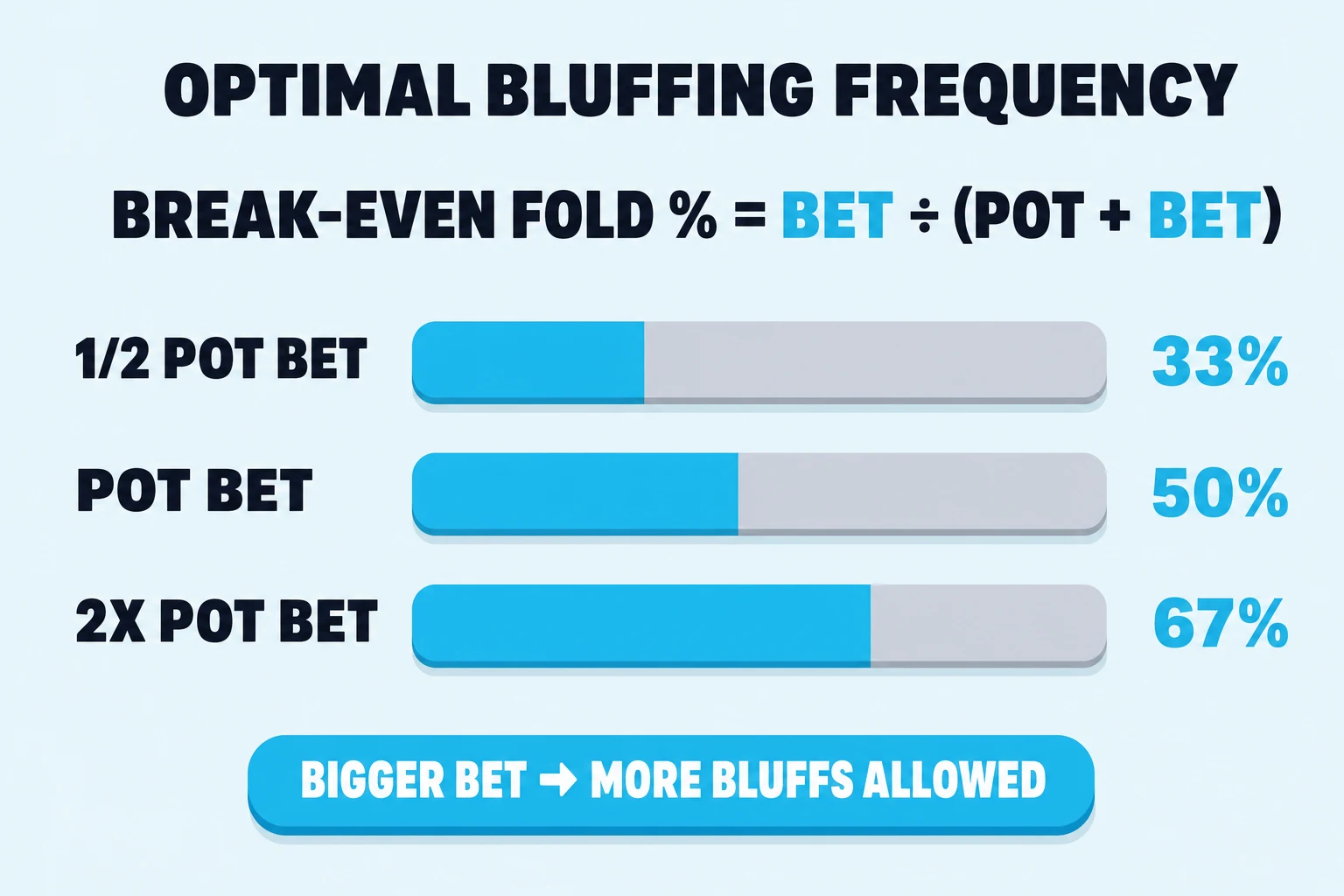
A pure river bluff breaks even when your opponent folds at least B / (P + B) of the time. That single ratio drives three numbers you actually use at the table: the break-even fold percentage on your side, the minimum defense frequency on your opponent’s side, and the share of bluffs your betting range should hold. Bigger bet, more bluffs allowed. Same formula, three views, and a handful of spots where it tells you the wrong story.
The shortcut, in one line
The bigger you bet, the higher the fold rate you need to break even on a bluff, the lower the call rate your opponent needs to defend, and the larger the share of bluffs your bet can carry. Half-pot, pot, and double-pot map to 33%, 50%, 67% folds required, mirrored by 67%, 50%, 33% defense, and a betting range that runs roughly 25%, 33%, 40% bluffs.
Quick-reference table
Memorize the four rows you actually see at the table. Pin the rest for when an overbet shows up.
| Bet size | Break-even fold % | Min defense frequency | Bluff share of range | Bluffs per value bet |
|---|---|---|---|---|
| 1/3 pot | 25% | 75% | 20% | 1 : 4 |
| 1/2 pot | 33% | 67% | 25% | 1 : 3 |
| 2/3 pot | 40% | 60% | 29% | 2 : 5 |
| 3/4 pot | 43% | 57% | 30% | 3 : 7 |
| Pot | 50% | 50% | 33% | 1 : 2 |
| 1.5x pot | 60% | 40% | 38% | 3 : 5 |
| 2x pot (overbet) | 67% | 33% | 40% | 2 : 3 |
The three percentage columns are not the same number. They are three views of one equilibrium: what the bluffer needs from the folder, what the folder owes the bluffer, and what your range should look like so the folder cannot escape either way.
Poker Skill’s odds chart lists the equity a caller needs against each bet size, from a quarter-pot bet up to double pot. From a third of the pot on, those figures match the bluff-share column row for row, 20% up to 40%, because both come from B / (P + 2B).
Why the math works
The break-even number comes straight from EV. Your pure bluff wins the pot when your opponent folds and loses your bet when your opponent calls, so EV equals F·P − (1 − F)·B. Set EV to zero and solve, and you get F = B / (P + B). The minimum defense frequency is the complement, P / (P + B), because the defender’s job is to fold no more often than the bettor’s break-even and make any single bluff break even at best.
The bluff share of your betting range is a different question with the same root. Your opponent calling your bet risks B to win P + B, so they need to win B / (P + 2B) of the time. That fraction is the share of bluffs in your range that leaves a bluff catcher indifferent between calling and folding. Against more bluffs than that share, calling wins; against fewer, folding does.
Three rivers you will see
River pure bluff with a missed open-ender (half-pot)
Hero opens the BTN with 7♣6♣, BB calls. Board runs J♥9♠4♦ 8♣ 2♠. Hero turned an open-ender with the 8 (any 5 or T completes), bricked the river. Pot is $100. Hero bets $50.
The formula says villain has to fold at least 33% for the bluff to break even. From the range angle, hero’s value on this runout is the made hands that fit a half-pot line: top pair Jx, J9 for two pair, the occasional set, call it 9 value combos. To balance at 25% bluffs, hero adds three bluff combos. A pure bluff like 76 of clubs blocks nothing villain folds and unblocks nothing villain calls, which makes it a fine pick. Every bet needs a job, a rule Poker Skill’s flop betting lessons open with, and 76 has no showdown value left, so its only job here is winning the fold. The bet is honest, the range is balanced, and villain folding more than a third of their continues makes hero a profit.
Pot-sized polarized river (one bluff per two value)
Hero has K♠K♣ on K♥9♥6♣ 5♠ A♦. Hero check-raised the turn for value and protection, villain called. River bricks. Pot is $300. Hero bets $300.
A pot-sized river turns the formula brutal. Villain needs to fold half the time for any single bluff to break even, and hero’s range needs to be one-third bluffs to keep villain indifferent. With sets and the occasional two pair as the value spine, say 6 value combos, hero adds 3 bluff combos. The right ones are busted straight draws that took the same turn line: Q♠J♠ missed the ten, and 4♠7♠ missed both the three and the eight. That is a polarized range: the strong stuff and the air, no medium hands, sized so the bluffs and the value support each other.
Overbet jam against a station (where the formula lies)
Hero has J♥T♥ on Q♦8♣2♠ 5♣ 3♦. Pot is $200, stacks behind are $400. Hero jams the river for $400, a two-pot overbet.
The formula says villain must fold 67% for the jam to break even, and that hero’s range can carry 40% bluffs. Both numbers are true on paper and wrong against this villain. The note from the first orbit reads “calls turns and rivers light, hates folding to overbets.” A station does not fold 67% to a two-pot jam. They fold maybe 30%. Your J-high overbet bluff loses money even though the table says you have permission to bluff.
The fix is to stop bluffing this villain at this size. Bet bigger for value, smaller or not at all for bluffs, or check and let them bluff into your weaker showdown candidates. The formula tells you what your range can do at equilibrium; the villain tells you what your range should do tonight.
When the formula lies to you
The math gives you the equilibrium answer. It costs you money in the spots where the equilibrium assumptions are wrong.
Minimum defense frequency assumes your continues actually have the equity to call. They often do not. On a board where the bettor’s range is much stronger, many hands MDF says you must defend simply lose money on the call. Take BB versus a UTG opener on A-Q-3 rainbow facing a one-third-pot c-bet: MDF says defend 75%, but the solver defends about 42% because the rest of the BB’s range is too weak. Defending less than MDF is correct when your range is dominated.
The break-even fold percentage assumes a single opponent. Multiway, the math compounds. With two callers behind, you need each player individually to fold at the square root of the heads-up break-even number. A bet that needs 33% folds against one player needs 58% folds against each of two.
The bluff share assumes the river. On the flop and the turn, your bluff is a semi-bluff with realized equity from cards still to come, so the frequency target understates how often you should bluff on earlier streets.
The framework also assumes you are picking the right combos. Two bluff candidates with the same showdown value are not the same bluff. KQo on a board where villain calls with KK and QQ is a stronger bluff than A2s, because the king blocker removes calls instead of folds. Combo selection moves the EV more than chasing the third decimal place of frequency.
A live-play pattern you can run in two seconds
Pre-decide your value range on the river before you pick a sizing. Count value combos. Look up the bluff cap from the table: half-pot 25%, pot 33%, double-pot 40%. Multiply your value count by the matching ratio (one in three, one in two, two in three) and that is the bluff combo budget. Pick the combos that block villain’s calls and have nothing else to do.
If you cannot find that many bluff combos, your bet should lean smaller, your range becomes value-heavy, and you give up the missed draws. If you find more bluff combos than the budget, you are over-bluffing, so either bet bigger to make room or check the worst ones back. The order is value first, sizing second, bluff count third. Most low-stakes leaks come from running it the other way.
Two pool tilts apply on top of the math. Against a tight, fold-prone villain, bluff a notch above the equilibrium count, because they over-fold. Against a station who calls anything to one card off the river, bluff well below it or not at all, and value-bet a step thinner instead.
Where this fits in your decision
The bluffing formula is half of a bigger compound. The other half is whether your bet is allowed to exist at all: value, protection, denial of equity, blockers, board texture, your read on villain. Pair this article with fold equity and bluff-to-value ratio for the rest of the framework. For the call-or-fold half of the same equation, break-even equity walks the math from the defender’s seat. Once the count is set, which hands to bluff covers picking the specific hands that fill it.
Frequently asked questions
What is the optimal bluffing frequency on the river for a pot-sized bet? A pot-sized river bet wants roughly one bluff for every two value bets, or about 33% of your betting range as bluffs. That is the share that makes a pure bluff catcher exactly indifferent, because your opponent is risking one to win two when they call.
How is minimum defense frequency calculated? Minimum defense frequency is one minus the bettor’s break-even fold percentage. If villain bets pot, their break-even is 50%, so your MDF is 50%. If villain bets half pot, their break-even is 33%, so your MDF is 67%. The defender folds no more often than the bettor’s break-even to keep the bettor from automatically profiting on a bluff.
Why does a bigger bet allow more bluffs? A bigger bet gives the caller worse pot odds, so a bluff catcher needs more equity to break even on the call. The bettor can carry more bluffs because each one is balanced against the harder call the bigger bet creates. Even a pot-sized bet stays two-thirds value, but that is a bigger bluff share than the one in five a third-pot bet carries.
What is the difference between break-even fold percentage and bluff share of the range? Break-even fold percentage is how often the bluff itself has to work. Bluff share of the range is what the bettor’s whole range should look like to keep a bluff catcher indifferent. Two related indifference equations, different questions: “is this single bluff profitable?” versus “is my whole betting strategy unexploitable?”
When should I bluff less than the formula says? Three spots. Against a station who does not fold to your sizing, bluff well below the equilibrium count or not at all. When your range is dominated on the board, defend less often than MDF and bluff less than your share. When your candidates are bad (they block folds and unblock calls), pick fewer of them even if the frequency target says you have room.