


Every drawing decision in poker is a comparison between four numbers: how many outs you have, what they are worth as equity, the price the bet is asking, and the expected value of the call. Name the four numbers in order and the math at the table stops being a wall and starts being a comparison you run in five seconds. If you only want the tables, the printable poker odds chart has all four of them on one page.
For a hand you want to check, the free poker odds calculator works out two of the four numbers: each hand’s equity from the cards, and the price from the pot and the bet.
The shortcut, in one line
Count your outs. Multiply by 2 if there is one card to come or by 4 if there are two and your call puts you all in. That is your equity as a percent. Compare it to the pot odds the bet is asking, which is your call divided by the final pot. If your equity is bigger than the price, calling has positive EV in the long run. If it is smaller, the call loses money and you fold or raise.
Quick-reference table
Two tables. The first turns outs into equity. The second turns bet size into the break-even equity it asks for.
| Outs | Common draw | Rule of 2 (one card) | Rule of 4 (two cards) | True equity, two cards |
|---|---|---|---|---|
| 4 | Gutshot straight draw | 8% | 16% | 16.5% |
| 6 | Two overcards on the flop | 12% | 24% | 24.1% |
| 8 | Open-ended straight draw | 16% | 32% | 31.5% |
| 9 | Flush draw | 18% | 36% | 35.0% |
| 12 | Flush draw plus gutshot | 24% | 48% | 45.0% |
| 15 | Flush draw plus open-ender or two overcards | 30% | 60% | 54.1% |
| Bet villain made | Pot odds (price as a percent) |
|---|---|
| Quarter pot | 17% |
| Half pot | 25% |
| Two-thirds pot | 29% |
| Three-quarters pot | 30% |
| Pot-sized | 33% |
| One-and-a-half pot overbet | 37.5% |
| Two-times-pot overbet | 40% |
If your equity for the cards the call buys is bigger than the price number, the call is profitable on its own. If it is smaller, the call needs help, usually implied odds or fold equity from a raise.
Why the math works
Each unseen card is roughly one out of fifty, so a single card you can hit is worth about 2% on a single street. Two streets gives you two pulls, which is why you double the multiplier. The price comes from a different direction. When you call a bet, the final pot is the original pot plus villain’s bet plus your call, and you put in your call to win the rest. Your call divided by that final pot is the break-even equity for the call. Beat it with your equity and the call has positive expected value. Lose to it and the call is a slow leak.
Three hands you’ll recognize
Gutshot facing a half-pot turn bet (4 outs)
Hero is in position with 9♥8♥. The turn board reads K♠J♥7♦4♣. Villain bets half pot. Any ten gives you 7-8-9-10-J for a straight, so 4 outs.
One card to come. Run the Rule of 2: 4 × 2 = 8% equity. The bet asks 25% to break even. Eight is nowhere near twenty-five, so the call loses money on pot odds alone.
To put EV in dollars, assume a $50 pot before the bet. Villain bets $25, the final pot becomes $100, and you call $25 to win $75. EV = 0.08 × $75 - 0.92 × $25 = $6 - $23 = -$17. Folding is worth $0 by definition. Negative seventeen against zero is a clean fold, unless you have a real reason to think implied odds will pay you off when you spike a ten.
Open-ended straight draw on the flop (8 outs)
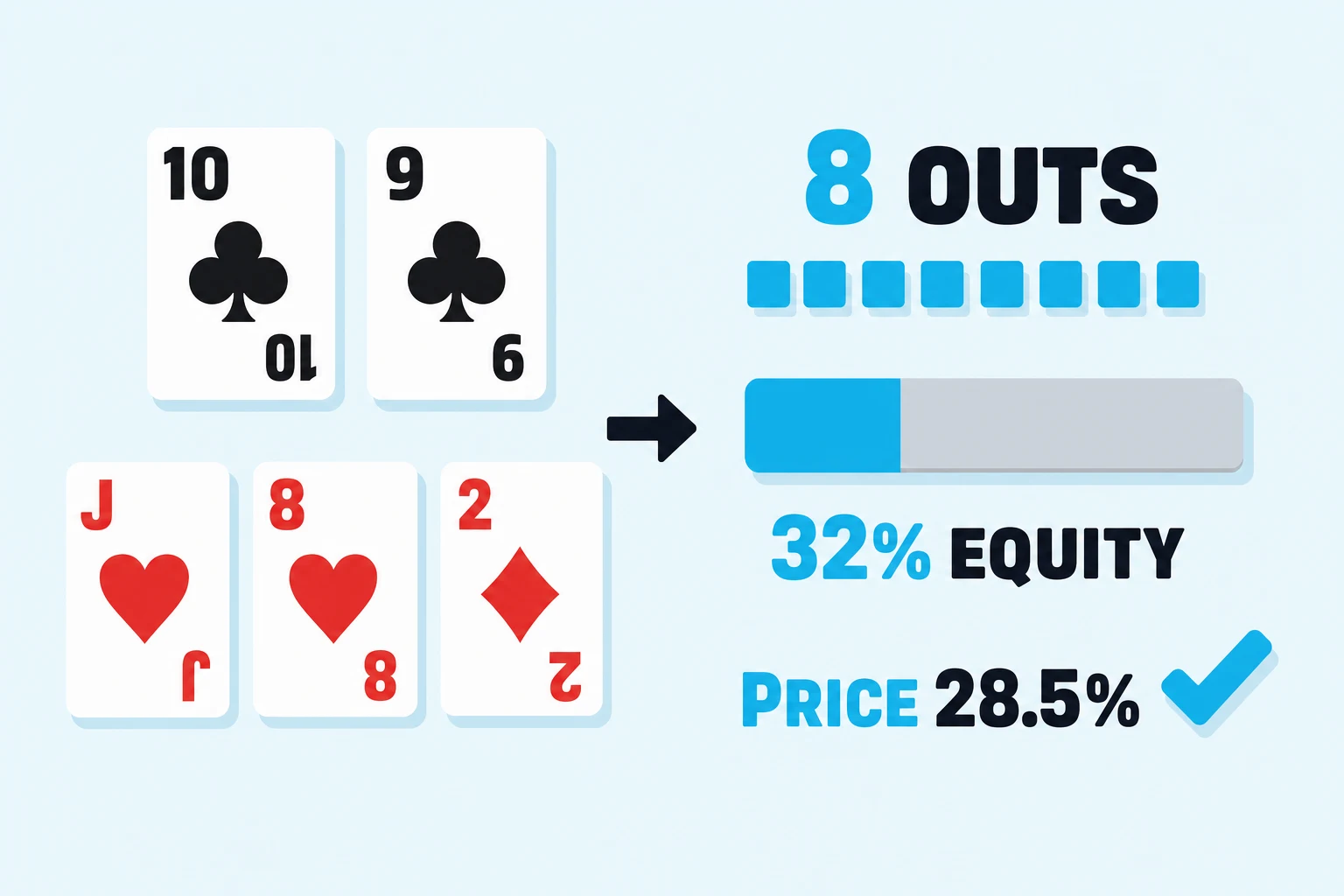
Hero opens T♣9♣ from the cutoff and the big blind calls. The flop is J♥8♥2♦. Villain leads two-thirds pot. You have an open-ender, since any 7 or any Q makes a straight, so 8 outs.
Two cards to come. Run the Rule of 4: 8 × 4 = 32% equity. A two-thirds-pot bet asks for 29%, so if this call puts you all in, thirty-two beats twenty-nine and the call has positive expectation.
In dollars, assume a $30 pot before the bet. Villain bets $20, the final pot becomes $70, and you call $20 to win $50. If that $20 is your last, EV = 0.32 × $50 - 0.68 × $20 = $16 - $13.60 = +$2.40. Small, but real. With stacks behind, villain can bet again on the turn, so the $20 buys only the next card, about 17%, and the call leans on implied odds, the chips you win later when the straight comes in.
Flush draw with overcards on a pot-sized bet (15 raw outs)
Hero has A♠K♠ on Q♠7♠2♥. Villain bets pot. You have a flush draw plus an ace and a king to make top pair if either lands. The naive count is 9 spades plus 3 aces plus 3 kings, or 15 outs.
The Rule of 4 gives 60%. A pot-sized bet asks 33%, so if the call puts you all in, it is profitable, easily. The shortcut, though, is overstating. The true equity by the river for 15 outs is closer to 54%, and that is before you ask whether all 15 cards really win the hand. Even after the haircut, 54% beats 33%, so the all-in call survives.
All in, with a $40 pot and a $40 bet, EV ≈ 0.54 × $80 - 0.46 × $40 = $43.20 - $18.40 = +$24.80. Big edge, but the math you trust is the 54%, not the 60%.
When the math lies to you
The shortcut is fast and the price is exact, but the answer is only as honest as the inputs. Three failure modes show up at the table.
The first is dirty outs. Raw outs are cards that improve your hand on paper. Live outs strip out cards that also improve villain. A non-nut flush draw against a higher one has no live flush outs, because every card of that suit also gives villain the better flush. An open-ender on a two-tone board where two of the eight straight cards complete villain’s flush trades eight raw outs for six. Count down from the textbook number, subtract any card that does not actually win against the range you face, and multiply what is left.
The second is reverse implied odds. Sometimes you hit your draw and still lose money. You complete a straight on a board that pairs and villain has a set turning into a full house. You make a king-high flush against an ace-high flush. The Rule of 2 still says 8% on a gutshot, but if hitting the ten brings a fourth flush card and you stack off into a flush, your real winning equity on that out is lower and your loss is bigger than the bet you are facing. The thinner your made hand on the runout, the harder you weight that adjustment.
The third is implied odds you cannot see. Sometimes the call loses on pot odds alone and is still correct because the future bets you collect when you hit pay for the times you miss. A small pocket pair flatting a raise has about a 12% chance to flop a set, but the stacks behind can be ten times the call. The math you need is whether the hits, weighted by how often they get paid, cover the misses. Implied odds are a forecast, not an excuse to keep calling thin.
A live-play pattern you can run in five seconds
Four steps, in order, before you put any chips in.
Count outs. Use the standard numbers (4 for a gutshot, 8 for an open-ender, 9 for a flush draw, 15 for a flush plus two overcards) and discount on the spot for any obvious dirty out. When the count is zero, fold without running the other three steps; in Poker Skill that exit comes up with five-high on a queen-high board, no pair and no direct draw against a flop bet.
Multiply. Rule of 2 for the next card, which is all a flop call buys when stacks are behind, and Rule of 4 when the call puts you all in on the flop. Past ten outs, trim the Rule of 4 number by about one point per extra out.
Name the price. Half pot is 25%, two-thirds is 29%, pot is 33%, and a 1.5x overbet is 37.5%. Memorize the four numbers and you never have to do real division at the table.
Compare. Equity bigger than price is a call. Equity smaller is a fold, unless you have a concrete reason to count implied odds, and a concrete reason names the future street, the future bet, and the player who pays it.
Where this fits in your decision
Odds are half of a decision; reads are the other half. The math you just ran tells you if the call has positive EV against villain’s range, but not what villain has, not what the river will let you bet, and not how much equity you will realize on later streets. Position, board texture, and stack depth bend equity realization in ways the shortcut does not show. Treat the equity-versus-price comparison as the floor: if the floor is broken, no read fixes the call. If the two numbers still blur together, equity vs EV separates them. Let reads decide the marginal spots where the floor is intact.
Frequently asked questions
What’s the difference between poker equity and pot odds? Equity is your percent chance to win the pot at a given moment, based on the cards. Pot odds are the percent you need to win to break even on a call, based on the bet sizes. Equity comes from your hand and the board; pot odds come from the math of the bet. Equity bigger than pot odds is a profitable call.
What is expected value (EV) in poker? Expected value is the average amount you win or lose on a specific action over the long run. Folding has zero EV by definition, because chips already in the pot are no longer yours. A call’s EV is your equity times what you stand to win, minus your loss percentage times what you risk. Positive means the action profits; negative means it bleeds.
Are implied odds part of pot odds? No. Pot odds are the price of the current bet on the current street. Implied odds are the future money you expect to win on later streets when your draw hits. A call can lose on pot odds alone and still be profitable on implied odds, but only when the future bets are realistic: deep stacks, an opponent who pays off, and a well-disguised hand. Stand-alone pot odds are math; implied odds are a forecast.
How do you calculate poker odds in your head? Multiply your outs by 2 if one card is left to come, or by 4 if two are left and your call puts you all in. That is your equity. Memorize four bet-size benchmarks for the price: half pot is 25%, two-thirds is 29%, pot is 33%, and a 1.5x overbet is 37.5%. Compare the two numbers. Discount dirty outs and account for implied or reverse implied odds on top of that comparison, not in place of it.