


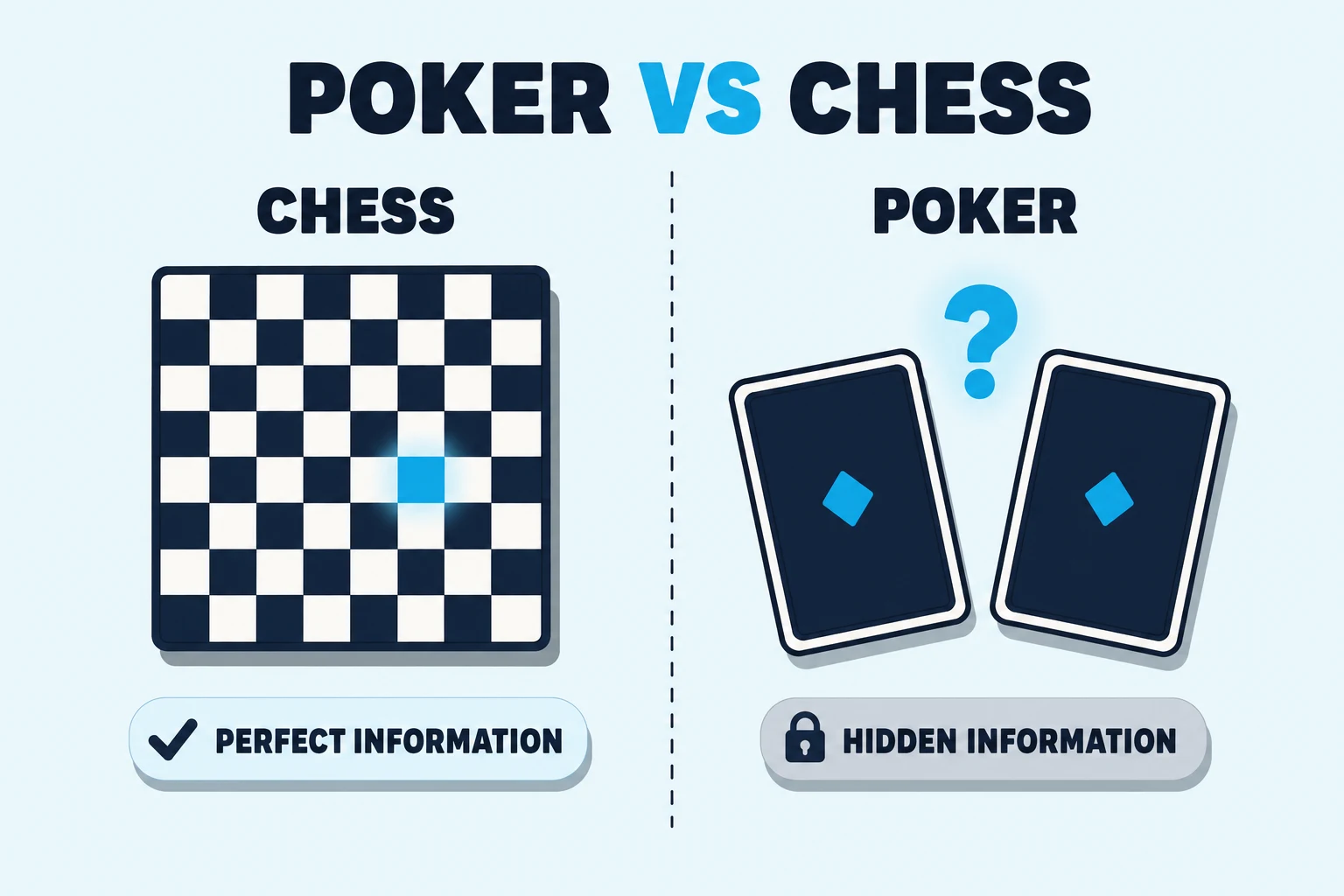
Both poker and chess are skill games. The difference is what kind of skill each one builds. Chess is perfect information — every piece is on the board, both players see the same picture, and a stronger move beats a weaker one given enough time on the clock. Poker is the opposite: you make decisions with cards you cannot see, against a range of hands your opponent could have, and a correct call can still lose the pot. That gap is the whole story of how each game rewards practice.
The short answer
Chess and poker both reward thinking, but they reward different reps. Chess trains pattern recognition and calculation against a fully visible position. Poker trains decision-making under uncertainty, where the right play is the one with the best expected value across every hand your opponent could be holding — not against the one hand they happen to have.
The two games at a glance
| Dimension | Chess | Poker |
|---|---|---|
| Information state | Perfect. Both players see everything | Imperfect. Hole cards are hidden |
| Source of difficulty | Calculation depth, position evaluation | Hand reading, EV math, betting strategy |
| Outcome of a “correct” move | Wins or holds the position over time | May still lose the specific hand |
| Variance over one game | Low. Stronger player usually wins | High. Weaker player often wins one session |
| Sample size to read skill | A handful of games can show the gap | Thousands of hands |
| How rating works | Elo, updated game by game | No clean equivalent; win rate over a sample |
| Decision unit | A move | A decision against a range, with a price |
| What “practice” trains | Pattern recall, opening theory, tactics | Range thinking, EV under hidden info, sizing |
The shape of the table is the article: the rows on the left are not better or worse than the rows on the right. They are the things each game teaches.
Why both are skill games
A skill game is one where better players win at a different rate than weaker players over a large enough sample. Chess clears that bar with the strongest grading system in any game. Elo updates after every result, and a 200-point rating gap predicts the outcome reliably. Poker clears the same bar, but it takes more hands to read because the variance per hand is bigger. The academic studies on the question, and the parallel arguments about whether poker should be classed as a skill game in court, all land on the same answer. The companion post on whether poker is a game of skill walks the actual research. For this article, treat it as settled: both games are real skill games, with different tools to read the skill.
The five real differences
1. Information
In chess, you see the whole board. So does your opponent. The position is a shared object, and the better player is the one who reads it better. In poker, you see your two hole cards and the community cards on the table. You do not see your opponent’s cards, and the work of the hand is updating your guess about their range from how they bet. The first move in a chess game starts with everything visible; the first move in a poker hand starts with most of the picture missing.
2. Decision unit
A chess move is an answer to a question with one correct answer most of the time. A poker decision has no single right card to play, only a right way to play your whole range. You choose the action with the best EV against your opponent’s range. The unit of work in chess is a move; the unit of work in poker is an action against a range, at a price.
3. Variance and feedback
A losing chess game tells you something useful about your play almost every time. A losing poker hand tells you almost nothing on its own. You can put the chips in as a 92% favorite and lose. You can play a hand badly and stack someone. The feedback in chess is loud per game; the feedback in poker is quiet per hand and only gets loud when you stack a lot of hands together. That is why poker improvement requires a study habit divorced from the night’s score, and chess improvement does not.
4. Sample size to confidence
A weaker chess player rarely beats a stronger one across, say, ten games. The skill gap is too persistent and the random component is too small. A weaker poker player can beat a stronger one across an entire night, an entire week, sometimes longer. To say with statistical confidence that one player is better than another at poker, you usually need tens of thousands of hands; for cash players to know their own win rate, the rough working number is in the hundreds of thousands. Chess gives you a verdict in an evening. Poker makes you wait.
5. What “practice” trains
A chess study session is mostly pattern recognition and concrete calculation. You drill tactics, work openings, and study endgames where the answer is exact. A poker study session is mostly decision review under uncertainty. You take a hand you played, identify your opponent’s range, your equity against that range, and whether your action had positive EV regardless of the river card. Both share a deliberate, feedback-driven habit. They aim at different targets.
Two short worked examples
A chess move and a poker decision live in different worlds. Side by side they show why.
Chess. Your bishop sits on a long diagonal blocked by your own knight. Behind the knight, your opponent’s queen is exposed. The position has one obviously correct answer: move the knight, opening the discovery and winning the queen. The right answer is what careful reading gets you.
Poker. You hold A♠ K♠ on the button. UTG raises 3bb, two players fold, you 3-bet to 9bb, and UTG calls. Flop comes Q♠ 8♠ 4♥. UTG checks. Now there is no single “correct” move. UTG’s calling range is some mix of broadway hands, mid pairs, suited connectors, and the occasional slowplay. Your A♠ K♠ has overcards, a nut flush draw, and good equity against most of that range. The right action is the one with the best EV against the whole range, at a price your opponent will pay. You bet around half pot, because that price keeps in the parts of the range you beat and charges the parts that are drawing. The EV math is right; the river card may still cost you the pot.
Where the chess analogy lies to you
People who learn chess first and come to poker often import a habit that costs them money: chasing the one right move. In chess, the best move on a given turn is usually a single one. In poker, the best action against a range is usually one of several with similar EV, and looking for a single perfect line burns time you should be spending on the easier judgment of what your opponent could have. The other common chess-to-poker mistake is reading results as feedback. A losing chess move was almost certainly a worse move; a losing poker hand was almost certainly not a worse decision. If you let the river card grade your play, your study loop will train the wrong things. The fix is not subtle. You judge poker decisions before the river card is dealt.
How to train each game
Chess practice is mostly pattern reps. Tactics puzzles, opening review, endgame technique, post-game analysis with the engine. The feedback is fast and specific because the truth is on the board.
Poker practice is mostly decision reps. You go back to a hand, reconstruct the action, write down what your opponent’s range looked like at each street, and grade the action by EV, not by the pot. Building this habit is the part of poker improvement that takes the longest, because the natural pull is to grade yourself on the night’s score. Short, daily reps with feedback that ignores the river card are how you train under uncertainty without paying the variance to learn.
Short decision drills, instant feedback graded on the choice not the outcome, and a position and range frame on every hand: that is the loop Poker Skill is built around, and it is how the reps stack into a real edge.
Poker’s nearest thing to a tactics puzzle is one decision with a graded answer, and the best puzzle app for poker decisions compares four apps built around that.
Where this fits in your decision
If you came to poker from chess, keep the careful-study discipline and drop the one-right-answer reflex. Without a chess background, the discipline still applies: drill the decisions, not the outcomes. Either way, the math at the heart of every hand is the pot odds and the break-even equity you need to make a profitable call. The skill is real. The practice is just shaped differently than in the game you might already know.
Frequently asked questions
Is poker harder than chess? They are hard differently. Chess is harder to play at the very top because the calculation depth required to beat a 2700-rated player is staggering. Poker is harder to measure progress in, because variance hides skill until the sample is big. A serious player at either game will tell you the same thing: the difficulty is real, the shape is just different.
Why don’t poker players have an Elo rating? Because a single hand is too noisy to update a rating from. Elo works in chess because the result of a game tracks the skill gap reliably. In poker, one hand’s outcome carries almost no information about the players’ relative skill. Poker rating systems exist, but they rely on tournament results over long periods, not individual hands.
Can someone be a top player at both? The skills overlap less than people think. Pattern-recognition and concentration habits transfer. Information-state habits do not. A grandmaster who picks up poker still has to learn range thinking, EV under uncertainty, and the discipline of grading decisions instead of outcomes. Different muscles, and the cross-training is real but not automatic.
Does the existence of poker-solving AI mean poker isn’t a skill? No, and the same logic applies to chess. Computers have been stronger than human grandmasters for years, and chess is still a skill sport. AI solving a game tells you about the game’s complexity ceiling; it does not tell you whether better human players beat weaker human players, which is the real definition of a skill game. Both games meet that bar with room to spare.