


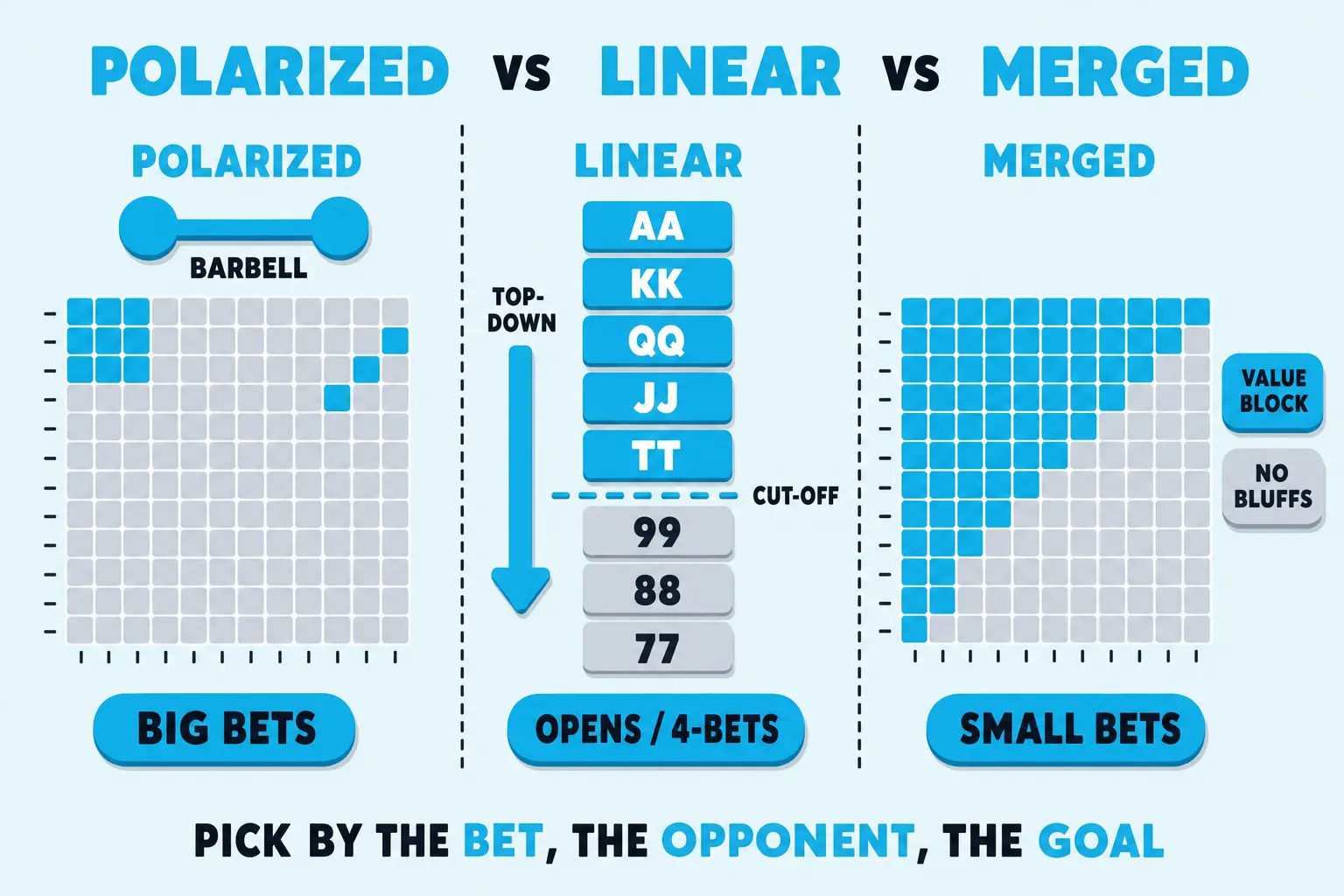
A polarized range is your strongest hands plus your bluffs, with the medium hands deliberately left out. A linear range is a clean top-down block of value hands in rank order, no gaps, no bluffs. A merged range is the in-between shape, wider than polarized, sometimes lightly bluffed, sometimes pure value, used when you want to bet small and often. Poker Skill’s lesson on the big blind against a button open is the linear case: every hand there is a 3-bet or a fold, and every 3-bet is for value. Each shape exists because a different table situation demands it. Pick by the moment, not by reflex.
The shortcut, in one line
Big bet plus folding opponent, polarize. Top-down value with no bluffs, linearize. Small bet with broad coverage, merge. The rest of the article is the why and the worked hands behind that one line.
Range shape, side by side
| Polarized | Linear | Merged | |
|---|---|---|---|
| What’s in it | Nuts and bluffs only | Strongest hands top-down, no bluffs | Strong + medium value, sometimes light bluffs |
| What’s left out | Medium-strength hands | Anything below the cut-off | Pure trash; usually no bluffs |
| Typical bet size | Big or overbet | Small to medium | Small, high frequency |
| Ideal opponent | Folds enough to bluff | Calls too much | Calls light, pays off thin value |
| Where it shows up most | Late-street pressure, button 3-bets vs nits | First-in opens, cold 4-bets, calling all-ins | Turn bets to keep range uncapped, c-bets vs sticky callers |
The pattern worth noticing is that the three shapes line up with three different bet sizes and three different opponent reads. Once you see that, the picker at the end of the article reads itself. Poker Skill ties the larger flop c-bet to the polarized shape, for boards where value hands and strong draws can both use it.
What each shape is built to do
Polarized
A polarized range bets big because every hand in it wants the bet to be big. Your nut hands want to charge a maximum price for the call. Your bluffs want maximum fold equity. Medium hands have neither goal, so they never enter the range; they check or call instead. Polarized ranges show up most often as the streets go on and bet sizes climb.
Linear
A linear range is the answer when there is no point bluffing. You start at the top of the rankings and add hands downward in order until you hit your cut-off, then you stop. No skipped hands, no scattered air. You use it whenever the opponent will call too often for bluff equity to matter, or whenever the action itself does not allow bluffing: a first-in raise, a cold 4-bet, a call-or-fold against an all-in shove. The shape does one job. Maximize value with the strongest cluster of hands in this spot, and let the medium hands fold out of the line.
Merged
A merged range is the one most newer players underuse. It is wider than polarized and not strictly top-down like linear. You include premiums, you include some medium-strength hands that profit when called, and you keep some low-equity bluffs in the mix when the situation supports them. The bet size is small, the frequency is high, and the goal is to stay broad. Merging works best when betting can continue across multiple streets and you do not want your check to advertise weakness. Betting a wider mix small avoids leaving only weak hands behind in the c-bet check-back.
Three hands you’ll recognize
Linear: opening UTG with a top-down block
You are in a 6-max cash game, 100bb deep, and the action folds to you under the gun. The hands you choose to open are the strongest cluster you can profitably play out of position against five players left to act. AA through TT, AK, AQ, AJs, KQs, plus a small handful of suited connectors and small pairs picked up for board coverage.
That shape is linear by construction. You cannot reasonably open AA and skip QQ. You cannot open KQs and fold AQs. The first-to-raise spot does not give you anyone to bluff yet. You are simply choosing whose hand will be in the pot next, and top-down is the default because nothing else makes sense.
After the flop, the linear shape lets you bet your whole range small on most boards where you have range advantage, which is almost always close to right.
Polarized: a button 3-bet against an UTG open
Same game, same stack depth, but now UTG opens for 2.5bb and folds to you on the button. The 3-bet you build here is polarized, not linear, and the reason is that you also have a flat-calling option. Hands that are too good to fold but not great as bluffs (AJs, TT) go into your flatting range, not your 3-bet.
That leaves the 3-bet itself as a barbell. The value side: KK+, AK, sometimes QQ. The bluff side: A2s through A5s. The suited wheel aces are not random. They block the ace-high combos UTG continues with, they have respectable equity when called, and they make playable hands post-flop on a lot of boards. The middle of the range (JJ, AQo, KQs) is mostly flat, not 3-bet.
When you do hit a flop with this 3-bet range, the strategy is what you would expect from a barbell: bet big with your value, bet big with your selected bluffs, check the rest. The pressure is real because every hand you bet is either crushing villain’s continuing range or pure air. Medium hands never have to decide; they were never in the bet.
Merged: c-betting small against a calling station
Cash game again, you open KQs from the cutoff, the flop comes K♠ 9♥ 4♦, and the big blind defender is a player you have already watched float two streets with second pair. Polarizing here would be a mistake. A polarized bet is built from the nuts and bluffs, and against a player who does not fold, the bluffs are wasted while your top pair wants calls from his weaker kings and nines.
So you merge. A small c-bet, around a third of the pot, with a wide value block: top pair good kicker, top pair weak kicker, pocket pairs that can charge a little for a turn card, and a thin slice of middling pairs you would rather bet than check-call. No big-bluff component, because there is no fold equity. The size stays small because the goal is to harvest one street of thin value from a hand that calls too much.
If the turn card is bad for you, you can check, and the merged shape means your check still has decent showdown value. The small bet keeps your range broad without cementing a check that screams “I missed.”
When the shapes blur
The lines are clean in textbooks and fuzzier at the table. A river bet often looks polarized because polarization happens by attrition. Both players have folded out their medium hands across earlier streets, so by the river the bettor is mostly nuts or air whether they planned the shape or not. The shape names a tendency, not a recipe.
A merged range with one or two bluffs in it is still mostly a merged range. The labels are not arithmetic. If the bulk of the range is value and a couple of low-equity hands are betting for protection or to deny realization, the strategy is merged in spirit even if a purist would call it lightly polarized.
Linear and merged look almost identical when the linear range is small and the merged range is value-only. The cleanest test is whether the range has gaps. A 3-bet of QQ+, AK, AJs, KQs skips JJ, TT, and AQs, so it is merged-for-value, not linear. A 3-bet of QQ+, JJ, AK, AQs, AJs, KQs with no skipped tier is linear. Knowing which one you built helps you defend correctly when the next street arrives.
The picker, in three questions
When you can feel the shape decision coming, ask three questions in this order before you act.
First, big bet or small bet? If the size you want is more than two-thirds pot, you are committing to a polarized shape, and the question becomes whether you actually have nuts or credible bluffs. If the size is small, you are merging or linearizing.
Second, will villain fold enough? If yes, polarize and add bluffs. If no, drop the bluffs entirely. A merged value-only range against a station harvests; a polarized range against the same station is just donating chips.
Third, is this a first-in raise, a cold 4-bet, or a shove call? If yes, linearize. There is no one to bluff yet, and top-down value is the right answer by default.
Where this fits in your decision
Range shape is the layer above hand strength. It is the choice that decides whether your two cards even belong in the line you are about to take. It interacts with range advantage, the question of which player has the better overall equity on this board, with nut advantage, the question of who has more stack-off hands, and with denying equity on draws-heavy textures. The picker above is the live-play version. The deeper version is doing the same three checks one street ahead.
Frequently asked questions
Is a linear range the same as a merged range? No, but they overlap when the merged range is value-only. Linear is strict top-down with no gaps. Merged is “wider than polarized” and can include mediums or skip tiers. A linear range of QQ+, AK is linear; a merged-for-value range of QQ+, AK, AJs, 99 is merged because it skips JJ-TT and AQs.
Why don’t polarized ranges include medium hands? Because medium hands fail at both jobs the polarized range is built for. They cannot extract big value the way nuts can, and they cannot generate fold equity the way bluffs can. Putting them in a big-bet line means losing the small pots and missing the big ones. They check or call instead.
Can a 3-bet be merged? Yes, and it should be when the opener calls too often. Replace the bluff portion with hands that profit by being called (AJs, KQs, 99, sometimes 77) and harvest value rather than fold equity. The shape ends up wider than polarized and not strictly top-down, which is the merged signature.
What’s the easiest sign you’ve polarized when you should have merged? You bet big and the calling station calls. You check the next street and now you have no plan, because half your range is bluffs that just lost their fold equity. That whole sequence is the cost of polarizing against a player who would not let you. Smaller bet, wider range, fewer bluffs is the fix.