


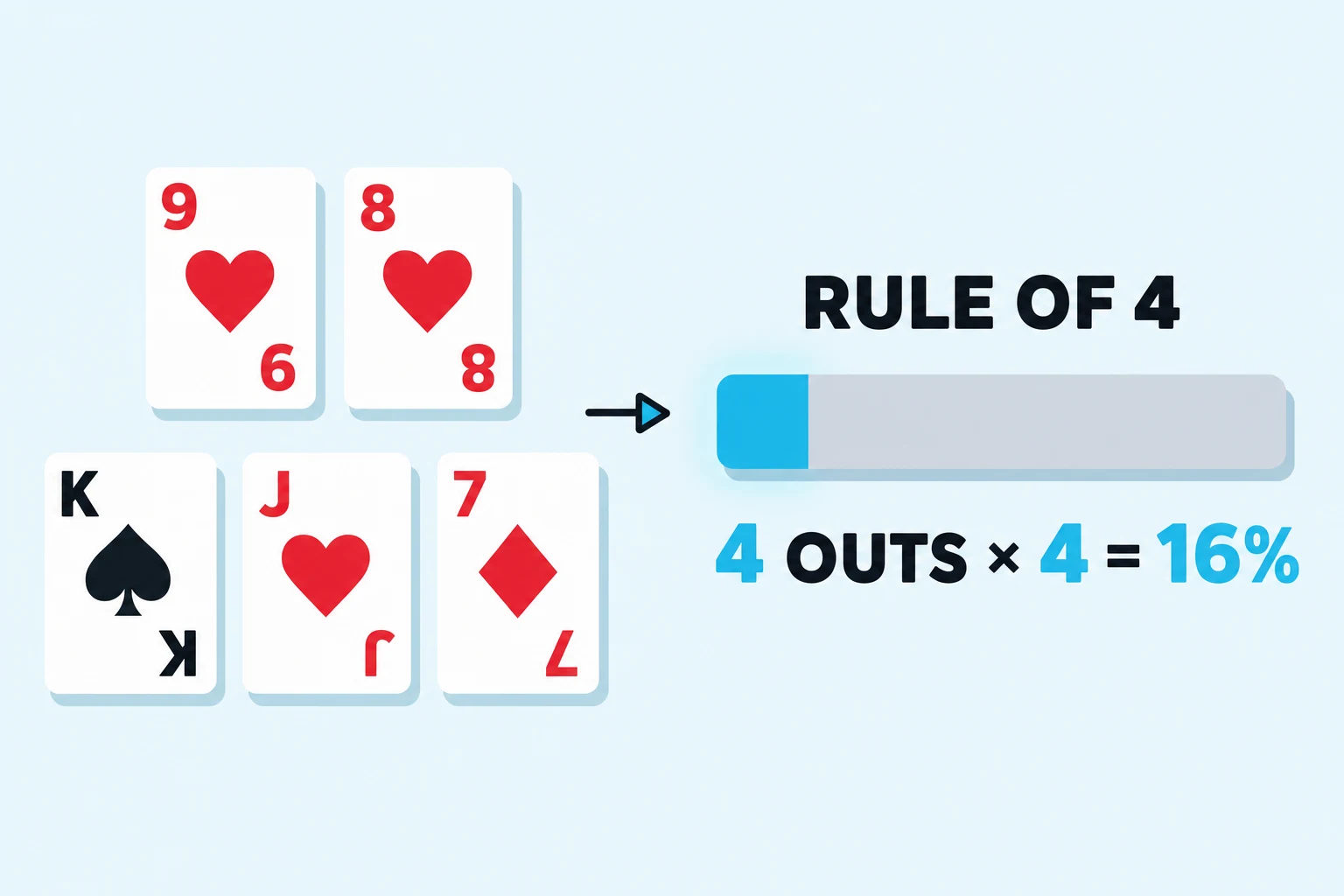
You can estimate the equity of a draw at the table without doing real arithmetic. Count your outs, multiply by 2 if there is one card to come, and multiply by 4 if there are two. Four outs becomes about 8% by the river with one card left, or about 16% with two. That is the Rule of 2 and 4, and once you trust it, every drawing decision gets faster and the math stops being the thing slowing you down. The exact numbers it approximates sit in the poker odds chart, out to twenty outs. On the turn in Poker Skill’s lessons, T♥ Q♥ calls a bet on 2♠ Q♠ 5♥ 9♥ with two ways to win: top pair now, and nine hearts for the river, a draw the Rule of 2 puts at about 18%.
The shortcut, in one line
If you are on the turn, multiply your outs by 2. If you are on the flop with the turn and river both still to come, multiply your outs by 4. The number you get is your rough equity as a percent. You compare that percent to the price the pot is offering — your pot odds — and you have your call-or-fold answer. The Rule of 4 figure counts in full only when you will see both cards for that one price, as when someone is all in. When a turn bet can still follow, calling the flop gets you one card at that price, and the turn bet sets a new price for the river.
Quick-reference table
| Outs | Common draw | Rule of 2 (one card) | Rule of 4 (two cards) | True equity, two cards |
|---|---|---|---|---|
| 4 | Gutshot straight draw | 8% | 16% | 16.5% |
| 8 | Open-ended straight draw | 16% | 32% | 31.5% |
| 9 | Flush draw | 18% | 36% | 35.0% |
| 12 | Flush draw plus gutshot | 24% | 48% | 45.0% |
| 15 | Flush draw plus open-ender or two overcards | 30% | 60% | 54.1% |
The twelve-out row is the draw A♣ 4♣ holds on 6♣ 5♦ 2♣ in Poker Skill’s lesson on leading into the preflop raiser: nine clubs for the nut flush and three more threes for a straight. The first three rows are tight. The last two start to drift, and the drift is what the rest of this article is about.
Why the math works
Each unseen card you have not folded into is roughly one out of fifty, so a single card you can hit is worth about 2% on a single street. Two streets gives you two pulls, which is why you double the multiplier. The shortcut rounds 47 unseen cards on the turn and 46 on the river up to a clean 50, which makes the mental math survivable but bakes in a small consistent underestimate. That is fine. Rough and right beats exact and slow when the dealer is waiting on you.
Three hands you’ll recognize
Gutshot facing a half-pot turn bet (4 outs)
Hero is in position with 9♥8♥. The board is K♠J♥7♦4♣. Villain bets half-pot on the turn. You have an inside straight draw — a gutshot, where any ten gives you 7-8-9-10-J — so 4 outs.
One card to come, so use the Rule of 2. Four times two is 8%. Half-pot is offering you 25% pot odds, because you are calling one unit to win three. Eight percent is nowhere near 25%, so the call loses money in the long run. Fold and live to draw another day, unless you have a real reason to think implied odds will pay you off when you spike.
Open-ended straight draw on the flop (8 outs)
Hero opens T♣9♣ from the cutoff and the big blind calls. The flop is J♥8♥2♦. Villain leads two-thirds pot. You have an open-ended straight draw — any 7 or any Q gives you a straight — so 8 outs.
Two cards still to come, so use the Rule of 4. Eight times four is 32%. A two-thirds-pot bet asks for about 28.5% equity to break even (you call 2 to win 5). 32% clears that line only if this call takes you to the river. If villain can bet the turn as well, this call is really for one card: about 16% by the Rule of 2, with the rest of its value coming from acting last and from the chips you win when the straight lands. This one is still a defensible call.
Flush draw with overcards on the flop (15 raw outs)
Hero has A♠K♠ on Q♠7♠2♥. Villain bets pot. You have a flush draw, plus an ace and a king to make top pair if either lands. The naive count is 9 spades plus 3 aces plus 3 kings, or 15 outs.
Run the Rule of 4 and you get 60%. Compare that to a pot-sized bet, which asks for 33%, and the call is profitable if it puts you all in. The decision is fine. The shortcut, though, is overstating. The true equity for hitting one of those 15 cards by the river is closer to 54%, and that is before you ask whether all 15 are really live against villain’s actual hand. The call survives a six-point haircut here. The next section is about the spots where it would not.
When the rule lies to you
The Rule of 4 is a linear shortcut for a curve that flattens. It works cleanly up to about ten outs. Past that, every additional out you count gives you less new equity than the rule promises, because the cards that hit on the turn and the river start overlapping in ways the multiplier ignores. By 15 outs the shortcut overstates by about 6 percentage points, and by 20 outs it overstates by a lot more. The right move with a big draw is to stop trusting the rule alone and lean on the cheat-sheet row that matches your true out count.
The other thing the rule cannot see is your live out count. The number you start with is your nominal outs, the cards that improve your hand on paper. The number you should actually multiply is your live outs, which strips out the cards that do not actually win the hand. There are two ways an out can fail. A dirty out is one that also improves villain’s hand to something that beats you — the textbook example is an open-ender against a flush draw, where two of your eight straight cards also bring in villain’s flush, leaving only six live outs. A dead out is one that improves you but still loses — pairing your ace against a set, for example, gives you top pair but loses to three of a kind. Both kinds shrink the number you should multiply. When in doubt, count down: start with the textbook count, subtract any card that does not actually win the hand against the range you are facing, and use what is left.
The shortcut also cannot see reverse implied odds. Hitting your gutshot on a board that brings a fourth flush card sometimes means you make a straight and lose to a flush. The Rule of 2 still says 8%, but your real winning equity is lower. This is judgment work. The math gets you to the door; you read the spot to decide whether to walk through it.
A live-play pattern you can run in two seconds
Round to ten outs as your trust threshold. If you have ten or fewer, just run the rule, compare to the pot odds, and act. If you have more than ten outs on the flop, run the Rule of 4 and then trim by about one percentage point for every out past ten — so 15 outs on the flop is 60 minus 5, or about 55%, which lines up with the cheat-sheet row above. The Rule of 2 on the turn does not need this trim; it stays close to true across the whole range you will see.
For pot odds, the lazy version is also fast. A half-pot bet asks 25%, two-thirds asks roughly 28%, pot asks 33%, and an overbet of 1.5x pot asks 37.5%. Memorize those four numbers and you never have to do real division at the table.
Where this fits in your decision
The Rule of 2 and 4 is half of a single decision. The other half is your pot odds. You are running the same comparison every time: my equity now, against the percent I need to break even on this call. When the equity number is bigger, you call. When it is smaller, you fold or you raise — the rule does not tell you which, but it tells you the call is bad on its own. If you want the long version of the call-or-fold math, the glossary entry on break-even equity walks through it.
Frequently asked questions
Does the Rule of 2 and 4 work on the river? There is no Rule of 2 or 4 on the river — by then there are no more cards to come, and equity is no longer a draw question. The shortcut is for the flop and the turn, where you still have at least one card left.
Why does the Rule of 4 overstate equity for big draws? Two streets share a deck. Some of the cards that would win it for you on the turn would also win it on the river, and the Rule of 4 double-counts that overlap. Up to about ten outs, rounding the unseen cards up to 50 roughly cancels that overlap. Past ten outs you should trim, or use a memorized cheat-sheet row.
What is a dirty out? A card that improves your hand but also improves villain’s hand to something that beats you. The classic example is an open-ender on a board with two cards of one suit while villain holds a flush draw in that suit — two of your straight cards also complete villain’s flush, so they only look like outs. Subtract them before you multiply.
What is the Rule of 2 and 4 for a gutshot? A gutshot is 4 outs. On the turn, that is 8%. On the flop with two cards still to come, it is 16%. Both numbers are close to true. A gutshot is rarely a profitable call without backup equity, an aggressive backdoor, or strong implied odds.
How accurate is the Rule of 2 and 4? For up to about ten outs, it is within roughly one percentage point of the true equity. Past ten outs, the Rule of 4 starts overstating, and you should trim by about one point for every out past ten. The Rule of 2 stays accurate across the whole range you will see at the table.