


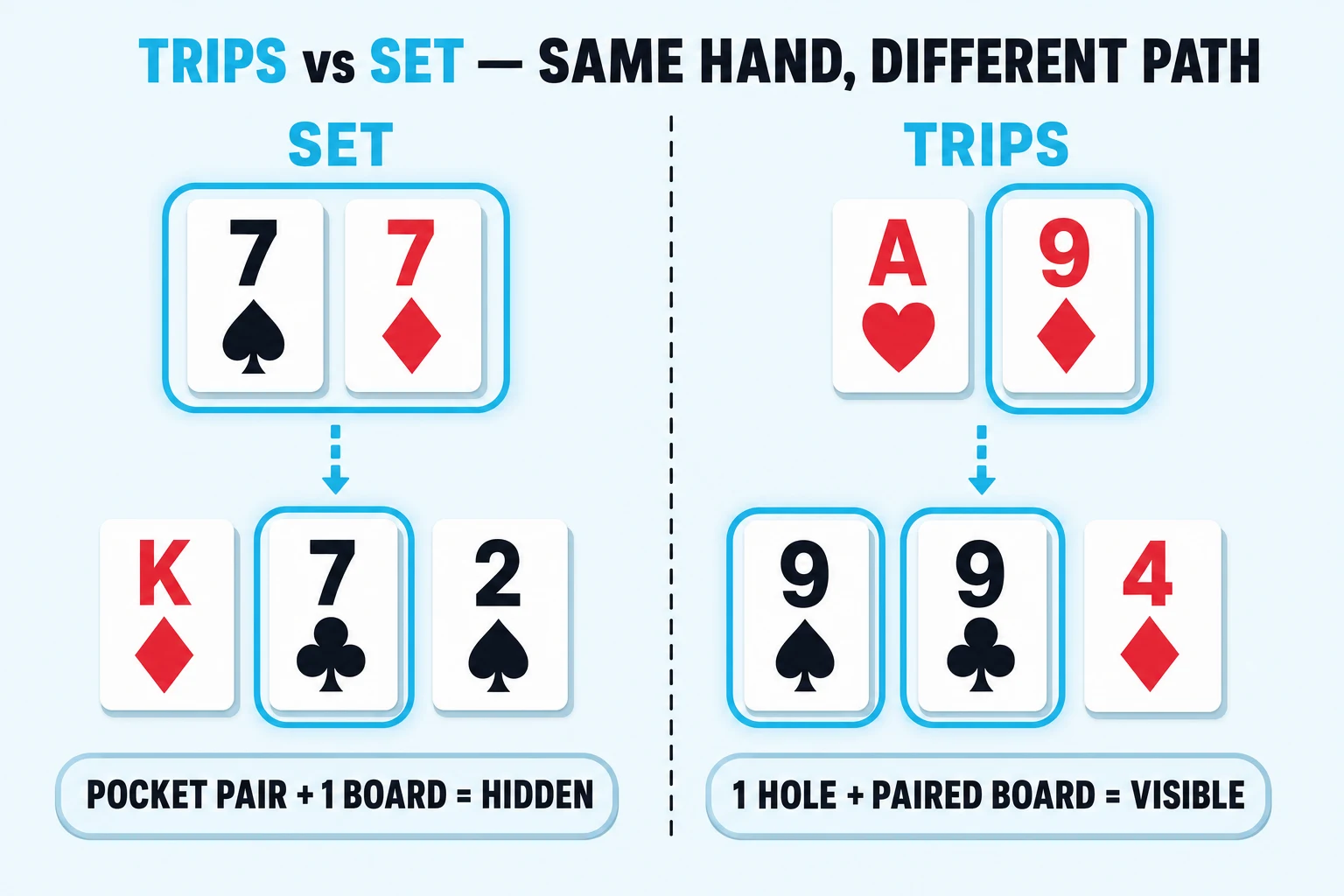
A set and trips are both three of a kind, and at showdown they break ties the same way. The difference is the path. A set is your pocket pair plus one matching card on the board; trips is one card in your hand plus a pair already sitting on the board. Same five-card rank, very different hands to play. The set hides; the trips advertise. Once you read the path, you know which version you have and how it is going to get paid.
The shortcut, in one line
If the pair is in your hand, you have a set, and the strength is concealed. If the pair is on the board, you have trips, and the strength is visible. That is the entire test, and you can run it before the dealer even finishes spreading the flop.
Trips vs set, side by side
| Set | Trips | |
|---|---|---|
| How it forms | Pocket pair + one matching board card | One hole card + a pair on the board |
| Board signature | One of your rank, no pair on the board | A pair already on the board |
| Concealed? | Yes — the pair is in your hand | No — the board advertises the pair |
| Frequency, conditional | ~11.8% of the time you hold a pocket pair | Less per hand, but more starting hands can make it |
| Typical line | Build a pot, get paid by overpairs and top pair | Pot control, kicker matters, trap rarely works |
| Kicker exposure | Almost never decides | Often decides at showdown |
The two hands collide most often when one player set-mines a pocket pair and the other plays a big card that connects with a paired board. Both rank as three of a kind, and the rest of the article is about why those two paths play so differently at the table.
Why the formation matters
Three of a kind is three of a kind on a hand chart. At the table, the formation decides what the rest of the room thinks you have. A set hides because the second and third cards of the rank are in your hand. The board shows one of that rank, alongside two unrelated cards, and looks like an unexceptional flop. Top pair, overpair and one-pair-with-a-real-kicker all want to keep playing, and you collect from each of them.
Trips reverse that. The paired board is the headline. Anyone holding a card of the matching rank can see the threat instantly, and anyone holding nothing of that rank slows down because the board itself looks dangerous. The same hand strength shows up at showdown, but the path to the river is narrower. Where a set quietly prints, trips have to fight for value, and the kicker you brought along starts to do real work.
Three hands you’ll recognize
A set on a dry flop
Hero is in the cutoff with 7♠7♦. The under-the-gun player opens, hero calls, the big blind comes along. The flop is K♦7♣2♠, rainbow, no draws.
Hero has a set of sevens. The board is dry, the under-the-gun raiser likely has a big pair or top pair with a strong kicker, and nobody can reasonably have you beat. The big blind checks, the original raiser bets two-thirds pot, hero raises. The raiser, holding A♣K♣, has top pair, top kicker, and is not going anywhere. Stacks go in over two streets and the set wins a full double-up.
The reason the hand pays so cleanly is the path. Three sevens are in front of the room and only one of them is showing. The opponent reads the board as K-7-2 and sees their A-K as the best hand. Concealment, not raw strength, is what builds the pot.
Trips on a paired flop
Hero opens A♥9♦ from the cutoff. The big blind defends. The flop is 9♠9♣4♦.
Hero has trips of nines with an ace kicker. The big blind checks, hero c-bets a third of the pot, the big blind folds. The hand wins, but it wins small. Anybody who missed the flop is folding to any reasonable bet because the board reads “someone has a nine,” and anybody who actually has a nine — say, T♣9♣ for a chunky kicker, or J♥9♥ flopping the same trips with worse — would already be slow-playing or raising.
This is the trips story almost every time. The strength is real, but the path is loud. Better hands stay in and worse hands leave. The right move is usually pot control on the early streets and a thin value bet on the river when a calling station finally pairs up. The trap that works for sets does not work here, because there is nothing left to disguise.
A trips kicker battle
Hero has A♥7♥ in the big blind. The cutoff opens K♣7♠ and hero calls. The flop is 7♣7♦2♠. Both players see trips of sevens. Hero check-calls a small c-bet. The turn is Q♥. Hero check-calls again. The river is 9♣. Hero checks, the cutoff bets two-thirds pot, and hero calls.
Hero shows 7-7-7-A-Q. Cutoff shows 7-7-7-K-Q. Hero wins because the ace beats the king on the side card.
This is the classic kicker trap. When the board pairs and chips go in late, trips with an ace or worse are often the hand that pays off the hand that improved. Hero held the better kicker and got there. Reverse the hole cards and hero is the one paying a two-thirds-pot river bet to lose to a better kicker. The lesson is not “always have an ace.” It is that with trips, the kicker is part of the hand strength, not a footnote, and the call size should reflect it.
When the line between them blurs
A handful of boards collapse the distinction. The first is a flop that already shows a pair alongside your set card — say you hold 9♠9♦ on a K♣K♦9♥ flop. You have nines full of kings on the flop itself, and the trips-vs-set conversation is already over because the full house ate it. Anyone with a single king has trips of kings; only K-9 in a hole has the better full house. Pocket pairs that flop alongside an existing board pair tend to skip the three-of-a-kind discussion entirely and play as boats.
The second is a board that turns over three of a rank. On 7♣7♦7♠K♥2♦, every hand at the table has trips of sevens. Showdown is decided entirely on kickers, and the player whose two best non-seven cards out-rank the rest wins. If the board ends up with three of one rank and a pair of another, everyone has a full house and the trips conversation disappears.
The third is the reverse-implied-odds trap of trips with a small kicker. You hit your three nines on a 9-9-x board, fire two streets, and get raised on the river by a hand that ran a small pocket pair into a turned set or rivered a full house. The hand looked like trips and ended up second-best. This is why “trips with a weak kicker on a paired board” tends to play smaller than its raw strength suggests.
A live-play pattern you can run in two seconds
When a third card of a board rank is involved, ask three quick questions in this order. First, is the pair in my hand or on the board? That answers set or trips. Second, who else can have this rank? On a 9-9 flop, only specific holdings (T9, J9, Q9, K9, A9, plus pocket nines) can have or share the trips. On a K-7-2 flop with your pocket sevens, almost every hand that wants to play continues, and you build the pot. Third, what is my kicker doing for me? If the answer is “nothing,” shrink your sizing and play one street at a time. Poker Skill’s lesson on sets and trips drills that first question, with pocket eights and an eight on the board as a set and A♠7♦ on a board with two sevens as trips.
The shortcut: sets play one way and trips play another, and the wrong move is to treat both like a green light. Sets want a bigger pot. Trips want pot control until the kicker matters or the board is safe enough to push.
Where this fits in your decision
Sets and trips are the entry point to the broader paired-board family — full houses, four of a kind, board pairs that counterfeit your two pair, and implied-odds calls that turn small pocket pairs into stack-winners on the right flop. The mechanics in this article apply every time the board adds a third of a rank, and the way you respond shapes whether the hand prints, holds, or leaks.
Frequently asked questions
Are trips and sets the same hand? Mechanically, yes. Both are three of a kind, and a set and trips of the same rank tie at showdown if the kickers match. Poker shorthand splits them on the path: set means the pair is in your hand, trips means the pair is on the board. The labels exist because the two paths play very differently.
Are sets really stronger than trips? Same five-card rank, but sets earn more on average because they hide. Top pair, overpairs, and second-best made hands stay in against a set and pay off across two streets. Trips advertise the threat, so weaker hands fold and stronger hands keep going. Pre-flop equity is identical; the bankroll difference comes from getting paid.
How often do you flop a set with a pocket pair? About 11.8% of the time, or roughly 1 in 8.5. The cleaner way to remember it is “set-mining is a 7.5-to-1 shot,” which is why a small pocket pair only justifies a call when the implied odds are deep enough to make up for the seven hands you miss for every one you hit.
What is a board with trips on it? A board with three cards of the same rank — for example, 7♣7♦7♠K♣2♦. Every player has trips of sevens, and the showdown is decided by the highest non-seven kicker. If a fourth card of that rank lands on the turn or river, every hand becomes four of a kind on the board, and the highest kicker still wins the kicker race.
Should I always slow-play a set? No. Slow-playing makes sense only when the board is dry, the opponent has a hand worth bluffing or value-betting, and there is no draw that punishes a free card. Most boards do not satisfy all three. The default with a set is to build a pot, not to hide forever; the disguise is doing the work for you whether you check or bet.