


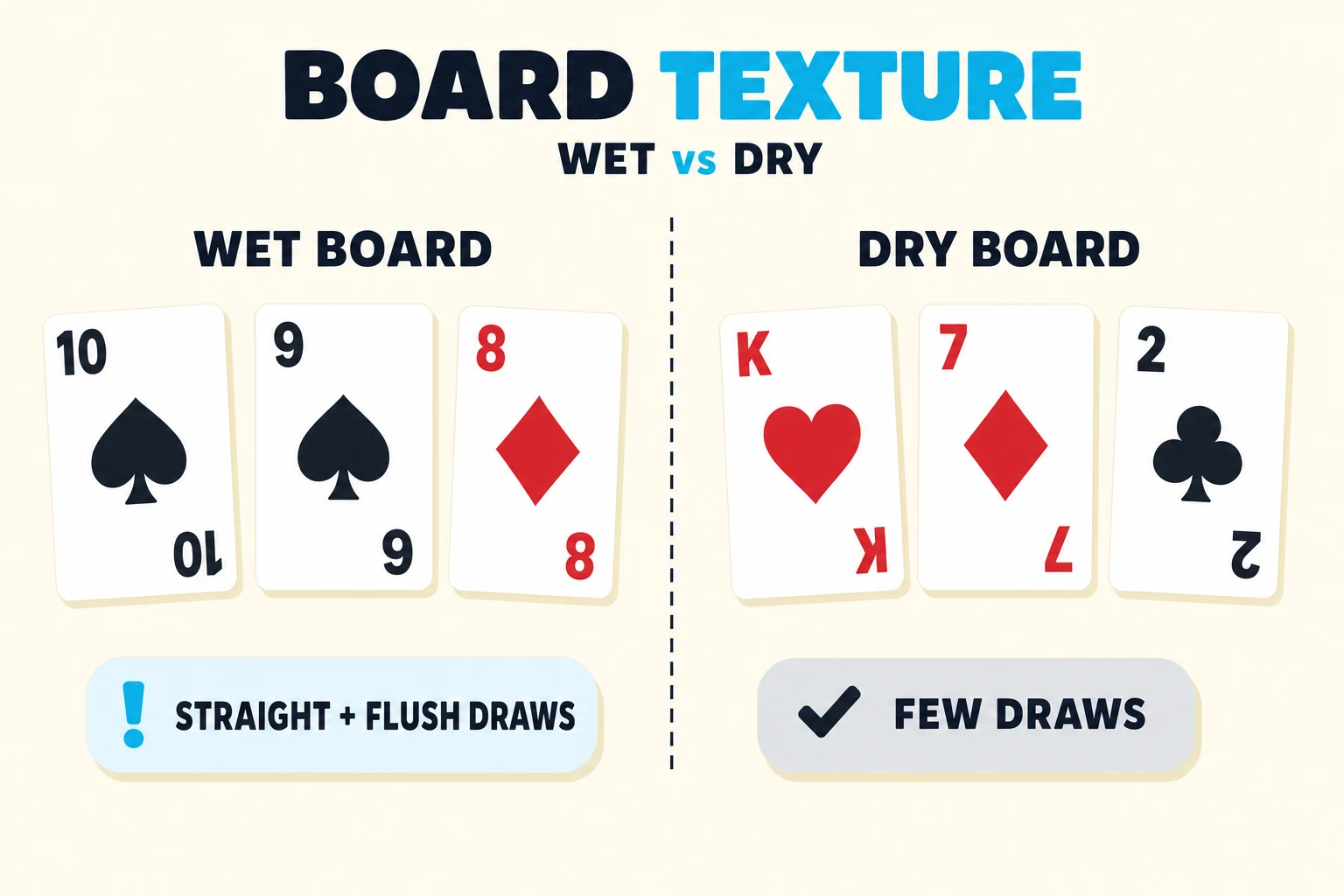
A wet board has live draws — straights, flushes, and combo draws that change the leader on the next card. A dry board has almost none of that. The decision the texture forces on you is sizing: bet bigger to charge draws when the flop is wet, bet smaller and more often when it is dry. The reason is not aesthetic. It is that hand equities shift fast on a wet flop and barely move on a dry one, and your bet has to charge the right price for what is actually going on.
The shortcut, in one line
On a dry flop, c-bet small (about a third of the pot) at high frequency. On a wet flop, c-bet bigger (two-thirds to pot) and bring fewer hands. Your sizing should follow the board texture, not the strength of the cards in your hand.
Wet vs dry, at a glance
| Trait | Wet board | Dry board |
|---|---|---|
| Connected ranks | Yes (T-9-8, J-8-6) | No (K-7-2, A-8-3) |
| Suit coordination | Two-tone or monotone | Rainbow |
| Live draws | Many | Few |
| How fast the leader changes | Often | Rarely |
| Whose range likes it | Caller’s gets closer | Raiser’s holds |
| Default c-bet sizing | ⅔ to pot | ⅓ pot, high frequency |
Two more shapes are worth naming. A damp board has one of the wet traits but not both — a flop like J♣ 8♣ 6♥ has connected ranks but no flush draw on its face, and it plays in between. A static board is a flop where future cards almost never change the leader; A♣ 8♦ 3♠ and paired flops like Q♠ Q♦ 5♣ both qualify.
Why texture decides sizing
The bettor on a wet flop is fighting two things at once. The caller has more equity right now (every middle pair, every gutshot, every backdoor draw is live), and that equity will keep changing on the turn. Sizing up does two jobs: it charges draws a price that loses money in the long run if they call without odds, and it does some equity denial on marginal made hands that would happily peel for cheap. On a dry flop, neither problem is loud. The raiser’s range stays ahead by a wide margin (high-card flops favor the raiser; low connected flops favor the caller), draws are sparse, and a small frequent bet extracts thin value and pressures missed broadways without bloating the pot. Range distribution decides the bet size; the bet size shapes the rest of the hand. The contrast shows up in Poker Skill’s c-bet sizing lesson, where K♣ K♦ bets for value on a dry Q♠ 8♥ 3♣ and 6♥ 6♦ checks on T♣ 9♦ 8♦, against too many made hands and draws.
Three flops, paired
Same hero, two flops side by side, every time. Read the contrast between the columns more than the absolute play in either.
The classic contrast: T♠ 9♠ 8♦ vs K♥ 7♦ 2♣
Hero opens A♥ K♦ from the cutoff, the big blind calls.
On T♠ 9♠ 8♦, A-K is air. The big blind’s calling range is full of T9, 98, 87, JT, J9, plus pocket pairs that have set, plus suited spade combos that have a flush draw. The raiser’s range advantage is gone here. The honest play is to check and give up cheaply with no equity. If you do bet, the right size is two-thirds to pot, and the bet is a semi-bluff that needs the runner-runner straight to keep working.
On K♥ 7♦ 2♣, the same hand is a monster. Top pair top kicker on a rainbow disconnected flop. The big blind’s range is mostly missed broadways and middle pairs. A small c-bet at about one-third pot folds out the misses, gets thin calls from worse Kx and middle pairs, and barely risks anything. Same hand, totally different decision, because the texture decides who has the range.
A semi-wet trap: J♣ 8♣ 6♥ vs A♥ 8♦ 3♠
Hero opens K♦ K♠ from the button, the big blind calls.
J♣ 8♣ 6♥ is damp. There are flush draws in clubs, an open-ended straight draw for any 7-9 hand, plus middle-pair combos that flopped a piece. Kings are an overpair, but a vulnerable one. Sizing here is two-thirds pot. The bet job is to charge the draws and to take it down on a brick turn before the river card swings the leader. Plan to fire again on a non-club, non-straight-completing turn.
A♥ 8♦ 3♠ flips the script. The ace is in the big blind’s calling range often, the flop is rainbow, and Kings on an A-high flop is exactly the spot where a check looks better than a bet. Betting bloats the pot in an overpair-vs-top-pair fight you do not want. Check, see the turn, and let the big blind bluff into you. Same overpair, very different plan, because one flop has draws to charge and the other has a high card you cannot represent.
Two-tone overcards: Q♠ 7♠ 2♥ vs Q♦ 7♣ 2♥
Hero opens A♣ Q♣ from the cutoff, the big blind calls.
Q♠ 7♠ 2♥ has top pair top kicker for hero, and two spades on the board. The big blind has flush draws (any two spades), some middle-pair-with-a-spade combos, and a few floats. Bet two-thirds pot to charge the spades. Letting a spade-draw call cheaply gives back the equity edge that the texture would otherwise hand you.
Q♦ 7♣ 2♥ is the same flop with one suit changed, and the change is the whole story. Now there are no flush draws on the table at all. Bet a third of the pot at high frequency. The big blind has fewer hands that have a real reason to call, the pot stays small, and the bet does its work on misses. One suit changed; the sizing changed by half a pot.
When the wet-vs-dry heuristic lies to you
The rule is a heuristic, not a law. Three textures pull it sideways.
A monotone flop like J♠ 8♠ 4♠ looks wet because every spade combo has a draw or a made flush. It is. But the right c-bet is smaller, not bigger, often only a third of the pot. The big blind’s range here is sharply polarized — already-flushes on one end, total air on the other — and a big bet folds out the air while only getting called by the part of the range that has you crushed. A small bet picks up the trash and keeps the pot manageable against the made hands.
A static-but-suited flop like A♠ 9♠ 6♠ is the same trap from the other side. Three of a suit, but the equity edge of the raiser’s range is so large on an A-high board that the right play is closer to the dry-board script than the wet one. The texture is suited; the equity distribution is not actually shifting much.
A paired flop like K♠ K♦ 7♥ looks dry, and structurally it is, but the right sizing comes from a different argument than on a disconnected rainbow. The big blind has very few strong hands here (only the rare K-x, plus 77 for the boat), and a small frequent bet extracts the maximum from a polarized range. Same small sizing, different reason. If you are betting small “because dry,” you will keep doing it on textures where the logic does not actually carry over.
A live-play pattern
You can read any flop in two seconds with four questions.
How connected are the ranks? Three cards within a four-rank window is wet. Three cards spread across the deck is dry. How suited is the board? Rainbow is dry, two-tone is half a step toward wet, monotone is its own special case. Whose range likes this flop more, yours or the caller’s? High-card boards favor the preflop raiser; low connected boards favor the big blind. What does the turn do? On a wet board, dozens of turn cards swing the leader; on a dry board, almost none do. Each answer pushes your sizing one click in a direction. When the four answers all point the same way, bet that size at high frequency. When two of them disagree, slow down and check more.
The sizing menu pairs cleanly with pot odds. A ⅓-pot bet asks the caller for 20% equity, ½ pot asks 25%, ⅔ pot asks 28%, pot asks 33%, and a 1.5× overbet asks 37.5%. Memorize those five numbers and your sizing decisions become read-and-pick instead of arithmetic.
Where this fits in your decision
Texture is one input into a sizing decision; equity, range advantage, and stack depth are the others. The Rule of 2 and 4 tells you what your draws are worth on a wet flop; the pot odds row tells you what the caller is being asked to pay. When both numbers line up with the texture, the bet size is obvious. When they fight each other, that is the spot to slow down — the texture is telling you one thing and the math is telling you another, and the math wins.
Frequently asked questions
What is a wet board in poker? A wet board is a flop with live draws — connected ranks, two or more cards of the same suit, or both. Examples are T♠ 9♠ 8♦ and J♣ 8♣ 6♥. Many turn and river cards can change which hand is ahead, so wet boards favor bigger bets and tighter continuing ranges.
What is a dry board in poker? A dry board is a flop with few or no live draws — disconnected ranks, rainbow suits, often one high card and two unconnected low ones. K♥ 7♦ 2♣ is the classic. Hand strength is locked in, draws are rare, and the preflop raiser keeps a wide range advantage.
How big should you c-bet on a wet board? Default to about two-thirds of the pot, sometimes pot-sized on the wettest textures. The bet has two jobs: charge draws a losing price, and protect made hands by denying cheap equity to marginal callers.
Should you always c-bet a dry board? Close to it. Dry boards are where small frequent c-bets print, because the preflop raiser’s range advantage is largest and draws are sparse. The exceptions are paired-and-low flops, which can favor the big blind, and monotone or three-flush textures that play more like wet.
What is the difference between a wet board and a dynamic board? Wet describes the flop’s draw density — how many straights, flushes, and combo draws are live right now. Dynamic describes how often later cards change the leader. They overlap heavily, and most wet boards are also dynamic, but A♠ 9♠ 6♠ is wet (monotone) and not very dynamic (ace-high range edge), while 9♣ 6♦ 4♠ is dynamic (many turn cards swing equities) without being especially wet.