


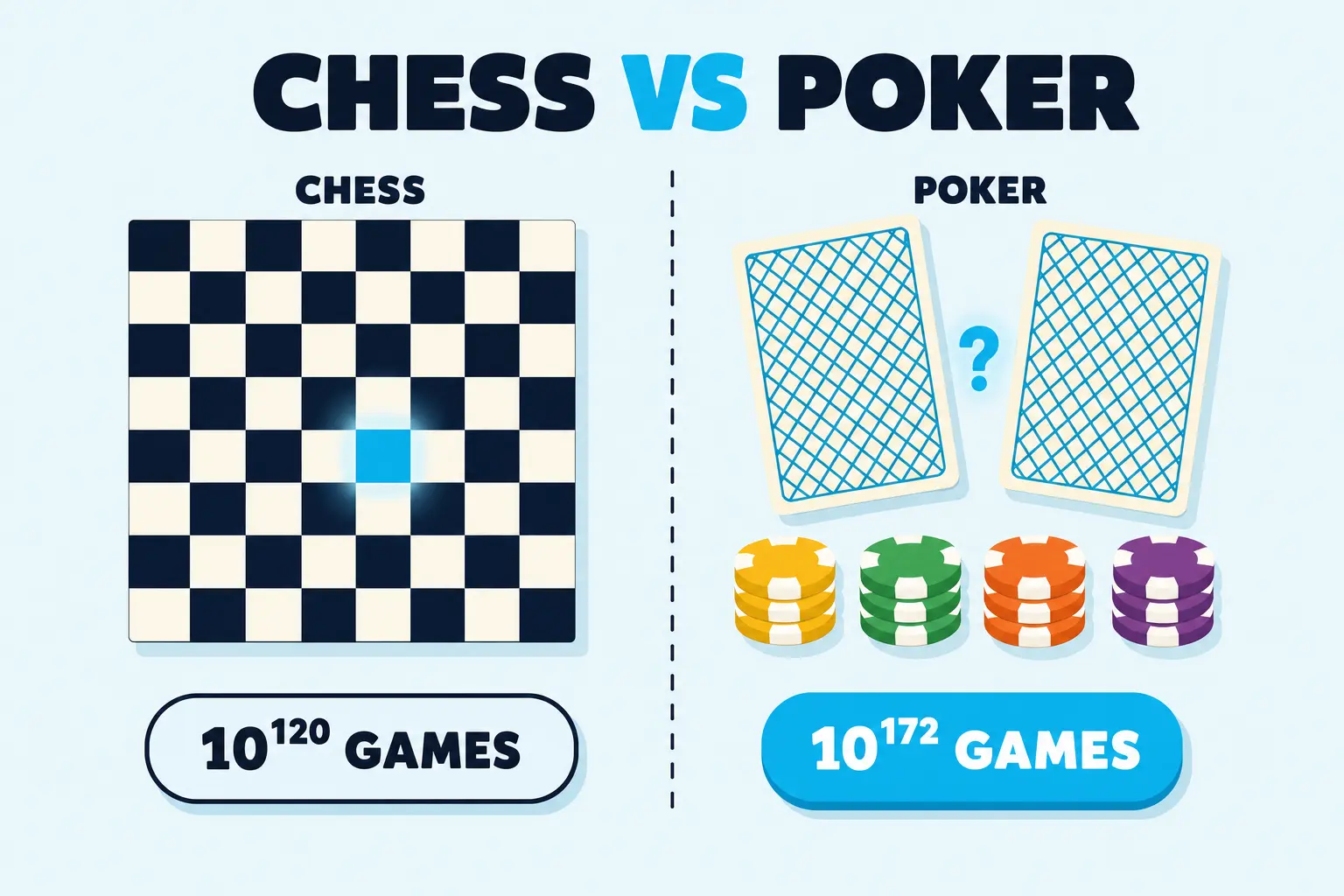
Deep Blue beat Garry Kasparov in 1997. Twenty-two years later, an AI named Pluribus beat five professional poker players at six-handed no-limit hold’em. The gap between those two milestones is not a story about hardware. It is a story about how much bigger poker is than chess, in the only way that matters to a computer: the size of the decision tree it has to reason through. A standard chess game tree has roughly 10^120 possible games. The six-player no-limit hold’em tree, with realistic chip granularity and no card-side compression, sits at a conservative floor of about 10^172. That is fifty-two orders of magnitude bigger. Not 52 times bigger. Fifty-two zeroes more.
The same compression problem the AI faces is the one a strong human is solving every street.
The short answer
Three things make poker harder than chess for a computer, and each one multiplies on the others. First, hidden information: you cannot see your opponent’s cards, so you cannot reason about a single board state. You have to reason about every board state your opponent could be in, weighted by how likely they are to be in it. Second, no-limit betting: a single decision in chess has maybe 30 legal moves, while a single decision in no-limit hold’em can have thousands of legal raise sizes. Third, more than two players: heads-up poker has clean game-theoretic guarantees that vanish the moment you add a third seat.
Chess is hard the way a deep cave is hard. Poker is hard the way a deep cave full of fog is hard, where the fog itself is reactive, and there are five other people in there making their own choices.
Just the deck is already astronomical
Before any betting happens, before any cards hit the felt, the deck has already done something absurd. A standard 52-card deck shuffles into 52! distinct arrangements. That is 8.07 × 10^67. To get a sense of how big that is, try this thought experiment.
Imagine a trillion people. Give each of them a deck and a perfect shuffle that runs a trillion times per second. Set them to work for a trillion years. Then run that whole setup in parallel across a trillion different universes. The total number of shuffles you would generate is about 3 × 10^55. That is still a factor of 2.5 trillion short of having seen each possible deck order once.
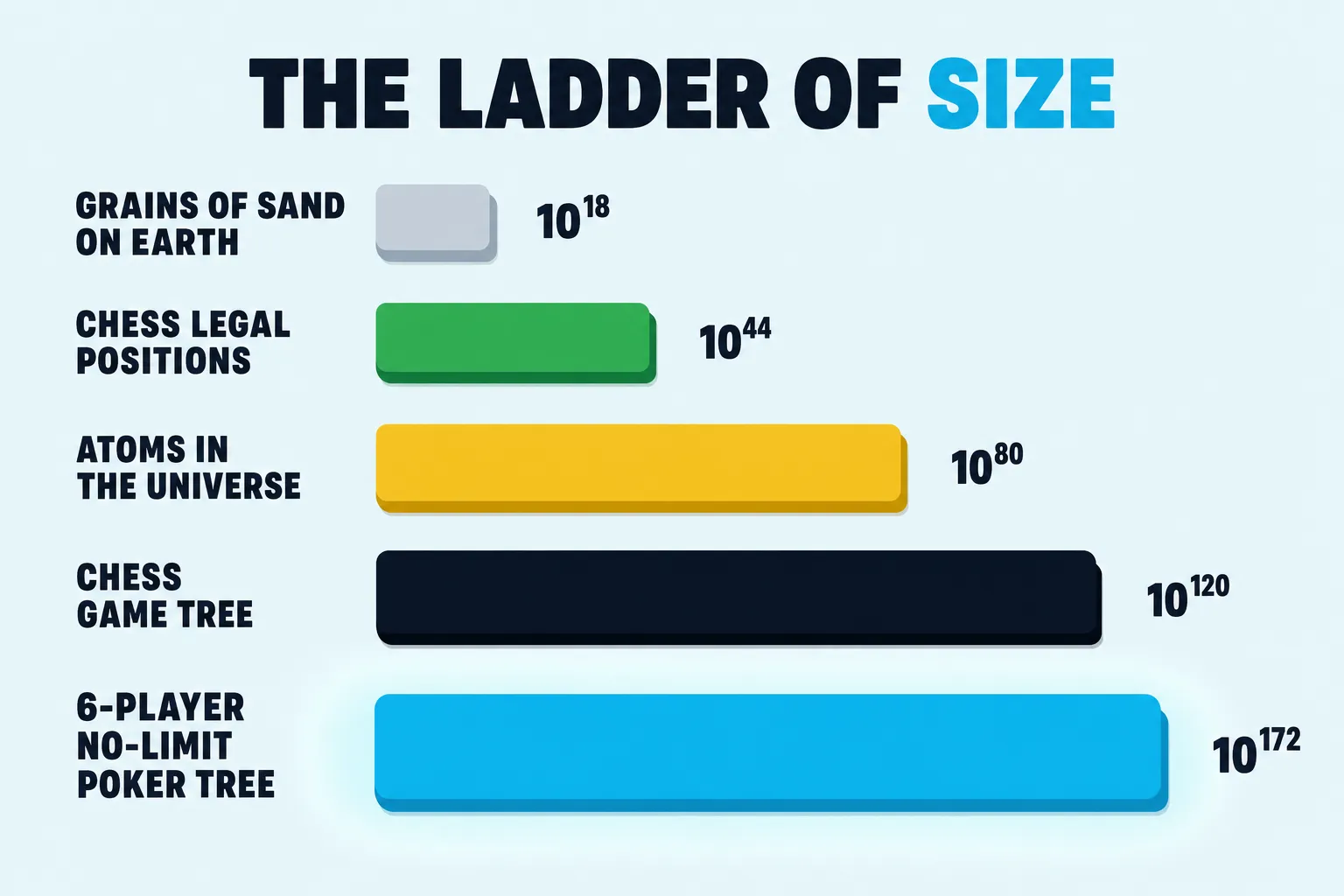
Every order of magnitude on that ladder is ten times the bar above it. The deck of cards in front of you, on its own, beats the number of atoms in this planet by seventeen orders of magnitude. The chess game tree beats the deck by a little over fifty-two. And the unabstracted six-player no-limit poker tree beats the chess game tree by another fifty-two. That is the size of the problem.
Chess vs poker, by the numbers
Two ways to count a game’s size matter for AI. The first is the number of legal positions, meaning every distinct board state the game could ever reach. The second is the number of decision points, sometimes called the game tree, which counts each path through the game as a separate thing. Chess has both numbers and they are large. Poker has both and they are astronomically large.
| Game | Legal states or decision points | Order of magnitude | Source category |
|---|---|---|---|
| Tic-tac-toe game tree (up to rotations/reflections) | 26,830 | 10^4 | Trivial |
| Heads-up limit hold’em decision points (symmetry-reduced) | ~10^13 to < 10^14 | 10^13 | Solved (essentially) in 2015 |
| Chess legal positions | 4.8 × 10^44 | 10^44 | Counted by Tromp |
| Heads-up no-limit hold’em decision points | 10^160 to 10^161 | 10^160 | Game branches on every legal raise size |
| Chess game tree (Shannon number) | ≈ 10^120 | 10^120 | Standard reference |
| Six-player NLHE, our shipping abstracted policy | 2,802,185,155 | 10^9 | After heavy bucketing |
| Six-player NLHE, no postflop card abstraction | ≈ 9 × 10^15 | 10^16 | About nine quadrillion rows |
| Six-player NLHE, conservative unabstracted floor | ≥ 10^172 | 10^172 | Adds private-card explosion only |
| Atoms in the observable universe | ≈ 10^80 | 10^80 | Cosmology reference |
Heads-up limit hold’em is small enough that humans solved it in 2015. No-limit is bigger by roughly 10^146, a multiplier so large that “a billion times bigger” doesn’t even start the conversation. The chess game tree, the famous Shannon number that is often used as the worst case for chess search, is smaller than the heads-up no-limit poker tree by 40 orders of magnitude. Our shipping six-player policy, after we compress the deck and the betting tree with enormous abstraction tricks, is “only” 2.8 billion rows of strategy. That is the scale we ship.
The card-side explosion
The first source of bigness in poker is the deck itself, multiplied across four streets. Two private cards per player, plus three flop cards, plus one turn card, plus one river card. The number of distinct card situations a single player can be in, counting suit-equivalent boards as the same situation, looks like this:
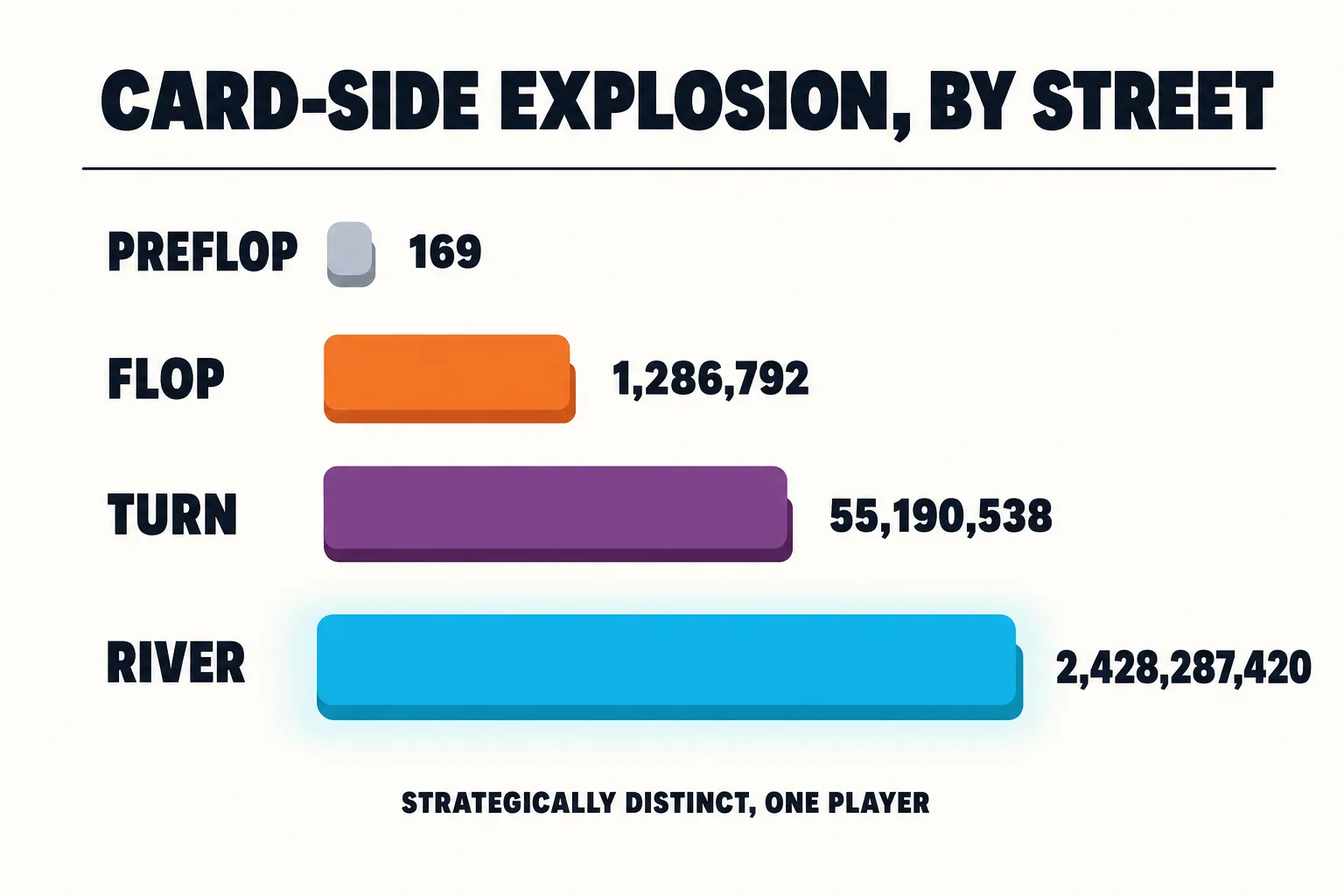
That is a 14-million-fold blowup from preflop to river. Preflop is small because there are only 169 strategically distinct two-card hands once you collapse suits: 13 pairs, 78 suited combinations, 78 offsuit combinations. By the river, you are looking at 2.4 billion situations a single player could be in. Add a second player who could hold any of a range of starting hands, and you are multiplying that 2.4 billion by every hand they might have. Every street, the tree fans out again.
Poker AI papers call this the card-side abstraction problem. Practical systems shrink the river’s 2.4 billion situations down to a few hundred buckets, grouping hands that are strategically similar. The Libratus system that beat heads-up pros used 1.25 million buckets on the river. That is a reduction of nearly 2,000 to 1. Our six-player engine compresses harder, down to 200 buckets per round on the flop, turn, and river, because the multi-player tree is so much wider that we cannot afford the same per-round resolution. Compression is the only way to fit poker into a memory you can buy.
The betting-side explosion
The second source of bigness is no-limit itself, and this is where the math gets sneaky. At every decision point in heads-up no-limit hold’em with $20,000 stacks and $1 chip increments, a player can make about 20,000 legal actions. Compare that to chess, where a typical position has roughly 30 legal moves. The no-limit action multiplier is more than 600 times bigger per decision, and it compounds across every betting round.
The deeper problem is that no-limit betting is technically continuous. If chips were arbitrarily divisible, you could bet any real number up to your stack, and the action space would be infinite. We get to pretend the tree is finite only because money comes in indivisible chips. That means the size of a no-limit game depends on the chip granularity in a load-bearing way.
Take a heads-up game where each player has 200 chips, and another where each player has $20,000 in $1 increments. The first has roughly a hundred legal raise sizes per decision; the second has roughly ten thousand. Across four rounds with several decisions per round, a multiplier of 100 versus 10,000 per decision stretches the tree by orders of magnitude. The 10^160-versus-10^161 range you sometimes see for heads-up no-limit comes from different published counting assumptions, including stack size and chip-granularity choices. That gap is real: the dial moves the answer by a factor of ten.
Solvers handle this by picking a small, finite menu of bet sizes: 5 to 14 raise options per decision, sometimes including a check, a half-pot bet, a pot-size bet, and an all-in. That is what a betting abstraction means. Without it, no-limit poker is not a finite tree you can enumerate. With it, you trade exactness for tractability and live with the rounding error.
And then there’s six players
Heads-up no-limit hold’em already weighs in around 10^161 decision points. Bring in four more seats and the problem changes shape twice.
The first change is the obvious one. Each new player you deal in adds two more hidden cards to the chance node at the start of the hand. A heads-up game has C(52, 2) × C(50, 2) ≈ 1.6 million distinct private-card deals. A six-player game has C(52, 2) × C(50, 2) × C(48, 2) × C(46, 2) × C(44, 2) × C(42, 2) ≈ 1.5 quintillion. The deal alone gets a trillion times bigger. That is what pushes the heads-up 10^161 number up to a six-player floor of 10^172.
The second change is more important and less well known. In heads-up zero-sum poker, Nash equilibrium has a clean meaning: it is an unexploitable strategy. If you play it and your opponent deviates, you win in expectation. That guarantee is a load-bearing piece of every two-player solver in existence.
The guarantee does not carry over to multiway pots.
Nash equilibria still exist in finite multi-player games. What does not survive is the special two-player zero-sum promise that any one equilibrium strategy is unbeatable on its own. In a six-handed game, if multiple opponents shift strategies together, or if each one independently picks from many possible equilibria, the one-player “unbeatable” story breaks. Pluribus did not solve six-player poker by computing a true Nash equilibrium. Its team used self-play, abstraction, and real-time search to build a strategy that empirically beat elite human professionals, while accepting weaker theoretical guarantees than the heads-up case enjoys. Multiway pots are the place where pure GTO reasoning runs out of road and even the AI has to choose its compromises. That is also why a six-player engine is so much more expensive than a heads-up one: you are searching a bigger tree for a weaker prize.
Hidden information is a different kind of hard
Chess and Go are perfect-information games. Both players see the entire state. Whatever is hard about them is hard vertically. The search has to go deep, and depth costs compute, but every node along the path is fully visible. Build a fast enough evaluation function, search deep enough, and the game falls.
Poker has a second axis the chess-style approach cannot flatten. At every decision, you do not actually know what game you are in. Your opponent could be holding any of dozens of hands, and the right play depends on which one. The standard answer is to reason about equity against a probability distribution over the cards your opponent could have, and to update that distribution every time they bet, check, or fold. That distribution is not a fixed input. It is shaped by your opponent’s strategy, which is shaped by their model of your strategy, which is shaped by your model of their model. The recursion bottoms out only at a fixed point, an equilibrium, and finding that fixed point is the hard problem.
Two-player zero-sum games are the special case where equilibrium methods are cleanest and best understood. Once the game has hidden information and more than two players, the useful guarantees weaken and the practical problem becomes too large to solve directly. That is why poker AIs lean on abstraction, self-play, and real-time re-solving instead of a chess-style full-tree search.
In chess, a stronger move beats a weaker move. In poker, a stronger move loses to a weaker move all the time, because the cards have a vote. The AI cannot just search; it has to search and reason about belief, and reason about belief about belief, and pay for the whole thing.
The two tricks that make Pluribus possible
A 10^172 tree is intractable in any honest sense of the word. The tree we shipped is 2.8 billion rows. Two engineering tricks close that gap, and they are exactly what a strong human is doing across the table from you.
The first is abstraction. You do not solve the real game. You solve a smaller, lossy version of the real game where similar situations get glued together. A flop of K♠ J♦ 7♣ and one of K♥ J♠ 7♦ are not literally the same board, but they are strategically nearly identical and the AI treats them as the same row. Cards get bucketed. Bet sizes get rounded to the nearest legal size on the menu. The 9-quadrillion-without-postflop-abstraction game becomes the 2.8-billion abstract game, and that abstract game is small enough to solve.
The second is real-time search. Even after abstraction, six-player poker on the flop is too big to solve all at once. The fix is to ship a coarse “blueprint” strategy precomputed for every situation, and then, while playing, re-solve a finer-grained subgame for the next decision using the blueprint as a reference. Pluribus’s team found that this depth-limited search reduced the compute and memory cost of six-player poker by at least five orders of magnitude. Without it, real-time search at full resolution on the flop is likely infeasible with six players at the table. The blueprint gets you within shouting distance of a strategy. The search gets you the rest of the way, one decision at a time.
A strong human player is doing the same two things, in slower neurons. They carry a range-based mental model of how each villain plays. That is the personal blueprint. When a hand gets weird, they slow down and re-solve the subgame in their head: what is the price, what is my expected value against the parts of the range that call, what does the river card do to my equity? Both the AI and the human have given up on enumerating the game and replaced it with the same compression-plus-search loop.
What this means for you
The reason poker AI was a multi-decade research problem is the same reason poker is a hard human game: the truth is too big to look at directly. You cannot see your opponent’s cards, you cannot enumerate every possible bet, you cannot run six-way Nash in your head while a dealer waits. The only way through is to do exactly what Pluribus does. Replace enumeration with a learned model of opponent ranges, and replace exhaustive search with a focused re-solve when the spot matters.
That is why a solver is a study tool, not an instruction manual. It runs the same compression you do, with more compute and less time pressure. The compression is the craft. The reason a strong player makes a fast, confident call in a tough spot is not that they have memorized the answer. It is that they have built better range buckets and better re-solve habits than the player across from them, on the same intractable tree.
Practice that loop deliberately. Decide on the range before the cards reveal. Grade the action, not the river card. Poker Skill’s Practice vs AI is built around that loop: full hands against AI opponents that run on Showdown AI, with Coach Max grading your decisions rather than the card that followed. The companion article on poker vs chess walks the same split from a different angle: what each game trains you to do. The math is the same; the reps are where it lands.
Frequently asked questions
Is poker harder than chess for AI? Yes, by orders of magnitude on every relevant axis. Chess has perfect information and a finite branching factor; poker has hidden cards, a near-continuous betting space, and a multi-player game-theoretic structure that breaks the heads-up Nash guarantee. Chess fell to AI in 1997 with brute-force search and a strong evaluation function; six-player no-limit poker took until 2019 and required a fundamentally different algorithmic approach.
Has poker been “solved” by computers? Heads-up limit hold’em was essentially solved in 2015. That game has on the order of 10^13 unique decision points. No-limit hold’em has not been solved and almost certainly never will be in the strict sense, because the unabstracted game is too large to enumerate. What we have instead is strong approximate strategies that beat top human professionals at the table. Libratus passed that line in 2017 in heads-up no-limit, where a true Nash equilibrium is the right target. Pluribus passed it in 2019 in six-player, where the team aimed at empirical strength rather than a specific solution concept and accepted weaker theoretical guarantees in exchange.
Why is hidden information so hard for AI? Because every decision depends on a probability distribution over what the opponent could hold, and that distribution is itself shaped by both players’ strategies. A perfect-information search algorithm can evaluate one position at a time. An imperfect-information algorithm has to evaluate a position together with its belief state, while also accounting for how the opponent’s belief state about the searcher’s belief state shapes their play. Math handles the recursion through equilibrium concepts; the cost is enormous.
Why is six-player poker harder than heads-up? Two reasons. First, more private cards mean a larger chance node at the start of every hand. In raw deal counts, a six-handed game has about a trillion times more starting deals than heads-up. Second, the heads-up unbeatability promise does not carry over. Nash equilibria still exist in multiway games, but no single strategy is unbeatable against every coalition of opponents the way one is in heads-up zero-sum. The AI has to settle for a strong empirical strategy with weaker theoretical guarantees. That is also why a six-player engine costs far more compute than a heads-up one: more tree, less guarantee.