


Commitment Threshold
The commitment threshold marks when chips already in the pot, relative to your remaining stack and pot size, make folding usually incorrect. Once you've invested enough, calling an all-in or making a big decision often becomes the right play. This applies pre-flop and on later streets. Commitment depends on chips in versus chips left, not on a feeling.

Practice this in Poker Skill. On the turn in the Hold the Plan lesson, A♣ 10♥ folds to a bet after missing the queen and the seven, because the chips it put in on the flop are already spent.
Get the free appCommitment Threshold in No-Limit Texas Hold’em
What the commitment threshold is
The commitment threshold marks when chips already in the pot, relative to your remaining stack and pot size, make folding usually incorrect. Once you’ve invested enough, calling an all-in or making a big decision often becomes the right play. This applies pre-flop and on later streets. Commitment depends on chips in versus chips left, not on a feeling.
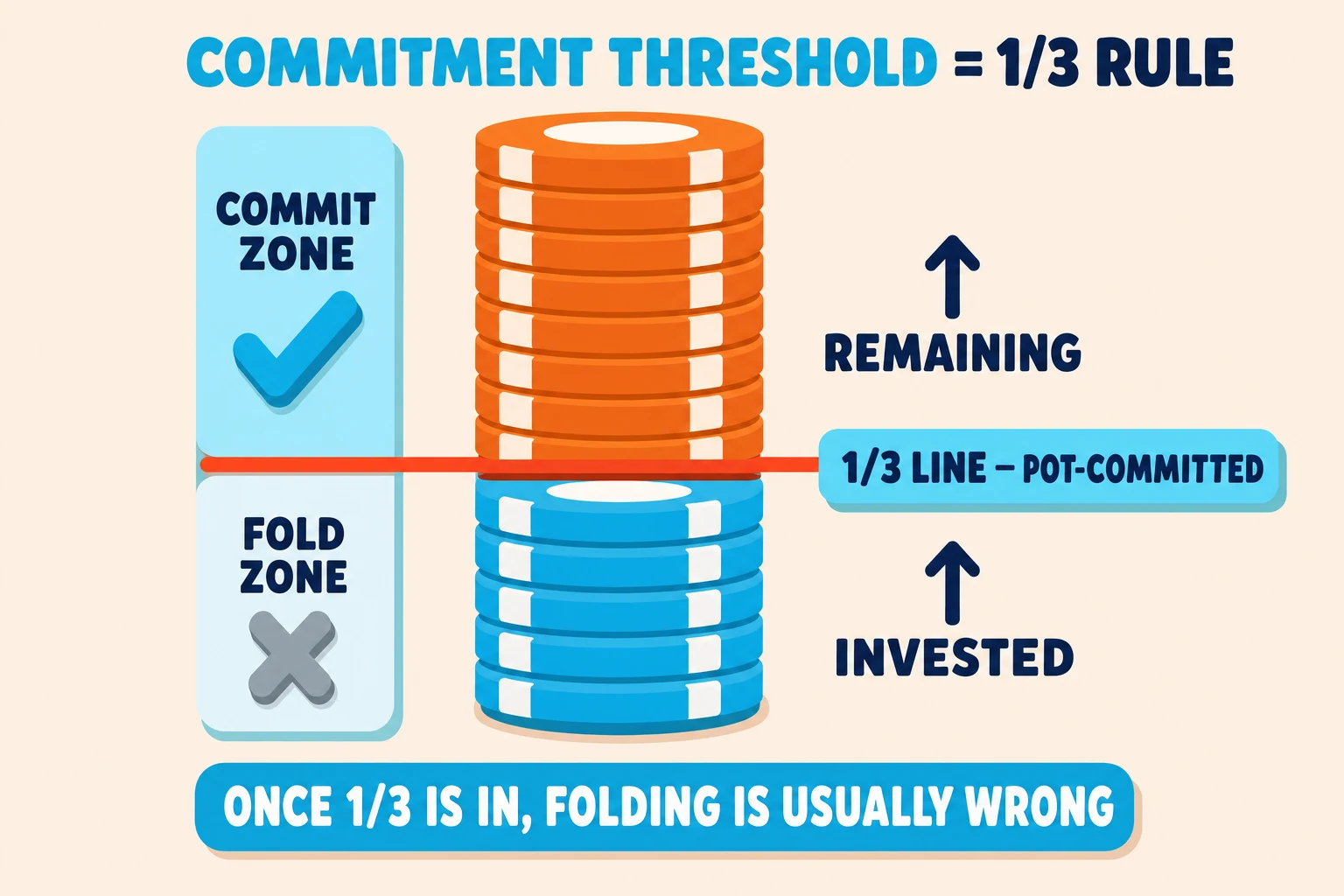
Recognizing pot-committed situations (the 1/3 rule)
Heuristic: if you’ve invested roughly one-third (≈33%) or more of your stack, you’re frequently pot-committed. “Pot-committed” means folding would surrender too much equity compared with the pot and the range of hands you beat. Example: with a 100bb start and 35bb already in, calling an all-in for your remaining stack is often correct. Only extremely weak hands, with essentially zero showdown value, justify folding. At the table, if a raise or squeeze leaves you with less than two-thirds of your stack behind, flag it as likely pot-commitment. (Quick jargon: a “squeeze” is a re-raise made after an open and one or more calls.)
Stack-depth rules: four-bets and five-bets at 40 big blinds and below
When effective stacks are ≤40bb, commitment logic yields clear sizing rules. Most recommended four-bets at these depths should be all-in. Smaller four-bets usually either auto-commit you or give opponents a cheap price to continue. Going all-in simplifies decisions and avoids awkward in-between spots. Example: with 40bb facing a 3-bet, four-betting to half your stack leaves you pot-committed and creates tricky follow-up choices. Similarly, five-bets and later escalations should be all-in: the pot and prior investments make full commitment unavoidable. (“Four-bet” means the third raise in a pre-flop sequence; “five-bet” is the next one.)
Multiway pots and heavy pre-flop action
Multiple callers accelerate commitment because each extra player increases the pot without increasing an individual’s stack. Your committed percentage therefore rises faster in multiway pots than heads-up. Example: you call an open, one other player calls, then you squeeze; the pot is already large relative to your stack. A small additional raise can push you past the one-third point. In these spots, be prepared to play heavily invested hands rather than folding superior holdings just because action continues.
Using commitment to guide bet-sizing and fold decisions
Use commitment awareness as a decision filter:
- Compare chips already invested to chips remaining. If invested > ~1/3, treat the spot as pot-committed.
- With shallow stacks (≤40bb), prefer all-in sizing for four-bets and any further escalation.
- Don’t fold strong made hands or high-equity draws after heavy investment; fold only with negligible equity.
- Avoid overcommitting with weak hands when you lack fold equity - the chance your opponent folds to your bet.
Thinking in terms of commitment simplifies ranges, removes awkward micro-sizing, and reduces exploitability when action gets big.
Quick checklist
- Compare chips already invested to remaining stack; flag >1/3 as likely pot-committed.
- At ≤40bb, default four-bets to all-in when appropriate; treat five-bets as all-in.
- Adjust expectations in multiway pots-commitment arrives sooner.
- Prefer all-in sizing over small escalations once commitment thresholds are reached.