


Heads-Up Pot
A heads-up pot has exactly two players contesting it after the flop. Most cash-game pots end up heads-up, so it sets the strategic baseline for c-bets, bluffs, and value betting.
Practice this in Poker Skill. On Q♠ 6♦ 2♥ against the big blind alone, you bet A♦ A♥ in the Intro to Continuation Betting lesson: dry boards miss the big blind more often, and a strong hand still gets value.
Get the free appHeads-up pot (No-Limit Hold’em)
What a heads-up pot is
A heads-up pot is a pot contested by exactly two players after the flop. The label describes the pot, not the table: a nine-handed cash game still produces a heads-up pot any time seven players fold preflop and two see the flop. Most cash-game pots end up heads-up, which is why heads-up postflop play is the strategic baseline that almost every other pot type adjusts away from.
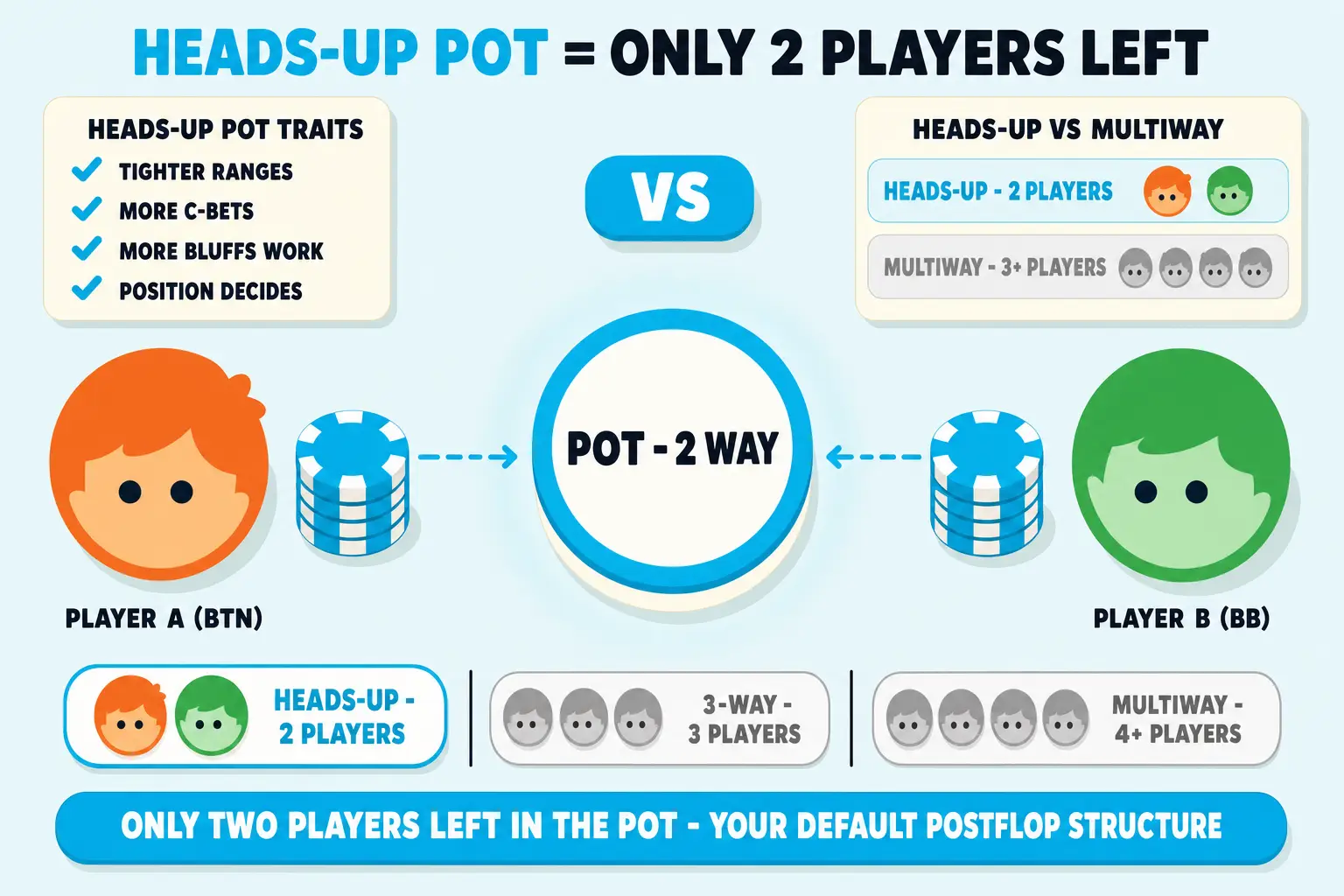
A heads-up pot is not the same thing as the playing format called heads-up, where only two players sit at the table. In heads-up cash or heads-up tournament play, every pot is heads-up. In a six-handed game, the heads-up pot is one of several possible postflop structures, and the most common one.
Related terms
- Multiway pot: three or more players still in the pot.
- 3-bet pot: pot type defined by a preflop reraise.
- Single-raised pot (SRP): one preflop raise plus any number of calls, usually heads-up.
- Heads-up: the playing format, two players at the table.
- Pot control: keeping the heads-up pot small with a marginal hand.
Heads-up pot vs neighboring pot types
The pot-type vocabulary overlaps because two different things describe a pot at once: how many players remain, and what the preflop action looked like.
| Pot type | Players postflop | Preflop action | Pot size on the flop |
|---|---|---|---|
| Heads-up pot | 2 | any | varies |
| Multiway pot | 3+ | any | varies |
| Single-raised pot (SRP) | usually 2 | one raise + any calls | small |
| 3-bet pot | usually 2 | raise + reraise + call | medium-large |
A single-raised pot is usually a heads-up pot. A 3-bet pot is almost always a heads-up pot, because the reraise filters out the weakest parts of preflop ranges and leaves only the player committed enough to call. A multiway pot is the foil: more players, more ranges to track, more ways the flop hits someone.
When you say “this is a heads-up pot,” you’re naming who is still in. When you say “this is a 3-bet pot,” you’re naming what got us here. The two labels describe different facets of the same hand.
When most cash pots end up heads-up
In a typical 6-max NLHE cash game at 100 big blinds (bb), most flops are seen by exactly two players: the preflop raiser and one caller. The structures that produce that outcome are:
- An open-raise from late position folded around to the big blind, who calls.
- An open-raise that gets one cold-call and folds the rest of the table.
- A 3-bet that gets one call and folds everyone else.
- A blind-vs-blind pot where the small blind raises and the big blind defends.
Three-handed and four-handed pots happen, especially at small stakes where players cold-call wider, but heads-up is the default. Strategy material is built around it for that reason: you spend more hands in heads-up pots than in any other pot type, so optimizing your heads-up pot decisions has the biggest effect on your overall win rate.
Example: a single-raised heads-up pot
Cash game, 6-max, 100bb effective. The cutoff opens to 2.5bb with A♠Q♠. Button and small blind fold. Big blind defends with K♣J♦.
Two players see the flop. Pot: 5.5bb. The cutoff is in position, the big blind is out of position. This is a heads-up pot, and specifically a single-raised pot.
Flop: Q♥7♦4♣. The cutoff has top pair, top kicker. The big blind has one overcard and a backdoor straight draw.
Heads-up pot logic kicks in immediately. The cutoff can c-bet a wide range here, using a small sizing on a dry, disconnected board, because only one opponent has to fold and the cutoff’s range advantage is real. C-betting a hand like A♠Q♠ in a heads-up pot is value-betting top pair against worse Qx and middle pairs that may call once.
If this exact hand were a four-way pot, A♠Q♠ on Q♥7♦4♣ becomes much less of an automatic value bet. Multiple opponents widen the chance someone has two pair or a set, and the cutoff has to bet less often and lean toward pot control. Same hand, same flop, different decision, because the pot is multiway, not heads-up.
Common mistakes in heads-up pots
1) Treating top pair like the nuts
Top pair is strong heads-up, but it is still one pair. Stacking off 100bb deep with top pair on a flop someone has obviously hit is the single biggest leak in heads-up pots, and it shows up most often when the player anchors on “I have top pair, I’m ahead of bluffs” without weighing how often the opponent’s continuing range is two pair or better.
2) Under-bluffing the river
Heads-up pots are where bluffs work best, because only one player has to fold. Players who learned poker in multiway pots often carry the multiway “bluff less” instinct into heads-up spots and never bluff the river. The fix is small: identify the runouts where your range is stronger than your opponent’s calling range, and pick a bluff or two that block the value combos.
3) Confusing heads-up pot with the heads-up format
The strategy that works at a heads-up table (extreme aggression, very wide ranges, frequent shoves) is calibrated for blinds passing every two hands and ranges that include almost every starting hand. A heads-up pot inside a 6-max game has narrower ranges and longer recovery from a bad spot. Playing heads-up pots with full heads-up-format aggression burns chips against opponents who have actually folded their weak hands.
4) Ignoring position because there is only one opponent
Position matters more in heads-up pots, not less. With only two players, every street is decided in two acts: out-of-position acts first, in-position acts last. The information edge compounds across three streets. Players who say “it’s heads-up, just go” forget that the in-position player still gets to see the out-of-position player’s action before deciding.
FAQ
Is a heads-up pot the same as heads-up poker?
No. Heads-up poker is the playing format with only two players at the table, where every pot is heads-up by definition. A heads-up pot is any pot in any game where exactly two players are still contesting it after the flop. A six-handed cash game produces heads-up pots all the time without being a heads-up game.
Are most cash NLHE pots heads-up?
Yes. In standard 6-max cash at 100bb, most flops are seen by two players, usually the preflop raiser and one caller. Multiway pots happen, especially at small stakes where players flat preflop wider, but heads-up is the default. Tournament early stages have more multiway pots; later stages with shorter stacks shift back toward heads-up.
Should I bluff more in a heads-up pot than in a multiway pot?
Yes. In a heads-up pot, only one opponent has to fold for the bluff to work, so bluffs and semi-bluffs hold more equity than in multiway pots. In multiway pots, the chance that at least one player calls rises sharply, and bluffing becomes a much weaker line. The same hand on the same board is a profitable bluff heads-up and a money-burning bluff three-way.