


Hi-Lo
A split-pot poker format where the pot is shared between the best high hand and the best qualifying low. Common in Omaha 8-or-better, Stud 8, and Big O.
Hi-lo: the split-pot format that pays the best high and the best qualifying low
What hi-lo means and how the split works
Hi-lo is a poker format in which the pot is divided between the best high hand and the best qualifying low hand at showdown. It is not a game on its own; it is a rule about how showdown is awarded that gets layered on top of a specific game like Omaha or Seven-Card Stud. In modern cardrooms the qualifier is almost always eight-or-better: to win the low half, your five-card low has to be five unmatched cards all ranked eight or lower, with the ace counting as the smallest card. A pair, two pair, or any card higher than an eight disqualifies the hand from competing for the low. If nobody builds a qualifying low, the entire pot goes to the best high hand.
The most common hi-lo game gets its own guide: Omaha hi-lo rules and strategy covers the deal, reading a qualifying low, counterfeiting, and the starting hands that scoop.
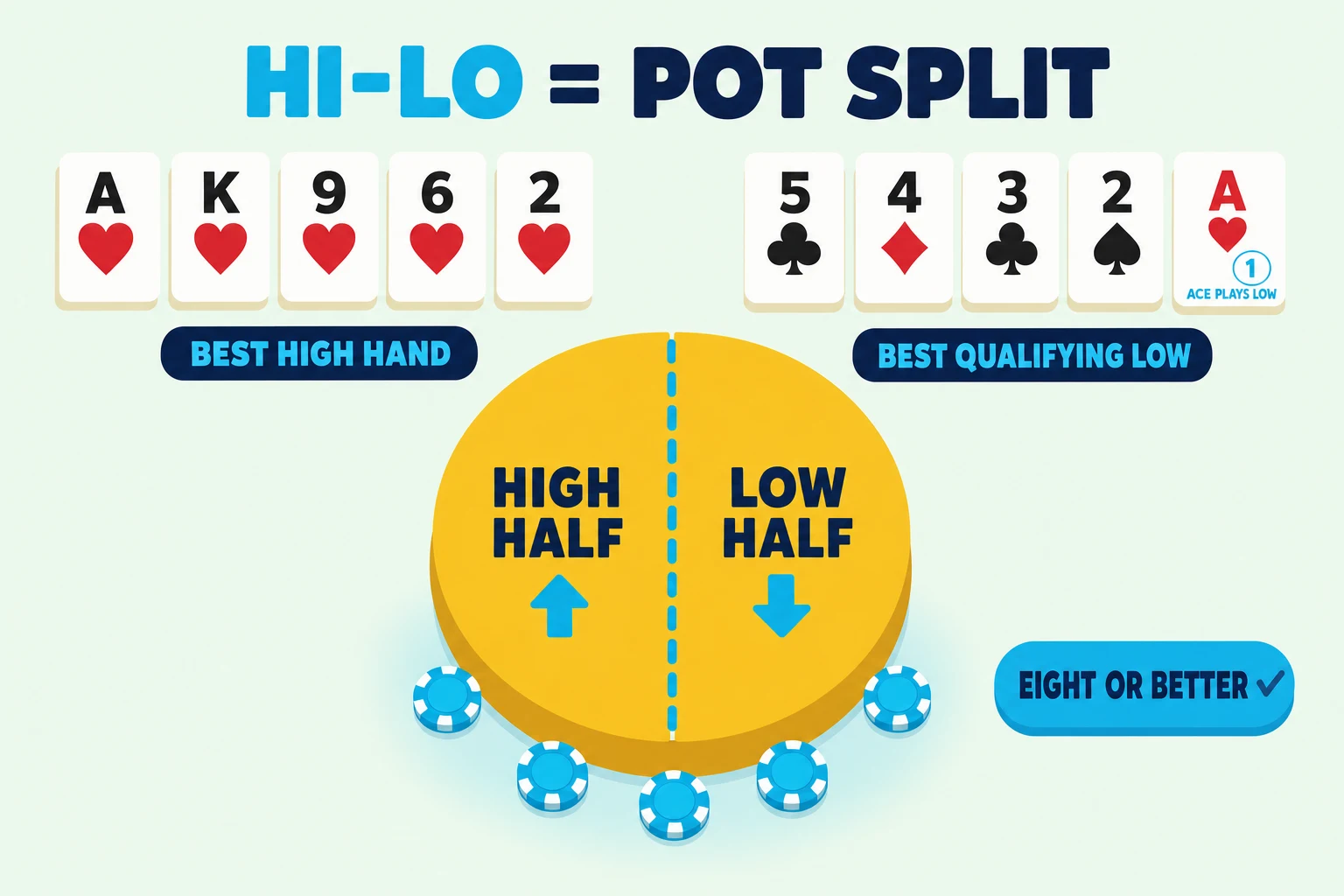
Related terms
- Low hand — the qualifying side of the split, including how to read one card by card.
- Wheel — the best possible low, A-2-3-4-5, which is also a five-high straight on the high side.
- Omaha — the four-card variant family; Omaha 8-or-better is the most common hi-lo game.
- Big O — the five-card Omaha cousin, almost always played hi-lo with the eight-or-better qualifier.
- Pot-Limit Omaha — the high-only Omaha sibling, useful contrast.
- Split pot — the underlying mechanic for dividing pots at showdown.
- Best five rule — the showdown construction rule each side of the split uses.
Hi-lo families: where you actually meet this format
Hi-lo is most commonly the eight-or-better split, but the layer it sits on changes which hands matter and how often the low even qualifies.
| Game | Hole cards | Hand-construction rule | Low qualifier | Notes |
|---|---|---|---|---|
| Omaha 8-or-better | 4 | Use exactly 2 hole cards + 3 board cards (separately for high and low) | 8-or-better | The default modern hi-lo. Often abbreviated O8 or PLO8 in pot-limit. |
| Big O | 5 | Use exactly 2 hole cards + 3 board cards | 8-or-better | Five-card Omaha cousin; equities run very close, multi-way pots are the default. |
| Stud 8-or-better | Up to 7 | Best 5 of your 7 (no community cards) | 8-or-better | Quartered pots are far less common than in Omaha 8. |
| Razz | Up to 7 | Best 5 low of your 7 | None | A relative, not a hi-lo: razz is low-only, the entire pot goes to the lowest hand. |
Because the same two cards can play for both halves, a hand like A-2 with a suited high partner is structurally valuable in any of these formats: the A-2 anchors the nut low, and the suited high partner gives you a flush or top-pair line for the high. That same starting-hand logic does not transfer to high-only games like Pot-Limit Omaha.
When this matters most
Hi-lo matters when:
- You can scoop. Scooping means winning both halves of the pot with the same hand. Hands that aim at both sides (A-2 with suited Broadway, A-2-3 in Big O, low cards plus a flush draw) get to play for the whole pot, not just half.
- The board lets a low qualify. A flop like 3-4-7 brings the low half live; a flop like K-Q-9 kills the low half outright and turns the rest of the hand into a high-only contest. Whether the third low card arrives is the single biggest variable for whether the pot is split or scooped.
- The pot is multiway. Nut-low value goes up with multiple opponents because more players means more dead money chasing one half of the pot. Weak lows do the opposite: drawing to a non-nut low in a big multiway pot is a bankroll drain.
Texas Hold’em, the game Poker Skill is built for, has no low half: one high hand takes the pot, and only an exact tie splits it, which Poker Skill drills in its Winners & Splits lesson.
Hi-lo matters less when:
- The board cannot make a qualifying low. With three high cards on the flop and the turn missing, no low qualifies and the entire pot goes to the high.
- The game is heads-up. Quartered pots are nearly impossible heads-up, so the strategic concern shrinks. Scoop and lose are the main outcomes.
Example: how one pot gets divided
Omaha 8-or-better, six-handed, a $400 pot at the river. You hold the best low but a straight beats your high, so you collect $200 and the straight collects $200. If a second player also holds the same low, the two of you share the low half and collect $100 each while the straight still collects $200. That is the difference between winning half a pot and being quartered, and it is why the hands worth playing are the ones that can win both halves.
The worked reads behind that split, card by card, are in Omaha hi-lo rules and strategy.
Common mistakes
1) Chasing a low that does not actually qualify
A “low” that includes a pair, a card higher than an eight, or only four unmatched eight-or-below cards is not a qualifying low. Beginners look at A-2-5-7 in their hand on a 9-9-K board and think they have something — they do not. Memorize the rule: five unmatched cards, all eight or lower, ace plays low, straights and flushes are ignored.
2) Forgetting the no-qualifier sweep
When the board kills the low (three or more cards above an eight), the entire pot goes to the best high hand. Pot-control instinct from Hold’em pulls beginners into checking down with a marginal high on a high-only board. In hi-lo with no qualifier on the runout, that marginal high is the only thing playing. Bet it like the whole pot is at stake, because it is.
3) Drawing to the second-nut low
The non-nut low gets quartered, dominated, or beaten outright far more often than its raw probability suggests. The book line is direct: in big multiway pots, draw to the nuts on at least one side. A 7-low draw in a six-way pot is mostly a way to put money in for someone else’s nut low.
4) Playing one-way hands
Hands that can only win the high half (or only the low half) are structurally penalized in hi-lo. The high-only hand gets chopped down by qualifying lows; the low-only hand caps at half the pot and is frequently quartered. Premium hi-lo hands are two-way: A-2 with a suited Broadway, A-2-3 in Big O, suited aces with low backup. They get to play for the whole pot.
FAQ
What is the difference between hi-lo and lowball poker?
Hi-lo splits the pot between the best high and the best qualifying low. Lowball games like razz or 2-7 triple draw award the entire pot to the best low hand: no high side, no qualifier, no split. Lowball is one-way; hi-lo is two-way. The shorthand “hi-lo” always implies a split-pot format.
Why is the wheel the best low instead of the worst hand?
Because for low-hand purposes the ace plays low and straights and flushes do not count against the hand. The cards 5-4-3-2-A are five unmatched cards all eight or lower, with the lowest possible top card (a five). Reading low hands top-down, the lowest top card wins, and 5 beats every other top card a qualifying low can have. The same five cards also make a five-high straight on the high side — which is why the wheel is famous: it can scoop in hi-lo, taking both halves with one hand.
What does it mean to be quartered?
You are quartered when you split half the pot with another player who has the same value hand on that side, leaving you with one quarter of the total. In Omaha 8-or-better this is a low-side phenomenon — two players holding A-2 will routinely split the low while a third player wins the high. Getting quartered turns a winning showdown into a money-leak: you put money in expecting half and collect a quarter, with the remaining three quarters going elsewhere.