


Removal Effect
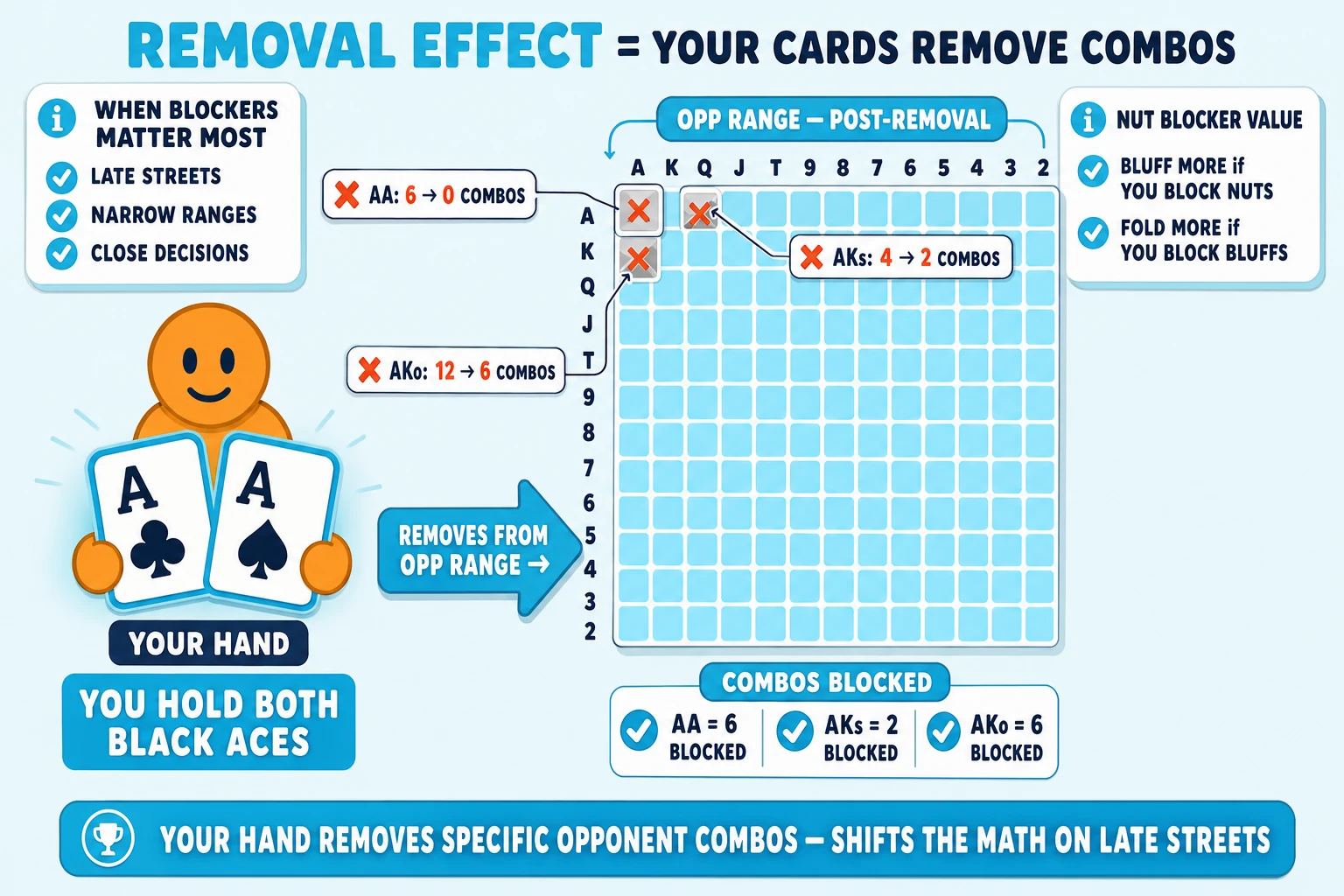
The removal effect, or card removal, means your hole cards and board cards reduce opponent hand combinations. A blocker is any card in your hand that removes combinations from the opponent's range. For example, holding the Ace of clubs blocks some club-flush combos that include that Ace. Use blockers when estimating how often an opponent holds a specific value hand or a bluff.
Practice this in Poker Skill. The Nut Flushes & Monotone Boards lesson covers the first step of the ace-of-clubs example, where holding the ace of the suit is what makes a flush draw the nut one.
Get the free appRemoval Effect in No-Limit Texas Hold’em
What the removal effect is
The removal effect, or card removal, means your hole cards and board cards reduce opponent hand combinations. A blocker is any card in your hand that removes combinations from the opponent’s range. For example, holding the Ace of clubs blocks some club-flush combos that include that Ace. Use blockers when estimating how often an opponent holds a specific value hand or a bluff.
(Note: “range” means the set of hands an opponent might reasonably hold; “nut” means the best possible hand in the situation, for example the nut flush.)
Why the removal effect matters most on later streets
Removal effects grow as the hand progresses because betting narrows ranges. Early streets leave many possible holdings, so removing a few combos has limited impact. On the river, opponents’ ranges shrink and each combination carries more weight. Late-street decisions often hinge on small probability shifts, so a single blocker can flip a profitable bluff into a losing one, or vice versa.
How blockers influence bluffing and bluff-catching decisions
Blockers change both the math and the read on your opponent.
- Bluffing: Holding a card that blocks your opponent’s nut (for example, the Ace of the flush suit on a flush-complete river) reduces their top-value combos. That reduction makes some bluffs more attractive because fewer hands can call with the nuts.
- Bluff-catching: If your hand blocks many of the opponent’s likely bluffs, fold marginal hands more often. For example, if your cards remove many two-card combos that represent missed draws, the opponent is less likely to be bluffing.
Blocker effects matter most when you are near indifference between two options. Small shifts from blockers can justify different lines.
Using solvers and GTO thinking with removal effects
Modern solvers and GTO thinking already account for card removal when calculating optimal bet, bluff, and call frequencies. Solver outputs implicitly reflect which hole cards are held and how those cards change combination counts. Study solver patterns to see how blockers shift polarization and frequency on later streets. Then adapt those patterns to exploit live opponents who deviate from GTO, for example bluffing more when they fold too often even if blockers only slightly help.
Practical examples and simple heuristics to apply now
- Example: You hold A♣ on a river that completes a club flush. Because you block many nut-club combos, a river bluff becomes more attractive versus opponents who often bet missed draws.
- Example: Facing a river jam while holding a card that blocks the opponent’s likely value hands can convert a marginal call into a fold.
Simple heuristics:
- The narrower the opponent’s perceived range and the later the street, the more weight you should give blockers.
- Prioritize nut blockers, cards that remove the opponent’s best possible hands, when deciding to bluff or call.
- If a decision is close, explicitly count whether your cards remove a substantial portion of the opponent’s value or bluff combos.
Quick checklist
- Before key turn and river decisions, scan your hand for obvious blockers (aces, high suited cards, pairs that remove sets).
- Ask how many opponent combinations your cards remove. If the reduction is large, adjust your play.
- Give extra weight to blockers against tight ranges and in heads-up late-street spots.
- Practice with solver outputs to learn blocker-based frequency patterns, then exploit real opponents who deviate.