


Set-Mining
A speculative preflop call with a small pocket pair, hoping to flop three-of-a-kind. Profitable only when stack depth gives roughly 10:1 implied odds.
Practice this in Poker Skill. When the third seven lands on a 7♥ 4♠ 2♦ flop, the Value Betting lesson has you bet 7♦ 7♣ into the worse pairs and ace-high hands that can still pay off a set.
Get the free appSet-mining: calling small pocket pairs to flop a set
What set-mining means
Set-mining is the act of calling a preflop raise with a small or medium pocket pair almost entirely so you can flop a set, three-of-a-kind built from your two pocket cards plus one matching board card. The pocket pair itself is rarely strong enough to win a big pot at showdown, so the strategy depends on hitting the set and getting paid. You will only flop a set about one time in eight and a half (roughly 12 percent), so the rest of the time you fold the flop cheaply and move on. The math only works when the chips you can win on the times you do hit are large enough to cover all the times you miss.
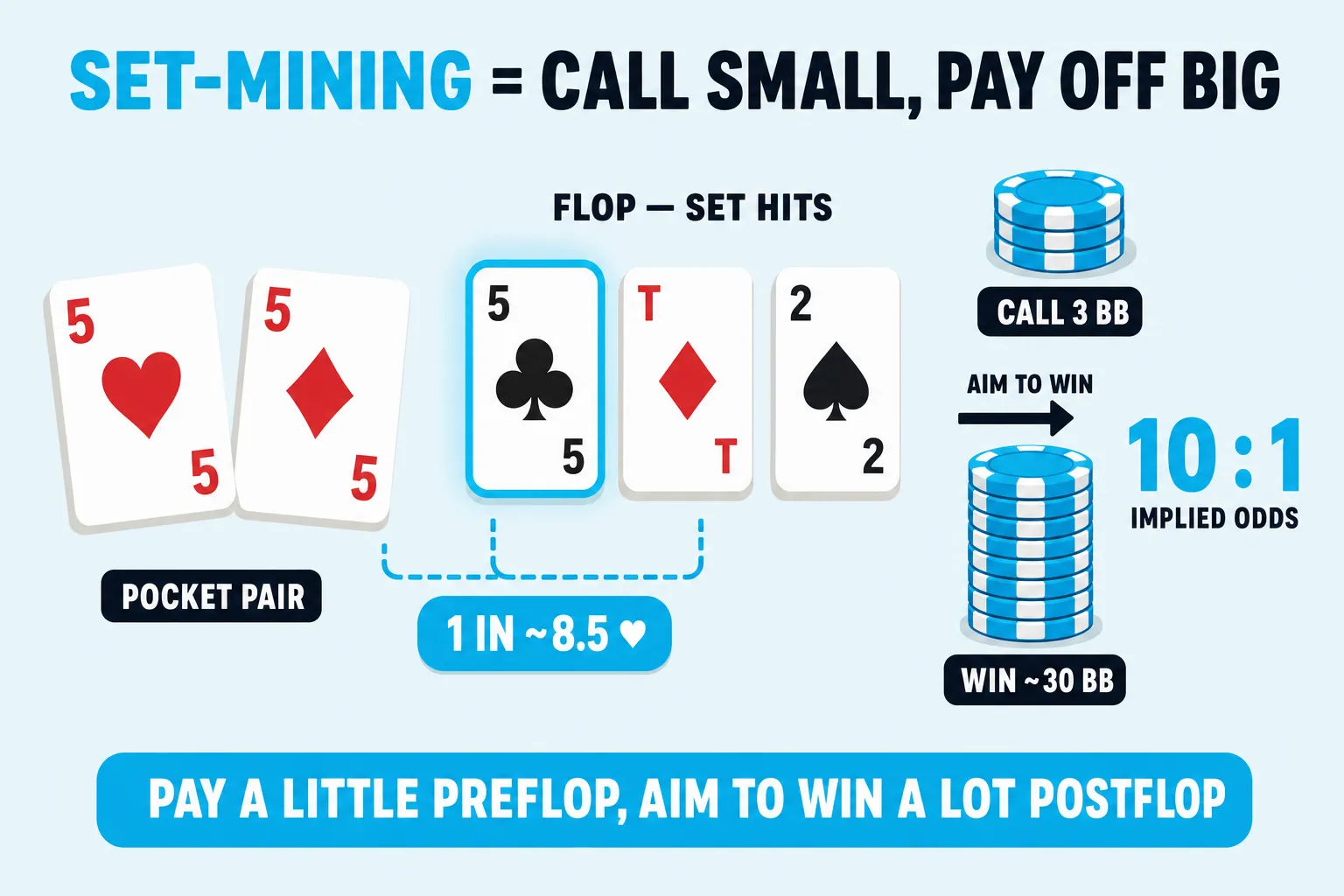
That single sentence frames every set-mining decision: you are paying a small price now for the chance at a big payout later. Set-mining is a cold call shaped by implied odds, not a value call with a hand that already has equity. Treat it as a speculative line, not a default move with every small pair.
Related terms
- Implied odds - the future-streets math that makes set-mining profitable.
- Set - the made hand the strategy targets.
- Effective stack - the depth that gates whether the call is correct.
- Reverse implied odds - the cost when you flop an underpair instead.
- Cold call - the preflop action that set-mining belongs to.
- Multiway pot - the spot small pairs gain extra implied value.
Set-mining versus a normal preflop call
Both lines call a preflop raise, but the reasons are different. A set-mining call relies on improving on the flop; a normal value call continues with a pocket pair that is already strong enough to fight for the pot.
| Line | Why you call | Hand strength now | Plan if you miss the flop |
|---|---|---|---|
| Set-mining call (3-3 to 8-8) | Hope to flop a set, win a big pot | Marginal, about a coin flip against two overcards | Check-fold the flop, lose the minimum |
| Value call (T-T to A-A range) | Hand is already strong | Strong overpair on most flops | Continue, often bet for value |
| Squeeze raise instead | Punish the open and a caller, deny equity | Mixed; folds out small pairs from villains | Plan a c-bet on most flops |
The line on the right matters most: a value caller plans to keep playing the hand, while a set-miner plans to give up cheaply when the flop comes A-K-7 and they hold 5-5. If you find yourself bluff-catching with an unimproved small pair on a wet flop, you have stopped set-mining and started losing money.
When set-mining works (and when it does not)
Set-mining is a math-driven call, so the spot has to give you the math. The rough rule of thumb from cash-game material: aim to win about ten times your call when you flop the set, counting both the current pot and the chips you expect to extract on later streets. A 3bb call wants something like 30bb back when the set comes.
Spots where the call is reasonable:
- Effective stacks of about 100bb or deeper. Deeper stacks raise implied odds; you can stack an opponent who has top pair or an overpair when your set hits.
- In position against a single raiser. Acting last makes it easier to extract value and easier to fold cheaply when you miss.
- Loose, paying opponents. A villain who calls big bets with one-pair hands is the type who pays off your set.
Spots where set-mining stops working:
- Short or medium effective stacks. At 50bb or less the implied odds usually do not cover the misses; at tournament stacks below 25bb, set-mining is almost always a fold. At 20bb deep, a 3bb call against an open can win about 22bb even when the set takes every chip, short of the 30bb target.
- Out of position. When you miss, you face hard turn and river decisions with an unimproved small pair, and you also leak value when you do hit and have to lead into the raiser.
- Tables with frequent squeezing. If a third player keeps re-raising behind you, your small pair gets blown off the hand before it can ever flop a set.
Example: 5-5 facing a 3-bet at 100bb
You hold 5♠ 5♦ on the button. The cutoff opens to 3bb, you call, and the big blind 3-bets to 11bb. Action folds back to you. Effective stacks are 100bb. The pot before your decision sits at 17.5bb (the cutoff folds), and you face an 8bb call to continue.
Run the implied-odds rule: 8bb to call, target about 10x return on a successful set, so you want to win roughly 80bb across the rest of the hand. The pot already gives you about 15bb of dead money. You still need around 65bb more from the 3-bettor’s stack on the flop, turn, and river when you hit.
Behind you sit 89bb. The 3-bettor’s range is heavy on overpairs and big aces, the exact hands that pay off a flopped set on a board like 5♥ T♦ 2♠. The math fits: in position, deep enough, against a range that pays you off, with a flop-fold plan when you miss. This is a clean set-mining call.
Now flatten the stack. Same spot, same line, but effective stacks are 35bb. Now you are 8bb to call with only 24bb behind. Even if you hit, the most you can win is the dead pot plus 24bb - well under the 80bb target. The call is no longer set-mining; it is closer to setting fire to chips with a non-premium hand. Fold.
Common mistakes
1) Paying too much preflop
Small pairs want a cheap flop. Calling a 4-bet, or stacking off preflop with 3-3, treats the hand like a premium when it is a speculative draw. If the price exceeds about a tenth of the effective stack, the implied odds rarely cover the call.
2) Set-mining out of position
Out of position you face two leaks at once: harder fold-cheap-on-misses (you act first), and harder value-extraction when you do flop the set (the raiser can check back and freeze the pot). A blind call with 4-4 against an early-position raise is one of the most common money-losing spots small-stakes players post.
3) Ignoring reverse implied odds
A small pair that misses the flop is not just a fold-to-pressure hand; it is a reverse implied odds hand. You will sometimes flop an underpair that bluff-catches a range you are crushed against, or a second pair that costs you another bet to find out you were behind. Those costs eat into the times you do flop a set.
4) Forgetting that a flopped set is not the nuts
Sets get coolered by higher sets and by completed straights and flushes. On boards like J♠ 9♠ 8♣, your flopped 8s are exposed to every made straight, every two-pair, and every flush draw. So bet or raise while the set is likely best and make the draws pay for their cards, then slow down if the turn or river brings the straight or flush the board was promising.
5) Set-mining at a squeezing table
When a third player keeps re-raising behind, your set-mining flat becomes a charity stop. You either fold and waste the price, or call into a much larger pot with a small pair that is now getting bad direct odds and worse implied odds.
FAQ
How often does a pocket pair flop a set?
About one time in eight and a half, or roughly 12 percent of flops. The other 88 percent of the time, the small pair misses, which is why set-mining only pays when the times you hit are big enough to cover all the times you miss.
What stack depth do I need to set-mine profitably?
The standard cash-game rule of thumb is about 10:1 implied odds on your call - if you put in 3bb to call, you want to win something like 30bb when you hit. That usually requires effective stacks of about 100bb or deeper, against an opponent who will pay you off. At 50bb the math is shaky; below 25bb it almost never works.
Should I always set-mine with small pocket pairs?
No. Set-mining is one option among several. In many 6-max spots, especially in position against a wide opener, raising or 3-betting a small pair plays better than calling for sets. Save the set-mine for deep-stack spots in position against an opponent who pays off big when your set arrives. Poker Skill shows the split on the button behind one limper: pocket nines raise to take the initiative, and pocket fours call to see a cheap flop.