


Bankroll management
Bankroll management is the discipline of keeping poker money separate from living expenses and large enough to absorb normal swings. It decides which stakes you can play.

Practice this in Poker Skill. While your bankroll rebuilds at a lower stake, its lessons and Practice vs AI, where you play full hands against AI opponents, let you keep working on decisions with no real money and no chips to buy.
Get the free appBankroll management: how poker money survives variance
What bankroll management is and why it matters
Bankroll management is the discipline of treating your poker money as money set aside only for poker, sized so it can absorb the normal swings of the game. It is the cushion that lets you keep playing the cash games or tournaments where you actually have an edge, instead of being knocked out of action by a normal losing stretch. Rent, gas money and the holiday fund stay out of the roll.
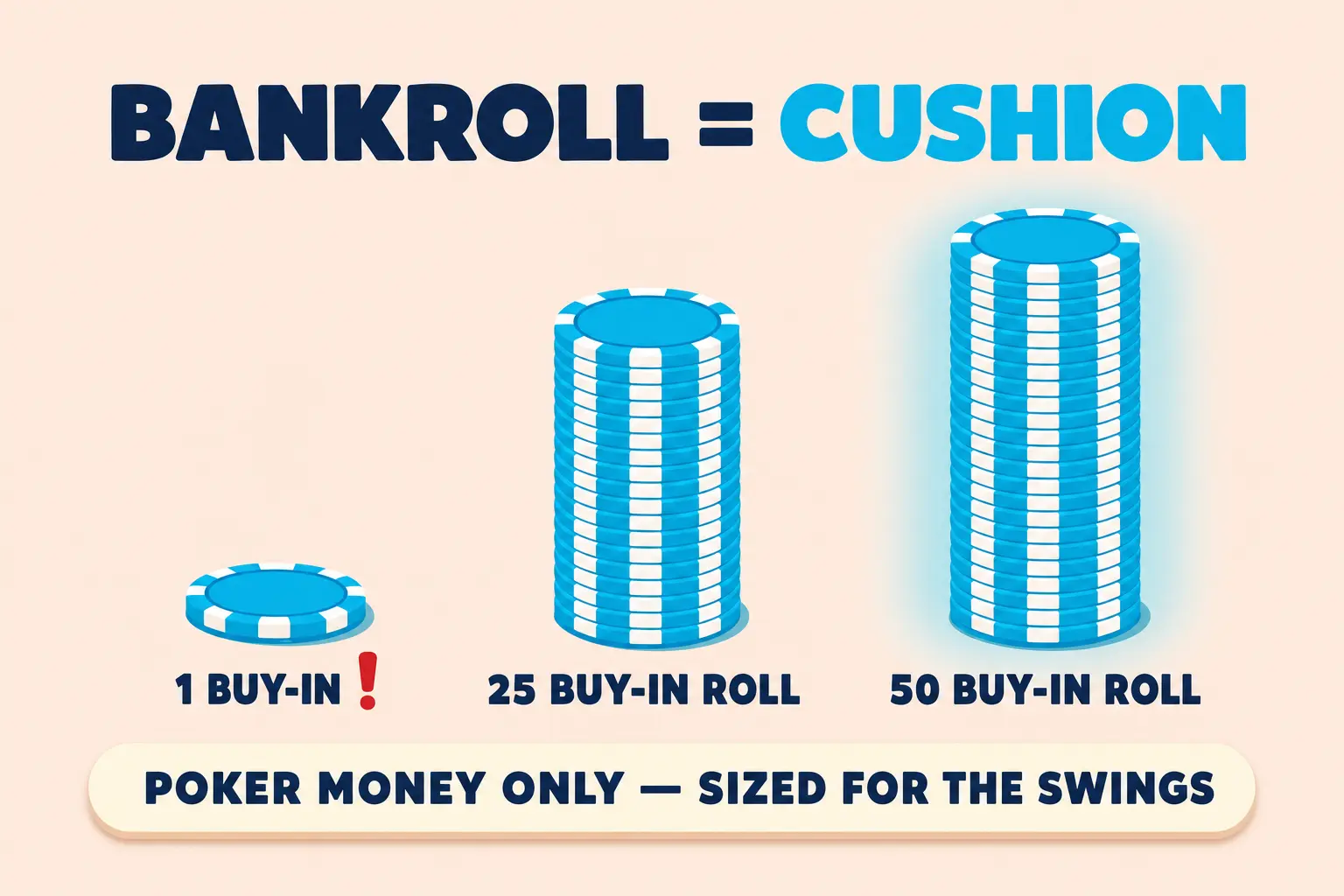
The mental shortcut: if a single ugly week could end your poker, the roll is too small for the game you are playing. Move down, rebuild and stop forcing action with money that cannot survive variance.
Moving down in time means knowing what the roll holds after every session, so record each one. We recommend Poker Stack, a bankroll tracker for iPhone and iPad: you log each session’s stake, buy-ins and cash-out, take tips and travel off the result, then see how your roll has moved.
Related terms
Bankroll size by game type
Different games hand you different swings. A cash player who never reloads has a smoother curve than a tournament player in events that pay only about the top 10 to 18% of the field. Match the cushion to the game.
| Game type | Buy-ins to keep | Why that number | Where it can flex |
|---|---|---|---|
| NLHE cash, beating the game | 30 | Enough for a solid winner, with a move down a stake once the roll halves | Lower if you have an outside income; higher if poker is your only income |
| NLHE cash, thin edge | More than 30 | Smaller win rate means variance dominates longer | Drop to 30 only after a real, sample-size-honest win-rate read |
| Single-table tournaments / SNGs | 100 | Short fields and steep payouts produce frequent dry stretches | Lower for live-only with strong ROI; higher if you bullet hard |
| Multi-table tournaments | 300+ | Only about the top 10 to 18% of a field gets paid, so months can pass between scores | Higher for bigger fields and for full-time play |
The numbers are starting points, not laws. The right roll for any given player is whatever survives that player’s worst realistic downswing with enough buy-ins left to keep playing the same stake without flinching.
When bankroll management matters most
It matters most when the roll is the only thing standing between you and stopping the game:
- Moving up in stakes. New games, new players, new variance. A roll that handled the old level may not handle the new one until you have enough hands at the higher stake to know your real win rate there.
- After a downswing. This is when most players violate their own rules, chasing losses by sitting bigger games or by widening into spots they would normally pass on. The discipline that mattered before the downswing matters double after.
- Before a tournament series. Series buy-ins stack up; reserve the full series cost in advance, including rebuys, and treat that number as the real cost, instead of a single event’s buy-in.
- When grinding micro stakes. Rake is a much bigger share of the pot at small numbers, so the effective edge is thinner and the roll has to be proportionally bigger to survive the same swings.
It can flex when poker is a hobby, you have a steady non-poker income and the bankroll is a fixed allocation rather than your livelihood. A part-time small-stakes player who can reload from a paycheck has a different math than a full-time grinder. Both still respect the floor for the stake they sit; the difference is what happens when the floor is breached.
Example: a 25NL cash-game roll
Suppose you play $25 NL online, full buy-in $25, and you want to know what cushion to keep.
A 20-buy-in roll is $500, and it is the kind of roll that will not survive a normal downswing. A winning $25 NL player can lose 15 buy-ins or more running below expectation; a 20-buy-in roll after that is $125, which is below the floor for the next stake down.
A 30-buy-in roll is $750, the floor. A 15-buy-in downswing leaves $375, half the roll, which is the point to move down a stake and rebuild.
A 50-buy-in roll is $1,250. The same 15-buy-in downswing leaves $875, which is 35 buy-ins remaining. That player can keep grinding the same game without thinking about money during the next session.
If the roll drops to $250 (10 buy-ins, the kind of nominal cushion most beginners actually carry), the move is to drop to $10 NL (or whatever the next stake down is at the room), rebuild to a real 30-buy-in floor at the lower level, then take shots back up. Forcing $25 NL with a 10-buy-in roll is the most common way bankroll management quietly fails: one bad session and the player either reloads from non-poker money or stops playing entirely.
The math is small at this stake, but the discipline is the same at every stake. Moving up to $50 NL at a 30-buy-in floor is $1,500. $100 NL is $3,000. $200 NL is $6,000. That ladder is what bankroll management actually looks like in practice.
Common mistakes
1) Rolling on win rate alone
A win rate is a number on a graph; the roll is what survives the variance around that number. Two players with the same $10,000 roll and the same stake but different win rates do not need the same cushion. The thinner the edge, the bigger the roll has to be: small win rates mean variance dominates results for tens of thousands of hands. Roll for the win rate you actually have, not the one you think you have. You learn that win rate by keeping a record of every session, and your estimate gets more accurate the more you play.
2) Treating the roll as spending money
The bankroll is not an ATM. The first time poker money pays for groceries, the roll turns into a slush fund that variance will drain. Keep poker money in a separate account, in a separate envelope, in a separate anything. The point of separation is to make the bankroll’s number an honest one.
3) Moving up at 20 buy-ins after a heater
Running good for a week is not a win-rate read. Players who climb the stakes ladder on a 20-buy-in roll right after a hot stretch are the players who fall back down on the next normal downswing. Move up only when the roll supports the move at the safer floor for the new stake, not the bare minimum for the old one.
4) Ignoring rake, tips and travel in the math
Rake is a real cost. So is tipping the dealer in live games, and so is the gas to and from the room. The bankroll has to cover everything you actually pay to play, buy-ins included. A live $1/$2 grinder paying around $10 an hour in rake, plus tips, is paying real money out of the roll every session, win or lose. Build that into the cushion or the cushion is fictional.
FAQ
How many buy-ins do I need for cash games?
A working answer is about 30 buy-ins for a clear winner, and more if poker is your only income or your edge is thin. Ten buy-ins or fewer is nowhere near a real bankroll for the stake. The right number for you depends on your true win rate and how much variance the game throws at you; a smaller edge always needs a bigger cushion.
Is the same number right for tournaments?
No. Tournaments pay only about the top 10 to 18% of the field, so the dry stretches are much longer. A common floor is 100 buy-ins for single-table tournaments and 300 or more for multi-table tournaments, and the number grows with field size. Variance is the reason for the gap, not paranoia.
What happens if my bankroll drops below the floor?
Move down. The whole point of a floor is to be honest about what stake the current roll supports. Keep playing the same game on a half-sized roll and one normal downswing ends your bankroll entirely. Drop a level, rebuild to a real floor at the lower stake and then take a controlled shot at the higher game once the cushion is real again.