


Rake-adjusted EV
Expected value of a poker decision after the cardroom rake comes off the top of the pot. Net EV is the number that pays the bills; gross EV is the number that fools you.
Rake-adjusted EV in NLHE cash
What rake-adjusted EV means
Rake-adjusted EV is the expected value of a poker action after the cardroom rake comes off the top of the pot you would actually win. It is the same long-run scoreboard as plain expected value, with one correction: the prize side of the equation is the net pot, not the gross pot. In a cash game, the room takes its fee out of every raked pot before it pays the winner, so the EV that lives on your bankroll is the rake-adjusted number, not the chip-stack number you see on the table.
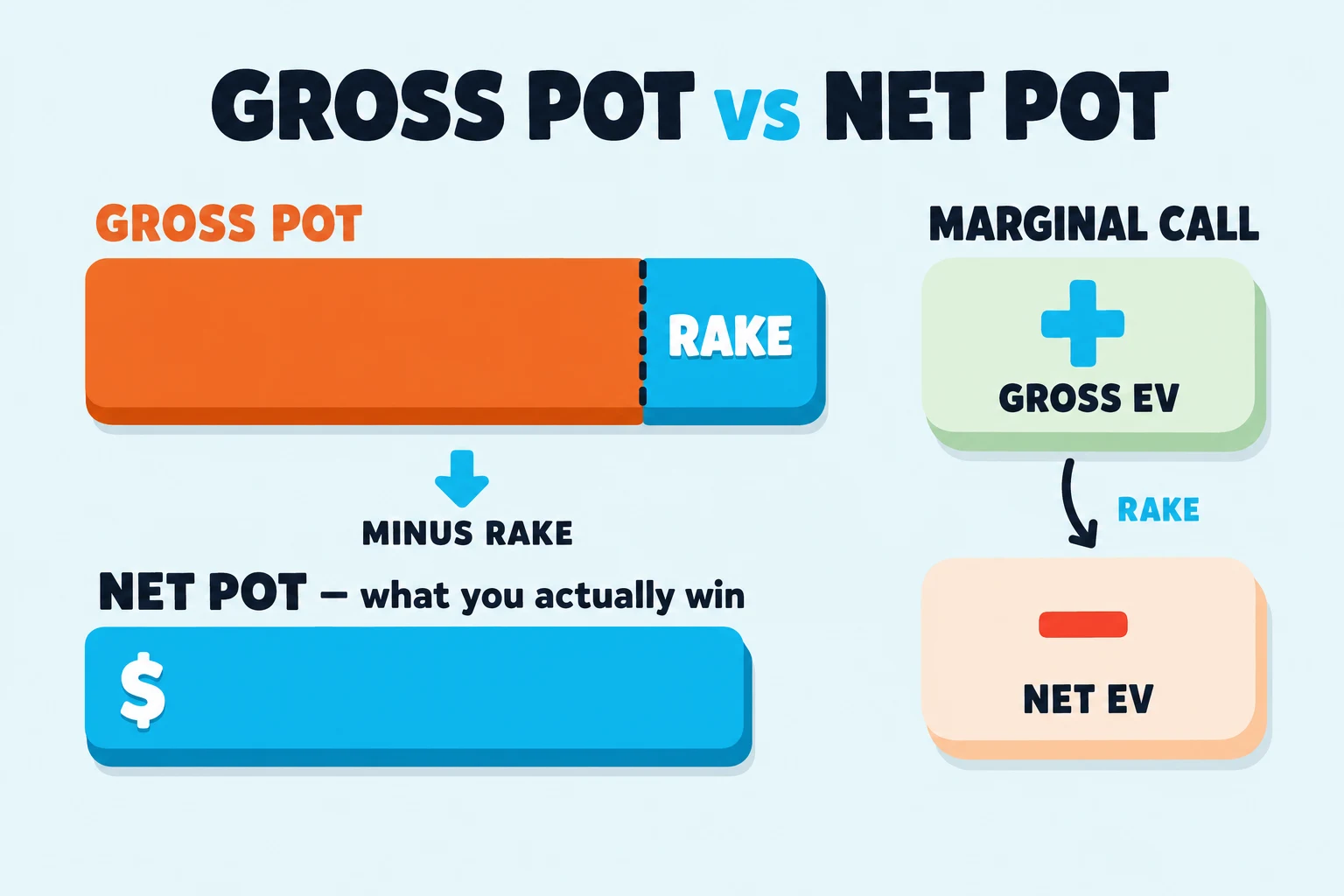
A simple way to hold the idea:
- Gross EV uses the pot you can see.
- Net EV uses the pot you actually take home.
- The gap is the rake share, and it can flip a marginal +EV call into a -EV one without anything else changing.
Related terms
- Rake: the house fee that creates the gross-vs-net gap in the first place.
- Expected value: the long-run-average framework rake-adjusted EV is a corrected version of.
- Expected value (EV): sister entry framing EV as the action-by-action long-run scoreboard.
- Pot odds: the immediate price to call, computed against the net pot in raked games.
- Break-even equity: the equity bar that rises once the rake comes off the top.
- Implied odds: the future-money concept rake also taxes when the future pot is raked.
- Micro-stakes: the stakes where rake-adjusted EV reshapes ranges most.
- Value bet: the line where the gross-vs-net gap shows up first when sizing thinly.
Gross EV vs net EV
The plain EV equation a player learns first treats the pot as if every chip in it pays the winner. Rake-adjusted EV swaps the gross pot for the net pot anywhere the action you are evaluating ends in a raked showdown.
| Term | What it counts | When to use it |
|---|---|---|
| Gross EV | %win × gross pot − %lose × call | Tournaments, time-charge games, no-flop-no-drop pots that end pre-flop. |
| Rake share | The cardroom fee taken from the gross pot | Any cash-game pot that sees a flop in a raked room. |
| Net EV (rake-adjusted EV) | %win × (gross pot − rake) − %lose × call | Cash-game decisions that are likely to end in a raked showdown. |
The structural change is small: subtract the rake share from the prize side. The practical change is large, because most marginal poker decisions are decided by a few cents per hand, and a few cents per hand is exactly what the rake takes.
When rake-adjusted EV matters most
Net EV and gross EV diverge in predictable spots. The bigger the rake-to-pot ratio, the bigger the gap.
- Low-stakes cash games. A $4 or $5 cap is a meaningful share of the average pot at $1/$2 or $0.10/$0.25, so the rake-to-pot ratio at the cap is high. The same dollar fee at $5/$10 is a much smaller share of an average pot.
- Capped-percentage rooms. A 5% cut taken until a fixed dollar cap means small pots feel the percentage and big pots feel the cap. Rake-adjusted EV reshapes the small-pot decisions; the big-pot decisions barely move.
- Marginal calls. Any call that is barely +EV at gross-pot prices is the first to flip once the rake share is removed. Solver outputs in raked games show this directly: raising frequencies tend to rise, calling and limping frequencies tend to fall, and folding frequencies tend to rise.
- Thin value bets. A river bet that is barely thin-value at the gross-pot price stops being worth it once the net pot you collect is smaller than the gross pot you risked the bet to win.
- No-flop-no-drop dynamics. Most rooms take no rake on hands that end before a flop. Pots you take down pre-flop are paid 100% of the gross; pots you take down on the river are paid net of the cap. That gap is why rake-aware play tends to favor pre-flop aggression in heavily raked games.
- Time-charge games. A flat hourly seat fee is paid regardless of how many pots you play, so per-pot decisions in a time-charge game stay on gross EV. Rake-adjusted EV is a percentage-rake idea; do not import it into a time-charge game.
- Tournaments. Tournament fees are paid once at registration, not per pot. Inside the event, every decision is on gross EV. Rake-adjusted EV is a cash-game concept; tournament charts do not need the correction.
Worked example
A $1/$2 6-max live cash table runs 5% rake capped at $5. Hero is on the river with a bluffcatcher. The board is ♣K♠9♦4♣2♥7. Pot is $40 going to the river. Villain bets $30. Hero is reading villain as having a polarized range — strong made hands or pure bluffs.
- Hero estimates villain bluffs 31% of the time. To call profitably on gross-pot math alone, villain would need to bluff at least 30/100 = 30% of the time.
- Gross EV of the call: 0.31 × $70 − 0.69 × $30 = $21.70 − $20.70 = +$1.00.
Looks like a small +EV bluffcatch. Now apply the rake.
- The pot at showdown if hero calls is $40 + $30 + $30 = $100. 5% of $100 is $5, which hits the cap. Rake = $5.
- The net pot hero collects on a win is $70 − $5 = $65.
- Net EV (rake-adjusted EV): 0.31 × $65 − 0.69 × $30 = $20.15 − $20.70 = −$0.55.
Same hand, same read, same opponent. The gross-pot framing said call. The rake-adjusted framing says fold. Run the same call a thousand times in a session and the gap is the difference between sliding chips your way and sliding chips toward the rake box.
The shape generalizes. When gross EV is small and positive, rake will often flip it. When gross EV is large and positive, rake shrinks the win but does not change the decision. When gross EV is negative, rake makes a bad call worse, never better.
Common mistakes
1) Treating gross-pot pot odds as if they were net
The most common rake-adjusted EV leak is computing pot odds against the gross pot and stopping there. The price you are getting in a raked game is the price after the rake comes out. Marginal calls that look fine on the gross number can fail the net-pot test by a few percent of equity, which is enough to lose money over thousands of repetitions.
2) Importing tournament charts into a raked cash game
Tournament fees are paid up front at registration, so in-game tournament EV is gross EV. Cash-game rake is paid per pot, so cash EV is net EV. A solver chart built without rake will limp more, call more, and 3-bet less than the rake-adjusted version of the same spot. Using a no-rake chart at $1/$2 quietly drifts the player into too many small pots that are exactly the pots the rake hurts most.
3) Open-limping for cheap flops in heavily raked games
A limp is a soft entry into a small multiway pot, which is the worst possible matchup for rake-adjusted EV. The pots tend to be small, capped percentage rake takes a larger share of small pots, and the marginal hands that limp tend to win a smaller fraction of the time than the strong hands that raise. Tight, position-aware preflop play earns a quiet bonus in raked games: it shifts you toward fewer, bigger pots, and bigger pots get a smaller share taken at the cap.
4) Forgetting that no-flop-no-drop is a free option
If the pot ends pre-flop, no rake is taken in most rooms. That makes the EV of pre-flop fold-equity moves higher than the same move computed with a flat rake assumption. A successful steal is paid 100% of the gross pot; a successful river bluffcatch is paid net of the cap. Rake-adjusted EV recommends shifting volume toward the pre-flop path when the rake structure rewards it.
Poker Skill takes no rake, since nothing in it is played for money, but its Squeeze Play lesson drills the preflop pressure this favors, a 3-bet that wins the raise and the call already in the pot.
FAQ
What is rake-adjusted EV in plain English?
Rake-adjusted EV is the long-run average money a decision wins or loses after the cardroom takes its fee. The plain EV formula treats the pot you might win as if you keep all of it; rake-adjusted EV treats the pot you might win as the gross pot minus the rake. In a cash game, the rake-adjusted number is the one that lands on your bankroll.
How much does rake change EV at low stakes?
Enough to flip the decision on close calls. A 5% capped percentage rake takes a small share of a big pot but a larger share of a small pot, which is exactly the asymmetry that hurts low-stakes calls and value bets. Solver outputs in heavily raked games shift toward more raising, less limping, and a little more folding compared with the same spot solved without rake. The size of the shift grows with the rake-to-pot ratio.
Do solvers compute rake-adjusted EV directly?
Modern solvers can. They take the rake structure as an input — usually a percentage and a cap — and produce range and frequency outputs that already net out the fee on every pot that reaches a flop. Rake-adjusted solver outputs are the closest thing to a baseline strategy for raked cash games. Charts that ignore rake are approximations of the same spot in a free-to-play world.