


Rake awareness
The habit of treating the house fee as part of every cash-game decision. Rake-aware play tightens preflop ranges, drops marginal calls, and prefers lower-rake games.
Rake awareness in NLHE cash
What rake awareness is
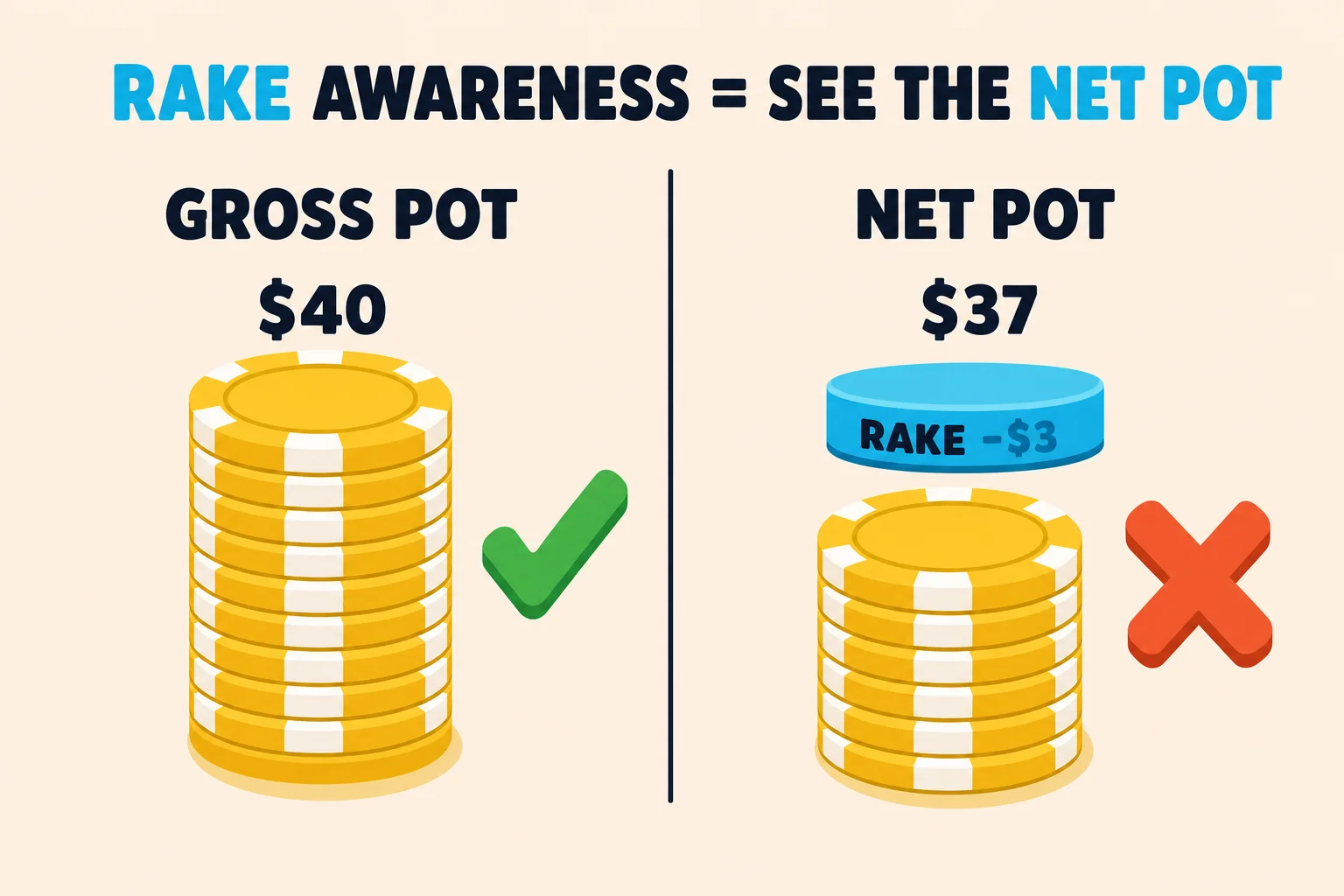
Rake awareness is the habit of treating the rake as part of every cash-game decision instead of an invisible tax that happens after the hand. A rake-aware player asks what the rake structure is before sitting, watches how much of each pot the room actually keeps, and lets that number bend their preflop ranges, their marginal calls, and the games they choose to play in the first place. The same skill that makes a fold tighter or a call tighter at heavy rake is what makes a player at lower rake feel free to widen back out.
Related terms
- Rake: the underlying fee being recognized; this entry is the skill of accounting for it.
- Pot: the gross figure on the table; rake gets removed before the winner is paid.
- Pot odds: the call-math that quietly shifts when the net pot shrinks below the gross.
- Expected value: the long-run scoreboard rake bends in cash games.
- Expected value (EV): sister entry framing EV as the action-by-action long-run scoreboard.
- Cash game: the format where rake awareness pays off; tournaments charge their fee up front.
- Small stakes: the band where the rake-to-pot ratio bites hardest.
- Preflop: the street where no-flop-no-drop changes which lines pay rake at all.
Rake awareness vs. just knowing the rake
Knowing the rake is reading the placard on the table. Rake awareness is changing your behavior because of what it says.
| Just knowing the rake | Rake awareness | |
|---|---|---|
| Reads the placard | Yes | Yes |
| Asks the dealer when the placard is missing | No | Yes |
| Treats marginal calls the same at all stakes | Yes | No, tightens at heavy rake |
| Picks the table with the lowest cap when both are open | No | Yes |
| Counts dealer tips and travel as part of the cost of playing | No | Yes |
| Adjusts preflop range to reduce small raked pots | No | Yes |
Both players are sitting in the same game. The rake-aware player loses fewer chips to the room across a year of sessions because the rake number is shaping every borderline decision instead of sitting in the back of their mind.
When rake awareness matters most
Some spots make the gross-vs-net gap matter more than others. The bigger the gap, the more the awareness pays off.
- Low-stakes cash games, live or online. A $4 or $5 cap is a meaningful slice of the average $40-$80 pot at $1/$2. The same cap at $5/$10 is a much smaller share of the same average pot. The rake-to-pot ratio shrinks as you move up; rake awareness matters most where it is biggest.
- Micro stakes online. A 5% rake on every flop pot grinds steadily against the small edges micro winners earn. Players who do not adjust their preflop frequencies often look like they are running cold when they are really paying the room what they would otherwise win.
- Marginal river bluff-catchers. A call that is barely +EV at the gross pot is often slightly -EV after the cap is taken. Thin made hands on the river are the most common spot rake quietly flips a decision.
- Small multiway pots. Limped multiway pots are exactly the shape of pot the cap takes the largest percentage of. They feel cheap to enter and quietly hand the room a bigger share than they hand any single player.
- Time-charge games at busy hours. A time charge does not scale with the pot, so the cost per hand depends on how many hands the table runs. A slow live game makes the time charge bigger per hand than a fast one.
Where it matters less: tournaments, where the fee is paid once before the cards come out and stops being a per-decision concern; high-stakes cash, where the cap is a small fraction of an average pot; and home games with no rake at all, where every chip in the pot pays out.
Example: a marginal call that flips after rake
You are on the river in a $1/$2 6-max cash game with a 10% rake capped at $3. The board is ♠T♦8♣4♥6♣2 and you hold ♠A♣J for ace-high with a missed gutshot. Villain bet the river $20 into a $20 pot. The pot before you decide is $40, your call is $20, and you estimate from prior streets that ace-high is good 26% of the time.
- Gross pot price. If you call and win, you collect the $40 in the middle. If you call and lose, you lose the $20 call. Gross EV: 0.26 × $40 - 0.74 × $20 = $10.40 - $14.80 = -$4.40 — already a fold without rake at this 26% estimate.
- Tighten the read. Now imagine villain over-bluffs slightly and your read is closer to 36% good. Gross EV: 0.36 × $40 - 0.64 × $20 = $14.40 - $12.80 = +$1.60. Net EV after a 10% cap-hit rake of $3: 0.36 × $37 - 0.64 × $20 = $13.32 - $12.80 = +$0.52. Still a thin call, but now barely above zero.
- One more click of pessimism. At a 32% read, gross EV: 0.32 × $40 - 0.64 × $20 = $12.80 - $12.80 = 0. Net EV: 0.32 × $37 - 0.64 × $20 = $11.84 - $12.80 = -$0.96.
A break-even gross-pot call is a small loser at the net-pot price. The dollar gap is small per hand and devastating across thousands of hands. Live $1/$2 grinders who run break-even before rake show losing graphs after rake for exactly this reason.
A second case shows the cap working in your favor. Same room, $1,000 pot at showdown. 10% of $1,000 is $100, but the cap kicks in at $3; you pay $3. The gross-vs-net gap is now 0.3% of the pot. The thin value bet you would never take in a $40 pot is back on the menu in a $1,000 pot, because rake stops scaling once the cap is reached.
Common mistakes
1) Treating rake as a fixed cost you cannot change
The rake the room takes is set by the room, but the amount you personally pay is set by how you play. Tighter preflop ranges win fewer raked pots; wider, looser ranges enter more small pots that the cap takes a bigger percentage of. Two players sitting at the same table with the same cards over a session pay very different total rake bills.
2) Refusing to drop marginal lines that flip after rake
The reflex to call “because the gross-pot odds say so” is the most common rake-blind habit. The pot odds the dealer’s chips show you are gross-pot odds. A rake-aware player adjusts the read by a sliver in heavily raked games and folds the closest cases that would have been thin breakevens.
3) Limping junk into raked pots and hoping to flop well
Open-limping with weak hands is already a marginal habit; in a raked game it is worse, because the small pots you tend to win after limping are the ones the cap takes the biggest percentage of. Tight, position-aware preflop play earns a quiet bonus in raked games. Books on small-stakes cash are direct about this: in heavily raked games, fold or raise more often, and limp far less.
Poker Skill plays for no money and takes no rake, yet its BTN vs Two Callers lesson teaches the cure for this habit, raising the hands worth a heads-up pot behind two limpers and folding the rest.
4) Counting only the rake the dealer drops
Live cash adds dealer tips and travel costs to the real bill. A $5/hour tipping habit in a $10/hour game cuts your take-home in half. A $20 gas round-trip to a $1/$2 session is a per-session cost the room never sees but you do. A complete picture of an hourly win rate counts gross winnings minus rake minus tips minus travel — not just the chips on the table at the end of the night.
FAQ
How do I find out the rake before I sit down?
Most live rooms post the structure on the table or on a small placard at the brush stand. Online rooms publish the structure on the cashier or rake-info page. If you cannot find it, ask the dealer or the floor — it is a normal question in a live cash game and they will tell you the percentage and the cap. Knowing whether the cap is $3, $5, or higher should change which game you sit in if more than one is open.
Does rake awareness mean I should play tight all the time?
Tighter than a no-rake baseline, yes, but not nit-tight. The size of the adjustment scales with the size of the rake. A 5% cap at $3 in a $1/$2 game asks for meaningful tightening; a 4% cap at $1 in a $5/$10 game barely moves the needle. Solver outputs comparing rake-on to rake-off cash games show the same direction of change everywhere — raise a little more often, limp a lot less, fold a little more often — but the size of the change depends on how heavy the rake is.
Why do tournaments not need rake awareness during play?
Tournaments charge the fee with the buy-in. Once you sit down, every chip in the pot stays in the pot, and no per-pot drop comes off the top. That structural difference shows up in solver ranges: rake-adjusted cash ranges are tighter and more aggressive than the same spots solved without rake, while tournament ranges resemble the rake-off baseline more closely. A rake-aware cash player walking into a tournament can loosen up a little; a tournament player moving to cash should expect to need the opposite adjustment.