


Coolered
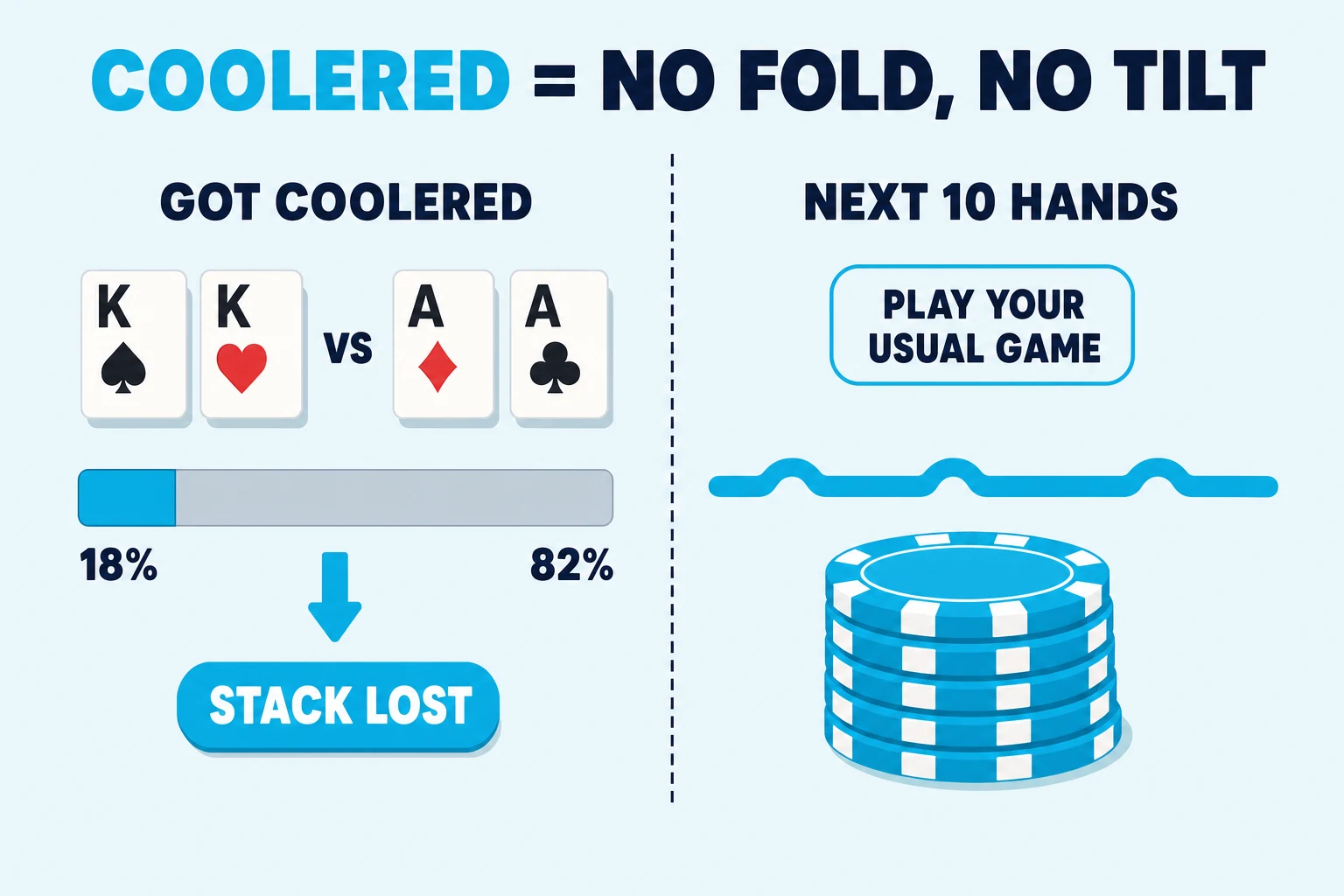
Coolered is the verb form of cooler. It means you lost a strong hand to a stronger one with no real fold available, and the next ten hands matter more than the cooler did.
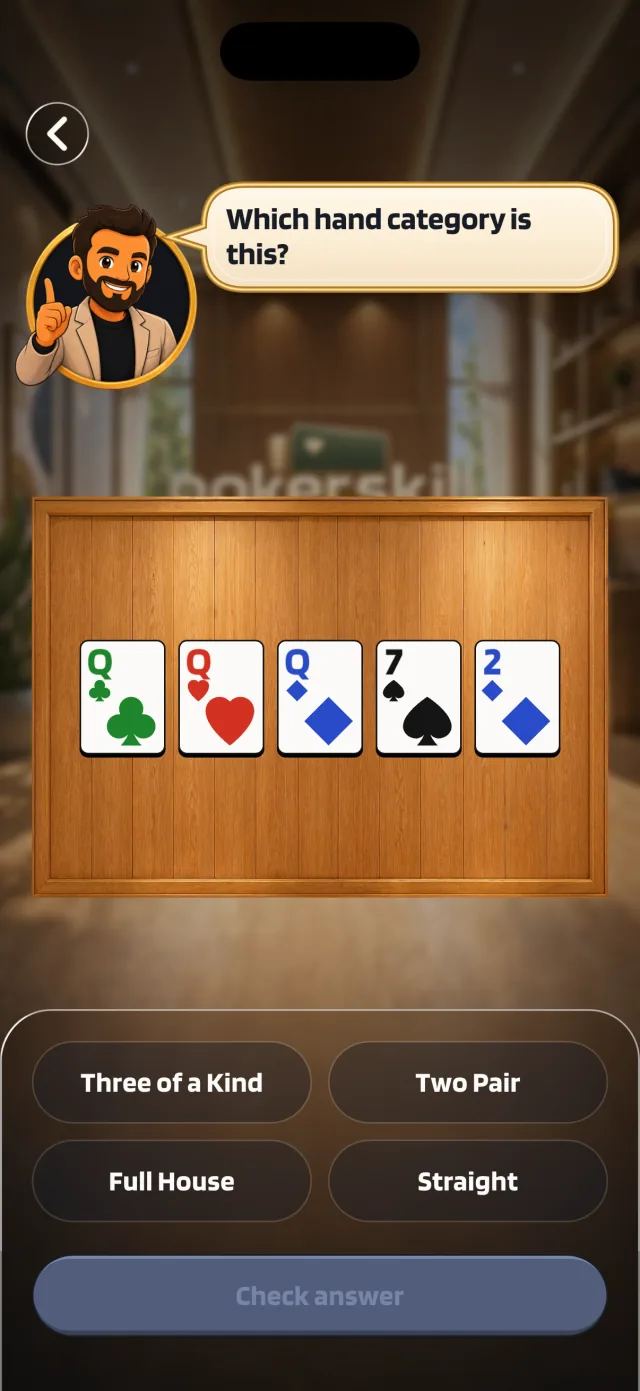
Practice this in Poker Skill. The turn lessons practice finding the fold a cooler never offers: Q♣ 8♣ lets a bet go on 10♥ K♠ 8♠ 3♠ since bottom pair with no spade can’t beat what bets there.
Get the free appCoolered (also “got coolered” / “cold-decked”)
What “coolered” means
Coolered is the verb form of cooler. To say “I got coolered” is to say you lost a strong hand to a stronger one and there was no real way to fold given the information you had. The decisions in the hand were defensible; the cards lined up badly. The label is past tense and situational, not a description of how you played. A player at 6-max NLHE cash is “coolered” when they were the loser in a strong-vs-stronger clash where folding was not on the table.
Related terms
A useful way to keep the verb honest:
- You got coolered = strong hand, even stronger villain, no fold given the line and the range.
- You got bad-beated = strong hand, you were ahead when chips went in, villain caught a long-shot draw to overtake.
- You overplayed = the loser thought they had a strong hand, but villain’s range had it crushed and a fold was available the whole time.
The face-up rerun test is the same one the cooler entry uses: would I make the same call against villain’s range, even if I knew I was beat in this single hand? If yes, you were coolered or bad-beated. If no, you overplayed. Saying “I got coolered” three times in a session and meaning all three is the long-run reality. Saying it ten times in one session usually means at least seven of them belong in a different bucket.
Coolered vs ran bad vs played bad
Same losing pot, three different labels. Picking the right one is most of what review work actually does.
| Label | What happened to the chips | Was a fold available? | Where the fix lives |
|---|---|---|---|
| Got coolered | Equity was already with villain when chips went in | No | Acceptance and bankroll |
| Ran bad | You were the favorite when chips went in; villain hit a long-shot | The call was correct | Acceptance and patience |
| Played bad | Your equity was never there; villain’s range had you crushed | Yes | Better hand reading and tighter stack-offs |
A coolered hand is rare and unavoidable. A bad beat is rare and unavoidable. An overplay is common and fixable. Spreading those three labels across the right hands is the work; flattening them all to “coolered” is the leak.
When you actually got coolered
The diagnostic the books point at is short: count the ways you can be beat. Walk back through the action street by street. List every reasonable hand in villain’s range given the line. Ask how many of those reasonable hands have you crushed.
You got coolered when:
- Villain’s line is consistent with a value hand that has you beat. A flop check-raise plus a turn jam from a tight player on a coordinated board is consistent with sets, two pair, and combo draws. If you stack off your overpair into that line, the range is doing what it usually does. The label fits.
- A fold gives up too much equity against the rest of the range. KK on a 9-high flop facing one bet from an unknown player is an easy continue because most of villain’s range is hands KK is ahead of. Folding KK there is a bigger leak than the AA combos that show up sometimes.
- The board did not turn your hand from “calling” to “stacking off.” Top set on a wet board collides with flopped straights at a known frequency. The set was always going broke against that line; the runout did not change the call.
You did not get coolered when:
- Villain’s line is too thin for the strength shown. A passive opponent suddenly check-jamming a paired river usually has the boat. Calling because “I had top two pair” and the result was a cooler is a misread, not bad luck.
- A fold was actually available. An overpair facing a flop check-raise plus a turn barrel on a connected board is a fold against most ranges, and calling because the hand felt strong is not a cooler. Stack depth is part of that fold; deeper stacks make one-pair holdings worse, not better.
- You were drawing thin and called for a turn or river miracle. That is a different kind of loss. Calling it a cooler skips the actual lesson, which is in the call.
The line between the three labels is range vs range, not result vs result.
What to do in the next ten hands
The most expensive part of a real cooler is usually not the cooler itself. It is the next ten hands, where the urge to win the chips back makes the tilt feedback loop louder than the strategy.
The book stance across multiple titles is consistent: do not change your style because you lost a pot. The next-session habit looks like this.
- Take one orbit before any non-standard line. Standard opens, standard 3-bets, standard postflop. The hand that just happened is over; the cards in the next hand do not know about it.
- Keep the same stack-off thresholds you walked in with. The cooler did not make villain’s range looser, even if the table feels different now.
- Read the opponents who saw the hand. Some will tighten up because they think you are now playing scared; some will widen because they think they can run you over. Adjust to what they do, not to what the cooler did to your stack.
- If a rebuy is a normal bankroll-and-table decision, take it. If it is the chips trying to make themselves whole, that is the moment to step away. The first kind of rebuy is part of cash; the second is variance tax with extra steps.
That is the whole post-cooler protocol. The pot is gone. The bankroll is the only thing that has to survive the session.
Example: the rerun test on KK vs AA
The canonical coolered hand at 100bb effective stack, 6-max NLHE cash. You opened K♠K♥ to 2.5bb from the cutoff. Button 3-bet to 8bb. You 4-bet to 22bb. Button jammed for 100bb. You called. Villain showed A♦A♣.
You got coolered. The diagnostic walks like this.
The line. A 5-bet jam from the button at 100bb is a tight range. AA, KK, and AKs are the body of it; an aggressive opponent might add a few bluff combos, a passive one will be almost pure value. KK is 18% against AA, ~80% against AKs, and a small favorite or near-coin against the bluff combos.
The math. Pot at the moment of the call is ~125bb (your 22 + their 100 + small blind dead money). You put in another 78bb to win 122bb. Break-even equity is 78 / (78 + 122) = 39%. Against the full jamming range, KK clears that bar comfortably; against the AA combos alone, KK is at 18%. The single-result EV against AA only is roughly (0.18 x 122bb) - (0.82 x 78bb), about -42bb. Across the full range it is positive.
The rerun test. If both hands were turned face-up before the runout, the call against AA alone is a clear chip-EV mistake. So why is this still a cooler?
Because the question at the table is not “what was the EV face-up?” It is “what was the EV against the range that 5-bet jams 100bb?” That range is heavy with AA, KK, and AKs. KK is calling against most of it and getting it in good against AKs. The number gets pulled down by the AA combos that show up roughly one in twenty-six times you hold KK. The call is correct against the range. Folding KK to the jam concedes too much money the times villain is not on AA.
You got coolered. The line was reasonable. The cards just sat where they sat. The next ten hands are where the actual session is decided.
Common mistakes after getting coolered
1) Using “coolered” as tilt cover
The label is almost free of moral content when it is honest. It earns weight when the hand really was strong-vs-stronger with no fold. It loses weight when it gets stretched to cover overplays, misreads, and bad calls. A reader who hears themselves say “coolered” three times in one session should run the rerun test on each hand before letting the label stick.
2) Ignoring effective stack
A cooler at 100bb is a cooler. The same stack-off at 250bb often is not. As stacks deepen, sets and full houses gain value over overpairs faster, and the case for slowing down with one pair gets stronger. The “I had to call” framing does the most work at 100bb. It does less and less work as the stacks grow. Stack depth is part of whether a hand was a real cooler or a hand you stacked off too thin for the depth.
3) Chasing the chips back
The most reliable losing line in cash is the one that opens up immediately after a cooler. Wider opens, looser 3-bets, thinner river calls. The reasoning sounds like a strategy adjustment (“the table is soft, I can press”) but the timing gives it away. Real strategy adjustments do not arrive on the same orbit as the chip loss. The literature is plain on this: strategic aggression is poker; revenge aggression is tilt.
4) Rebuying to fix the result, not the bankroll
Rebuying in a cash game is fine when it is a normal bankroll-and-table decision: the table is good, the stake is comfortable, the player is well. Rebuying because the chips are missing and the seat feels owed something is a different action wearing the same clothes. If the rebuy makes the bankroll uncomfortable, the smaller stake is the answer, not a second buy-in at the same table.
FAQ
What does “got coolered” mean in poker?
“Got coolered” is the past-tense form of cooler. A player got coolered when they lost a strong hand to a stronger one and there was no real fold available given the betting line and the range they were facing. The classic shape is pocket kings against pocket aces preflop at 100bb, set-over-set on the flop, or a smaller full house against a bigger one on a paired river. The label is about the texture of the loss, not about how the loser played the hand.
Is getting coolered the same as a bad beat?
No. A cooler means you were behind when chips went in and there was no obvious place to get out. A bad beat means you were ahead when chips went in and a long-shot draw on a later street ran you down. Same outcome, different mechanism. Mixing them up muddles every review session, because the fix for bad beats is patience and the fix for coolers is acceptance, and neither is the same as the fix for an overplay. Three labels, three different lessons.
How do I stop tilting after I get coolered?
Treat the cooler like a rake bill. The chips are gone, the line was defensible, the next hand does not know about the last one. Take one orbit of standard play before any non-standard line. Keep the same stack-off thresholds you walked in with. If a rebuy is a normal bankroll-and-table decision, take it; if it is the chips trying to make themselves whole, step away from the table for the rest of the session. The cooler is one hand. The next ten hands are the session.