


Tilt
A temporary, emotion-driven deviation from your normal poker strategy, usually triggered by a bad beat or a long card-dead stretch. Tilt is a state, not a player type.
Practice this in Poker Skill. The Put It Together lesson practices the give-up that tilt skips, checking ace-jack on a turn king after it has missed two streets, since the card gave the hand nothing to bet for.
Get the free appTilt: emotion-driven poker decisions, not a hand-reading style
What tilt is
Tilt is a temporary state where emotion takes over and a player stops making the decisions their normal strategy would call for. The classic trigger is a bad beat or a cooler, but tilt can also come from a long card-dead stretch, a suckout by a weak opponent, a needling table, or even a big winning pot that breeds overconfidence. The shape at the table is a deviation from the player’s baseline: a usually disciplined opponent suddenly 3-bets junk, calls down with king-high, or shoves their stack on the next hand. The decisions are no longer running through the same filter.
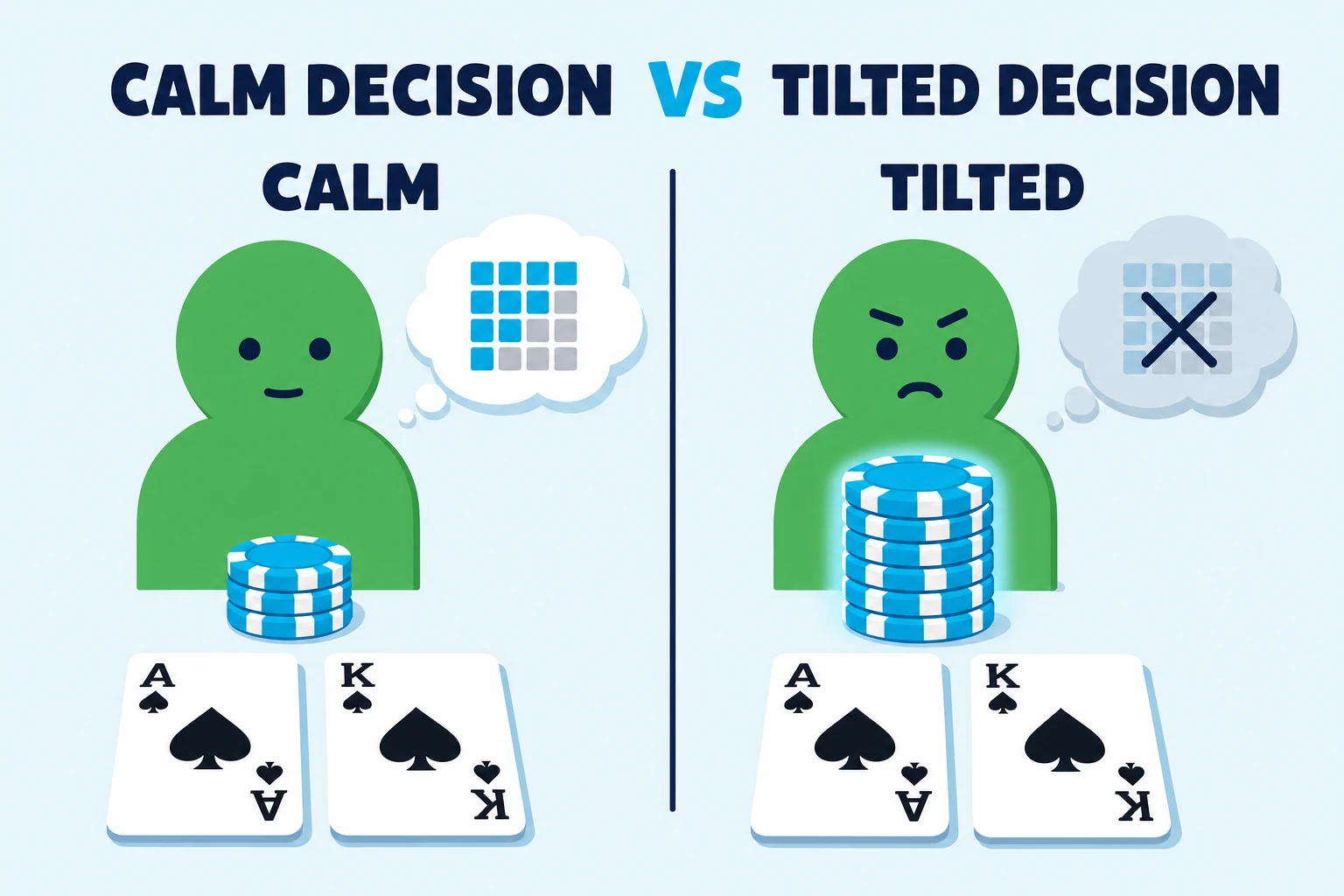
The recognizable signature is short:
- The line is bigger, faster, and looser than the same player ran an hour ago.
- The trigger is recent and visible (a hand they expected to win that they did not).
- The pattern fades when the emotion fades; an archetype does not fade.
Related terms
Common types of tilt
The same emotional state shows up in different table behavior depending on the player and the trigger. The names below come straight from poker shorthand; the rows describe what each one looks like across two or three hands.
| Type | Trigger | What it looks like at the table |
|---|---|---|
| Steam tilt | A bad beat or a brutal cooler | ”Win it back” mode: 3-bets the next two hands, calls down too wide, fires rivers without a plan. |
| Monkey tilt | Stack drop or several losses in a row | Reckless aggression: shoves wide, bluffs marginal draws, treats every spot as a gamble. |
| Entitlement tilt | Long card-dead stretch | Forces action with hands that are not strong enough; raises junk to “make something happen.” |
| Frustration tilt | Missed flops, slow service, a needling opponent | Either over-aggression (any bluff feels good) or sullen passive play, often muttering or visible head-shakes. |
| Despair tilt | Big stack drop with no fight left | Tightens up to avoid more losses, becomes easy to push around, or flips to “gamble and rebuy” mode. |
| Winners’ tilt | Just won a large pot | Widens ranges, calls weaker, splashes around. The danger of feeling on a rush. |
The two most expensive at small stakes are steam tilt and monkey tilt because both push money into the pot fast. Despair tilt and winners’ tilt are quieter leaks that bleed value over a longer stretch.
When tilt matters most
Tilt is not equally costly in every spot. The state matters most where decisions are large and reversible by the same player.
Where tilt costs the most:
- Deep-stacked cash hands where a single bad call-down is worth tens of big blinds.
- Big preflop confrontations: a 3-bet or 4-bet made out of revenge instead of range design pulls the next two streets out of shape.
- River decisions where your normal calling threshold quietly relaxes because you are already down two buy-ins and want to be right.
- Long sessions where fatigue and tilt compound; the late-night hour after a cooler is the most dangerous chair in the room.
Where tilt costs less:
- Push-fold spots in tournaments where the math is forced and there is no room to invent a wider line.
- Folding decisions on the early streets: the worst tilt-driven fold is still smaller than a tilt-driven all-in call.
- Hands you are not in. A player who recognizes their own state and folds the next two orbits will have lost very little to tilt that session.
The honest test for whether you should still be at the table: would the next decision look the same to you tomorrow morning, or are you only making it because the last one stung?
Example: 100bb 6-max NLHE cash, after a cooler
100bb effective, $1/$2 6-max NLHE cash. Hero opens K♠K♣ from the cutoff, gets 3-bet by the button, 4-bets, and stacks off on a 9♣ 7♦ 2♠ flop against A♠A♥. Two minutes later, the same button opens to $6 from the cutoff. Hero has been at the table for an hour and the button has played a regular range until that hand.
The hand the cooler is asking hero to play is wider than the moment justifies. A♠Q♦ is a common revenge candidate here: the brain says “I lost a big pot to the same opponent, time to get it back.” The math says something different. The button’s opening range is unchanged from the previous orbit; A-Q offsuit is a flat or fold against a regular’s cutoff open in this seat, not a 3-bet for value. Three-betting A-Q here, with no table image reason to widen, is a steam-tilt 3-bet.
Pot is $9 after the open. Hero 3-bets to $22. The button calls. Pot is $45.
Flop: J♥ 8♥ 4♠. Hero c-bets $20. The button calls. Pot is $85.
Turn: 6♣. The board is wet, the button has called twice, and A-high has no read-supported reason to fire again. Hero barrels $55 anyway. The button calls. Pot is $195.
River: 2♣. Hero shoves the remaining $103. The button snap-calls with J-T suited.
The line the cooler produced lost another stack. The hand A-Q played was disciplined preflop only if the read on the button had changed; nothing in the previous hand changed the read. The takeaway is not “fold A-Q forever” but “tilt is what made A-Q a 3-bet and a triple-barrel here.” A regular’s standard line for A-Q against an unknown cutoff opener is flat or fold preflop, give up by the turn at the latest. Chips that go in on lines like this one have a name of their own: spew, the bet, raise, or call without enough expected value behind it.
The cleanest fix is the one the books keep coming back to: stand up, take five minutes, and come back when the next hand will go through the same filter as the K-K hand did before the cooler.
Common mistakes
1) Treating tilt as the same thing as a maniac read
A maniac is a player archetype confirmed across many hands and several showdowns of plan-free aggression. A tilting regular looks similar in the moment but the betting pattern fades when the emotion fades. The countermove for a confirmed maniac (call lighter, fold less, bluff less) is correct against tilt while the tilt episode lasts; the same line two hours later, when the regular has settled, becomes a leak. Update the read with the player’s state.
2) Trying to bluff a tilting villain
The instinct after watching someone splash chips around is to bluff into them. Tilting players call more often than the same player does sober, and steam-tilt often shows up as wider call-downs and looser preflop defense. The book line is the opposite: cut your bluff frequency, lean on bigger value sizes with strong hands, and let their pressure run into your stronger holdings.
3) Sizing your value bets like the opponent is calm
A tilting villain calls more, raises more, and folds less than the same player at baseline. Standard half-pot value sizes leave money on the table. Larger value sizes when you have a real hand are the cleanest exploit; that is the line the books point at most consistently for weak or risk-averse opponents who are uncomfortable folding.
4) Confusing your own tilt with “playing my A-game tonight”
The most expensive tilt is the kind you cannot see in yourself. Card-dead frustration, “I deserve to win this pot” thinking, and happy tilt after a winning stretch are all states where the player still feels in control. The honest checks are external: a stop-loss set before the session (three buy-ins is a common cap), a fixed quit time, and the willingness to leave after a probationary hour if the game still feels off.
5) Holding onto the tilt read after the player has settled
A regular who tilted for two orbits and then went back to a normal pattern is not a tilting player anymore, and not a maniac either. They are a regular again. Reading them as still tilted means calling lighter and folding less than the new pattern justifies, which is a slow leak in the opposite direction. Archetypes update with behavior; tilt reads update faster than that.
FAQ
What is tilt in poker?
Tilt is a temporary, emotion-driven deviation from a player’s normal strategy, almost always triggered by a recent loss, a card-dead stretch, or a needling table. The shape at the table is a player who suddenly plays looser, more aggressive, or both, in a way they would not at baseline. Tilt is a state, not a player type. It fades when the emotion fades, which is the cleanest separator from a true loose-aggressive style.
How do you avoid tilt at the poker table?
Set a stop-loss before you sit down (three buy-ins is the small-stakes default), use a dedicated bankroll separate from household money, and treat cash poker as one long session rather than a series of standalone results. When something inside the session triggers you, take a real break: ten minutes away from the table is cheap, another stack lost on autopilot is not. A practical cooldown protocol sets out the steps and the thresholds in order. The hardest part of anti-tilt work is recognizing your own state early enough to act on it.
Is tilt always bad for the tilting player?
Almost always at the table, yes. The exception is winners’ tilt, which can read as confidence and produce decent decisions in the short run before it slips into wider calls and looser ranges. Even then, the leak is just slower; the math of tilt-driven decisions is worse than the math of the same player at baseline. The right framing is not “tilt is sometimes good” but “tilt fades, and what matters is whether the player notices the fade in time to leave.”