


Variance
The gap between your long-run expected value and your short-run results. Why a 60% favorite still loses some flips, and why one losing session is a poor judge of skill.

Practice this in Poker Skill. Practice vs AI keeps the focus on decisions, with Coach Max grading them against the strategy for the spot, whatever the river brings.
Get the free appVariance in No-Limit Hold’em
What variance means and why it matters
Variance is the gap between your long-run expected value and your short-run results. EV tells you what a decision earns on average over many repetitions; variance tells you how widely the actual results spread around that average. A profitable line can still lose money over a hundred hands. A losing line can still win money over a thousand. Variance is the reason short stretches of poker do not look like skill, and the reason a single session is a poor judge of how well you played.
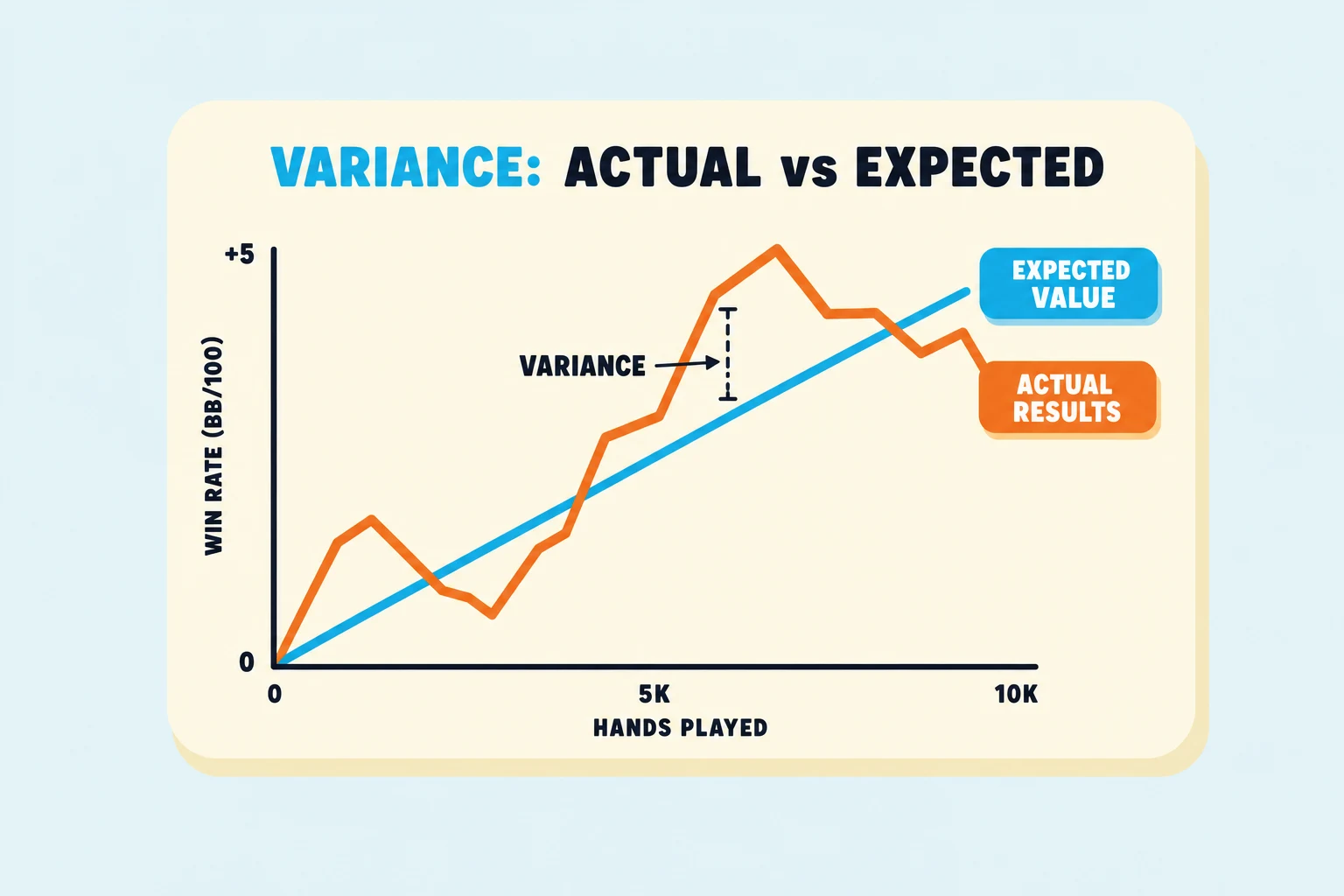
Variance vs. expected value
EV is the mean. Variance is the width of the distribution around the mean. They answer different questions:
| Question | What it answers | What it tells you |
|---|---|---|
| Expected value | What does this decision earn on average? | Whether the line is profitable in the long run |
| Variance | How far do results spread around that average? | How long the run has to be before results match the average |
Two players with the same win rate can have very different bankroll swings, because one plays a higher-variance game (more all-in equity, more multiway pots, more flips). A higher win rate does not lower variance — it only reduces the chance that the swings finish below zero over a given sample. Volume cuts variance: more hands tighten the spread around your true equity, but volume cannot make a small sample feel like a large one.
When variance is loudest
Some spots produce more variance than others. The same line played in a different context can have a much wider outcome distribution.
- All-in equity flips on the flop or turn. Once the chips are in, no further skill applies; you are watching probability resolve. A 60% favorite at 100bb stacks loses 40% of those pots by definition.
- Multiway pots. Top pair, overpairs, and continuation-bet bluffs lose value when more players see the flop. More opponents means more hands that can connect, and the spread of outcomes widens.
- Small samples. The fewer hands you have played, the wider the gap between your win rate and your true rate. The math is mechanical: variance is inversely proportional to sample size, so a 1,000-hand sample tells you very little, a 10,000-hand sample tells you something, and a 100,000-hand sample tells you a lot.
- Tournaments. Tournament chips do not cash out, and you cannot reload after busting. A late-tournament flip is worth more in real money than the same flip in a cash game, so variance spikes near the bubble and final tables. Tournament variance is structurally higher than cash variance for the same player.
Example: a 60% favorite over 10 and 100 all-ins
Suppose you get all in pre-flop with QQ versus AKo for 100bb. QQ is roughly a 56% favorite — close enough to call it 60% for the example. The math says you should win 6 of every 10 such flips on average. The math does not say you will win 6 of any specific 10.
Over 10 all-ins, “expectation” is 6 wins, 4 losses. But a result of 4 wins and 6 losses is well within normal short-run swing — losing 60% of your flips when you were a 60% favorite is the kind of streak variance produces routinely. You played the same hand the same way ten times in a row and the results looked terrible.
Over 100 all-ins, expectation is 60 wins and 40 losses. You will rarely land on exactly 60-40. Outcomes between roughly 50-50 and 70-30 are all common. The spread is narrower than at 10 flips, but it is still wide enough that one bad week of all-ins does not prove you were unlucky, and one good week does not prove you have an edge.
The lesson is not “math is unfair.” The lesson is that EV gives you the center and variance gives you the width. If you only look at the center, every short losing run looks like a leak.
Common mistakes when reasoning about variance
1) Results-orientation
You won the hand, so the call must have been right. You lost the hand, so the call must have been wrong. Both conclusions skip the only step that matters — was the decision +EV given the information at the time? Variance guarantees that some +EV decisions lose and some -EV decisions win. Judge the decision; let variance do its thing.
2) Changing strategy from a small sample
A 2,000-hand losing stretch is not a strategy verdict; it is roughly the noise floor of the game. Reworking your opening ranges, your bad-beat reaction, or your 3-bet sizing because last weekend went badly is over-fitting to a sample too small to read. The fix is to study individual hands, not to rebuild a strategy from a result.
3) Tilt as a feedback loop
Running bad costs money twice. The first cost is the variance itself. The second cost is the play it produces: paying off a suckout or a cooler with a hero call you would never make on hand one of a fresh session, or forcing a pot because you “deserve” to win one. Tilt converts a normal downswing into a real one. The mental-game discipline is to recognize the loop, leave the table, and come back when the next decision is being judged on its merits.
4) Confusing higher win rate with lower variance
Two players with 5bb/100 win rates do not necessarily have the same variance. A loose-aggressive game style produces wider swings than a tight-aggressive one at the same win rate. Higher skill cuts the probability of running below zero over a sample, but it does not flatten the curve.
FAQ
How many hands do I need before my results reflect my real win rate?
There is no clean cutoff. The relationship is monotonic — more hands always tightens the gap between your sample win rate and your true win rate, but variance never reaches zero. A few thousand hands tells you almost nothing about your win rate. Ten thousand hands tells you something. A hundred thousand hands tells you a lot. Most online players need a six-figure sample before their win rate stops swinging by a full bb/100 in either direction.
Can I lower my variance without changing my edge?
Some, but not most of it. You can pick lower-variance games (full-ring versus 6-max, cash versus tournaments, single-table versus multi-table). You can avoid spots that maximize all-in equity battles when you do not need them — flatting more pre-flop instead of 4-betting light, for instance. But variance is mostly a property of the game, not of the player. The largest lever you have is volume; the second-largest is game selection.
Is variance higher in cash games or tournaments?
Tournaments. Cash chips have a fixed real-money value and you can reload to your starting stack at any time. Tournament chips have a value that depends on the prize pool, the payout structure, and how many players are still alive — losing a flip late in a tournament costs much more in expected dollars than losing the same flip in a cash game. That structural difference is why tournament players need bigger bankrolls relative to their buy-ins than cash players need relative to their stakes.
Quick checklist
- Treat variance as the width of the distribution around EV, not as bad luck.
- Judge decisions by whether they were +EV at the time, not by whether the hand won.
- Resist strategy changes from samples under roughly ten thousand hands.
- Cut tilt fast: running bad costs money twice if it bleeds into the next decision.
- Match your bankroll to the variance of your game, not to your average outcome.