


Value-Own
When you bet for value on the river but only get called by hands that beat you. The bet was supposed to extract chips from worse; instead it pays the better hand.

Practice this in Poker Skill. The Put It Together lesson spots the risk on the turn, checking top pair of queens when an ace lands over them, since a bet would only build a pot for the hands that just moved ahead.
Get the free appValue-own: betting thin and getting called by better in No-Limit Hold’em
What value-owning means and why it stings
Value-owning yourself is a slang term for a river value bet that only gets called by hands that beat you. You picked a sizing meant to extract one more bet from worse pairs and missed draws. Instead, every weak hand folded and the only callers were the ones already ahead. The bet did the opposite of its job: it paid the opponent rather than building your pot.
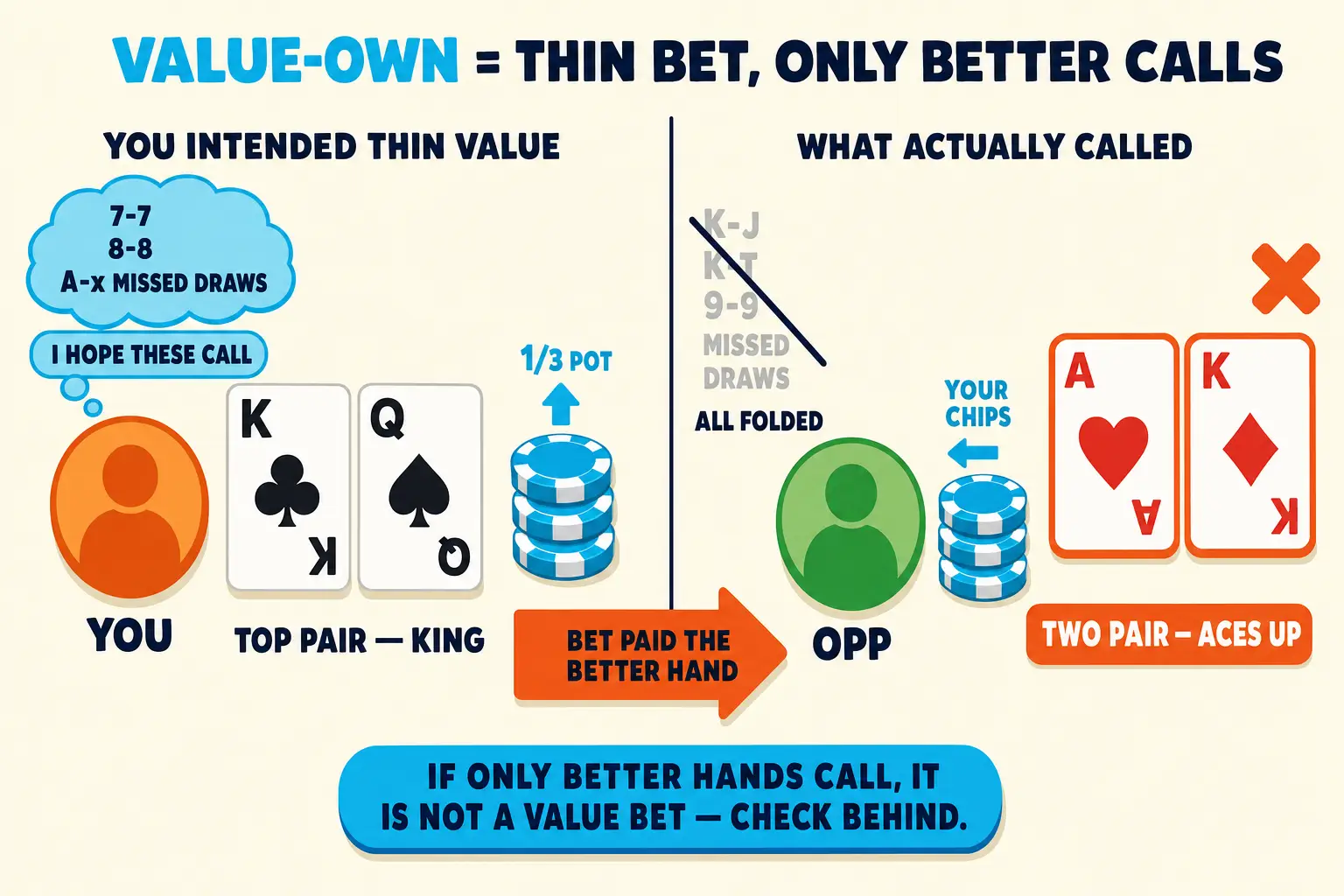
A clean test for whether a river bet is real value or a value-own: name one specific hand in the opponent’s continuing range that is worse than yours. If you can name two or three, the bet is value. If every plausible call beats you, you are about to value-own yourself.
Related terms:
Value-own vs. thin value vs. bluff-catch
The same one-pair hand on the same river can be three different decisions depending on what the opponent’s range looks like.
| Decision | Your hand vs. their continuing range | When it is the right call |
|---|---|---|
| Thin value | Slightly ahead of the range that calls | Worse pairs and missed draws are common in the call list |
| Value-own | Behind the range that calls | Worse hands fold; only better hands continue |
| Bluff-catch | Beats their bluffs, loses to their value | They have lots of bluffs and few value hands |
The difference is about what continues, not what is in their full range. A river check-call from a sticky opponent and a river check-call from a tight player look identical at the table; the continuing range tells you which one is which. Treat the question “name a worse hand that calls” as the gate.
When value-owns happen most
Three setups produce most value-owns at 100bb 6-max:
- Scary turn or river cards. An overcard, a third flush card, or a straight-completing card shifts the continuing range toward stronger hands. Top pair was a value bet on the flop; after a scare, it is a bluff-catcher.
- Paired or very coordinated runouts. A balanced opponent can show up with trips, two-pair, sets, or full houses on these textures. One pair stops being a thin-value hand and starts being a hand you would call with, not bet with.
- Uncapped opponent ranges. When the betting line lets your opponent have the nuts, they probably have the nuts often enough that worse hands no longer fill out the call list. A river check-call into them is fine; a value bet often is not.
When value-owns are unlikely:
- The board ran out clean and your hand still beats the natural worse pairs.
- The opponent is a calling station who pays off any one-pair line.
- The action so far capped the opponent’s range to medium-strength hands.
Example: top pair that owned itself on a scary river
You open 2.5bb from the cutoff with K♠ Q♦ and the big blind calls. Pot is 5.5bb.
Flop K♣ 7♥ 3♦. Big blind checks. You bet 2bb into 5.5bb. Big blind calls. Pot 9.5bb.
Turn 2♠. Big blind checks. You bet 5bb into 9.5bb. Big blind calls. Pot 19.5bb.
River A♥. Big blind checks again.
The temptation is a small bet, maybe 6–7bb, for thin value with top pair. Walk through the call list:
- Worse Kx (K-J, K-T, K-9): mostly folded the turn or river to your line.
- Pocket pairs 7-7 and 3-3: would have raised somewhere; a check on this river is plausible from 9-9, T-T, J-J, but those frequently fold to a third bet on an A-high runout.
- Ax: A-x calls — and A-x just made two-pair. A-K and A-Q in the big blind’s calling range now have you crushed.
- Missed draws: J-T, Q-J, suited connectors miss and fold to any bet.
The only hands that comfortably call this 6–7bb river bet are A-x (better than you), slow-played sets (better), and the occasional stubborn nine. The natural call list is dominated by hands you lose to. Betting here is a value-own. The right line is to check back, take the showdown when the big blind also checks, and lose the minimum when they led with two-pair.
A check on this river also lets you snap off the occasional pure bluff from a missed flush draw, which a small value bet would have folded out.
Common mistakes that lead to value-owns
1) Treating a river check as proof of weakness
Many players assume the opponent’s check means they have nothing. Some opponents do check trash; others check medium-strength hands that will call; a few check very strong hands hoping to induce. If your read does not separate those three buckets, your “thin value” hits the second and third more often than the first.
2) Auto-firing top pair on scary cards
A top pair that was clearly ahead on the flop is not necessarily ahead after the turn or river complete a draw. Each new card narrows the call list toward hands that beat you. The hand did not get worse, but the spot did.
3) Sizing too big for thin spots
Thin value bets get paid by elastic worse hands. A 70% pot bet for “thin value” prices out the worse pairs and only catches better. If the spot is genuinely thin, the size has to match: small enough that the worse hand still continues.
4) Ignoring opponent type
A tight, straightforward player who only calls rivers with strong hands is the wrong target for thin value with one pair. The same line against a sticky calling station prints. Picking the wrong opponent type is the most common mistake behind value-owns at small stakes.
FAQ
What does value-own mean in poker?
Value-own (or value-owning yourself) is a poker-slang term for a river value bet whose continuing range only contains hands that beat you. The bet was meant to extract value from worse hands, but the worse hands fold and the better hands call. It is a betting mistake, not a hand mistake — the same hand might be a clear bluff-catch or a clear check-back if you played it differently.
How is a value-own different from thin value?
A real thin value bet is a small river bet aimed at hands that are worse than yours and elastic enough to call. The bet wins more often than it loses among the hands that continue. A value-own is the same shape of bet on a spot where the continuing range has shifted; the bet still gets called, but the calling hand beats you. The visible action looks identical. The difference is whether worse hands actually call.
How do you avoid value-owning yourself?
Three habits help. Name a worse hand in the call list before you fire; if you cannot, do not bet. Re-read the runout after every street; a clean flop spot can become a scary river spot. Adjust by opponent type: thin value belongs against players who call rivers wide with worse pairs, not against players who only continue with the top of their range. When in doubt, check back for showdown value and let the opponent bluff if they want to.