


Downswing
A stretch of hands or sessions where actual results fall below your expected win rate. Driven by variance, measured in big blinds or buy-ins, weathered by sound decisions.
Practice this in Poker Skill. In the lessons every answer, right or wrong, comes with coaching on why, so your decisions get judged with no results graph attached.
Get the free appDownswing: a stretch of negative variance, not a verdict on your game
What a downswing is and why it is not the same as playing badly
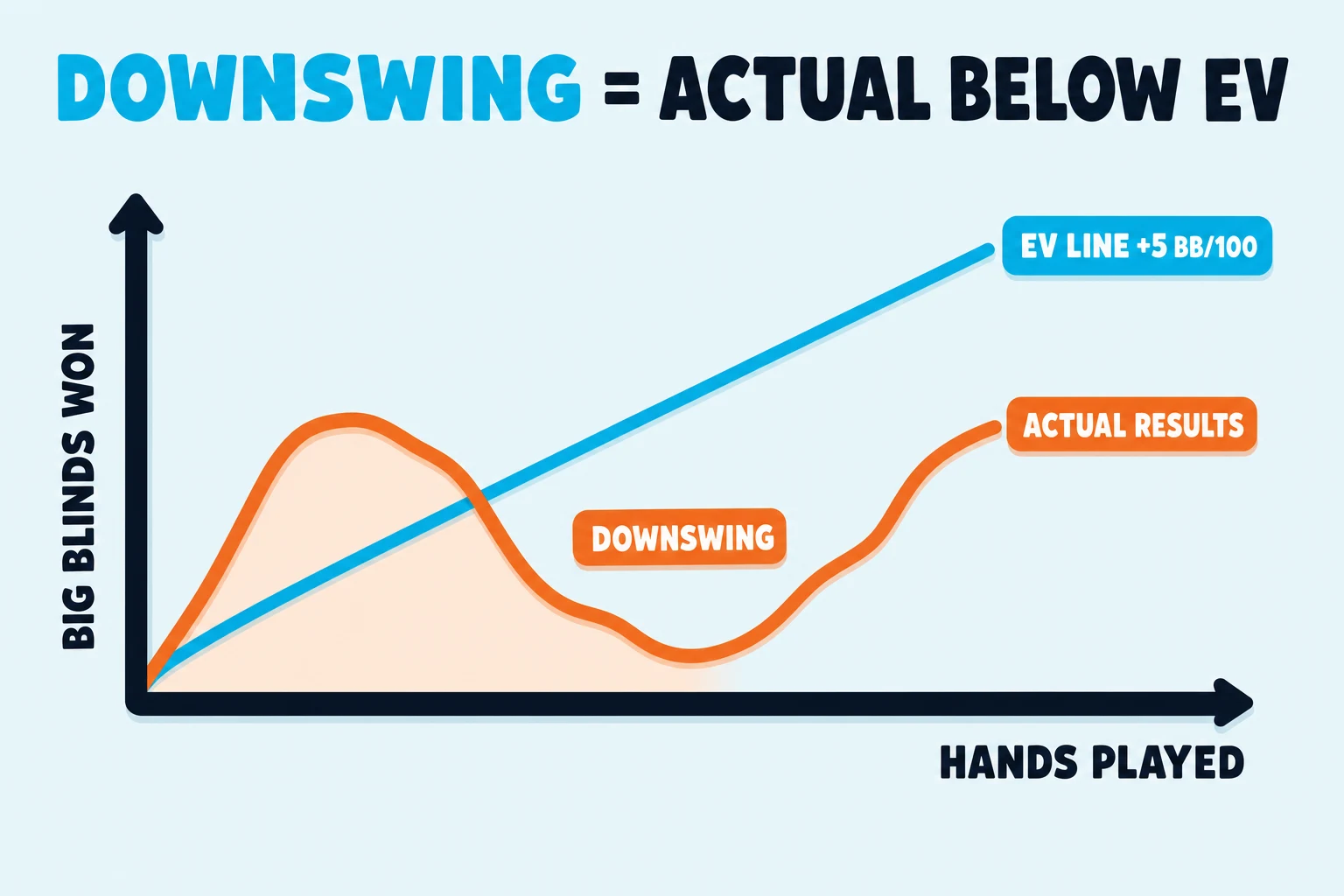
A downswing is a stretch of hands or sessions where your actual results land below your expected win rate. The cards run cold, the all-ins lose, the thin value bets get snapped off, and the line on your tracker drifts under the EV line you usually graph against. It is the cumulative form of a bad beat, a cooler, or a suckout — one bad session is noise, but a string of them stacked back-to-back is what players call a downswing.
For how long a normal downswing runs at your win rate and how to tell a cold stretch from a leak, read how long a poker downswing lasts.
Two ideas separate a downswing from “I am playing badly”:
- A downswing is measured against your expected value, not against zero. A breakeven stretch can be a downswing if your real win rate is +5 bb/100 and you have made the right decisions through it.
- A downswing is a statistical phenomenon. The same plays that print over a million hands can lose money over ten thousand. Treating a 4-buy-in slump as evidence that your strategy broke is a bigger mistake than the slump itself.
Said differently: your win rate and your variance are two separate things. The win rate is what you average per 100 hands. The variance is how widely individual 100-hand chunks stray from that average. A downswing is just a long-enough run on the unlucky tail.
Related terms
Downswing vs cooler, bad beat, and tilt
These four words get used interchangeably at the table, and they should not be. Each describes a different time scale and a different cause.
| Term | Time scale | What is happening |
|---|---|---|
| Bad beat | One hand | A heavy favorite loses to a hand that catches up |
| Cooler | One hand | Two strong hands collide and the second-best one pays off |
| Suckout | One hand | The underdog hits late to win the pot |
| Downswing | Many sessions | Cumulative results fall under the EV line over a meaningful sample |
| Tilt | A state of mind | Decisions get worse because emotions are driving them |
A bad beat is a single event. A downswing is a pattern across many of them. Tilt is what you do during a downswing if you are not careful — and tilt is the only one of these that is actually inside your control. The cards do what the cards do. Whether you keep playing your A-game while the cards do it is the part you own.
When a downswing matters most
A downswing matters when it changes a real-world decision. Sample size and bankroll are the two variables that turn a stretch of bad results into something you actually need to act on.
It matters most when:
- The downswing has dropped your bankroll below the buy-in floor for your stake. Move-down discipline kicks in here, not at the first bad session.
- The downswing is paired with a measurable change in your decisions — fewer 3-bet bluffs, looser river calls, tighter postflop because you “feel due.” That is the leak the downswing is masking.
- Your mental state has flipped. You sit down already braced for losing, you stop running the math on close decisions, and the next two hours of play are worse than your usual game.
- Sleep, time pressure, or money pressure outside poker has shortened your bankroll’s effective size, so you can no longer absorb the swings the stake assumes.
It matters less when:
- You have a sound strategy, your decisions look the same to a coach reviewing them, and the only signal that something is off is the dollar number on your graph.
- The sample is small. Ten thousand hands at 6-max cash is well inside one standard deviation for most win rates.
- You are not changing your stake, your hours, or the rest of your life because of the result.
In short: a downswing is a problem when it leaks into the rest of your game or your bankroll. Pure variance, with disciplined play around it, is uncomfortable but not actionable.
Example: a 10,000-hand stretch at 100NL cash
Take a winning 100NL ($0.50/$1) regular with a real win rate of 5 big blinds per 100 hands and a typical 6-max standard deviation around 100 bb/100. They sit down for a 10,000-hand stretch over a couple of weeks.
The expectation, plain and simple:
- Win rate: 5 bb/100.
- Hands: 10,000.
- Expected result: 5 × 100 = 500 big blinds, or 5 buy-ins (since one buy-in at 100NL is 100 bb).
Now the variance side. Across a 10,000-hand sample, one standard deviation of results is roughly the standard deviation per 100 hands times the square root of the number of 100-hand chunks. For a 100 bb/100 player over 100 chunks, that is about 100 × sqrt(100) = 1,000 big blinds, or 10 buy-ins, around the expectation.
What the player can plausibly see at the end of those 10,000 hands:
- Run a standard-deviation worse than expectation: ~500 − 1,000 = −500 big blinds. That is a 5-buy-in loss across two weeks, despite playing the same +5 bb/100 game.
- Run two standard deviations worse: ~500 − 2,000 = −1,500 big blinds. A 15-buy-in loss is rare but not extraordinary across one in twenty similar stretches.
- Run a standard deviation better than expectation: ~500 + 1,000 = +1,500 big blinds, a 15-buy-in heater that feels like proof of skill but mostly is not.
The point of doing the math is not to predict the next session. It is to see, in numbers, that “I lost five buy-ins over 10,000 hands” is exactly what variance does to a winning player a non-trivial fraction of the time. The decisions in the bad stretch and the decisions in the good stretch can be the same decisions. Your ♠ A and your ♥ K still get cracked sometimes. The graph just remembers.
Common mistakes during a downswing
1) Changing strategy because of the graph
Tightening up, pulling bluffs, or skipping thin value because “nothing has been working” is the most common downswing leak. The strategy that prints in a normal sample also prints in a bad one — the only thing that changed is the run of cards. Mid-downswing reactive tightening turns variance into a real win-rate cut.
2) Trying to win it back the same session
After a buy-in or two on the wrong side, a tempting move is to push for the rebound: wider opens, bigger bluffs, a thin call you would normally fold. This is the textbook tilt response. Cash games are one long session, not a daily settling-up. The next dollar is a separate decision, not a chance to even the running tally.
3) Taking shots above your bankroll
A losing stretch at $1/$2 does not get cured by sitting at $2/$5 with the rest of the roll. Higher stakes means tougher opposition, larger swings in absolute dollars, and a faster route to the move-down conversation. The opposite call — moving down a stake to keep the buy-in count healthy — is the disciplined response.
4) Confusing tilt with a hand-reading slump
When concentration slips, hand reading drops first. The hero call you used to make on a clear blocker line stops being clear. The triple-barrel you used to fire on a polarized turn becomes “maybe a check-call.” That is mental fatigue, not a strategy issue. The fix is sleep and time off, not solver studying.
5) Pulling money out of the bankroll mid-stretch
A losing run is the worst time to drain the roll for outside expenses. The bankroll’s job is to absorb downswings, and a smaller roll absorbs less. Treating poker money as separate from spendable cash is a discipline that gets tested most when results are bad, and matters most then.
FAQ
How long can a poker downswing last?
Longer than feels right. In 6-max NLHE cash, breakeven or losing stretches of 30,000 to 50,000 hands are not unusual for a solid winning player. In tournaments, 200-event stretches without a meaningful score happen to professionals. The rough rule from sample-size math: a downswing inside one standard deviation across 10,000 hands of cash play is not yet evidence that anything is wrong with the game. The cards alone can do it.
Is a downswing the same as bad luck?
It is the long-form version of bad luck, plus what you do about it. The cards-only part is luck — short-term variance against your real win rate. The part you own is the response: keeping the same decisions, keeping the same sleep schedule, not over-reaching for stakes that need a bigger bankroll, not letting one session bleed into the next. A downswing on its own is a statistical event. A downswing plus a tilt-driven leak is what actually breaks players.
How do I tell a real downswing apart from a leak?
Review the decisions, not the results. Pull the biggest losing hands and ask whether the same play was correct against the opponent’s full range, not just against the cards they showed up with. If the decisions hold up — sound preflop, defensible postflop lines, no out-of-range calls or speculative shoves — the stretch is variance. If the same hand types keep losing because the line was bad to begin with (limp-calling weak broadways, calling rivers without a clear value-fold pivot, putting chips in without position or initiative), the losses are coming from the play, not the cards. The cure for variance is patience. The cure for a leak is study.