


Five-card draw
The classic draw variant. Each player gets five private cards, swaps any unwanted ones in one draw, then bets and shows down. No flop, turn, or river.
Five-card draw: how the classic draw variant works
Definition and how the deal flows
Five-card draw is the classic draw-poker variant where every player is dealt five private cards face down, gets one chance to discard any unwanted cards and draw replacements, and then shows down for the best standard high hand. There is no flop, no turn, and no river. Five-card draw never uses community cards. The whole hand fits into two betting rounds: one before the draw, one after, then showdown if the pot is still contested.
The full walkthrough, with the ante, both betting rounds, the discard limits and what the draw counts tell you, is in five card draw rules and how to play.
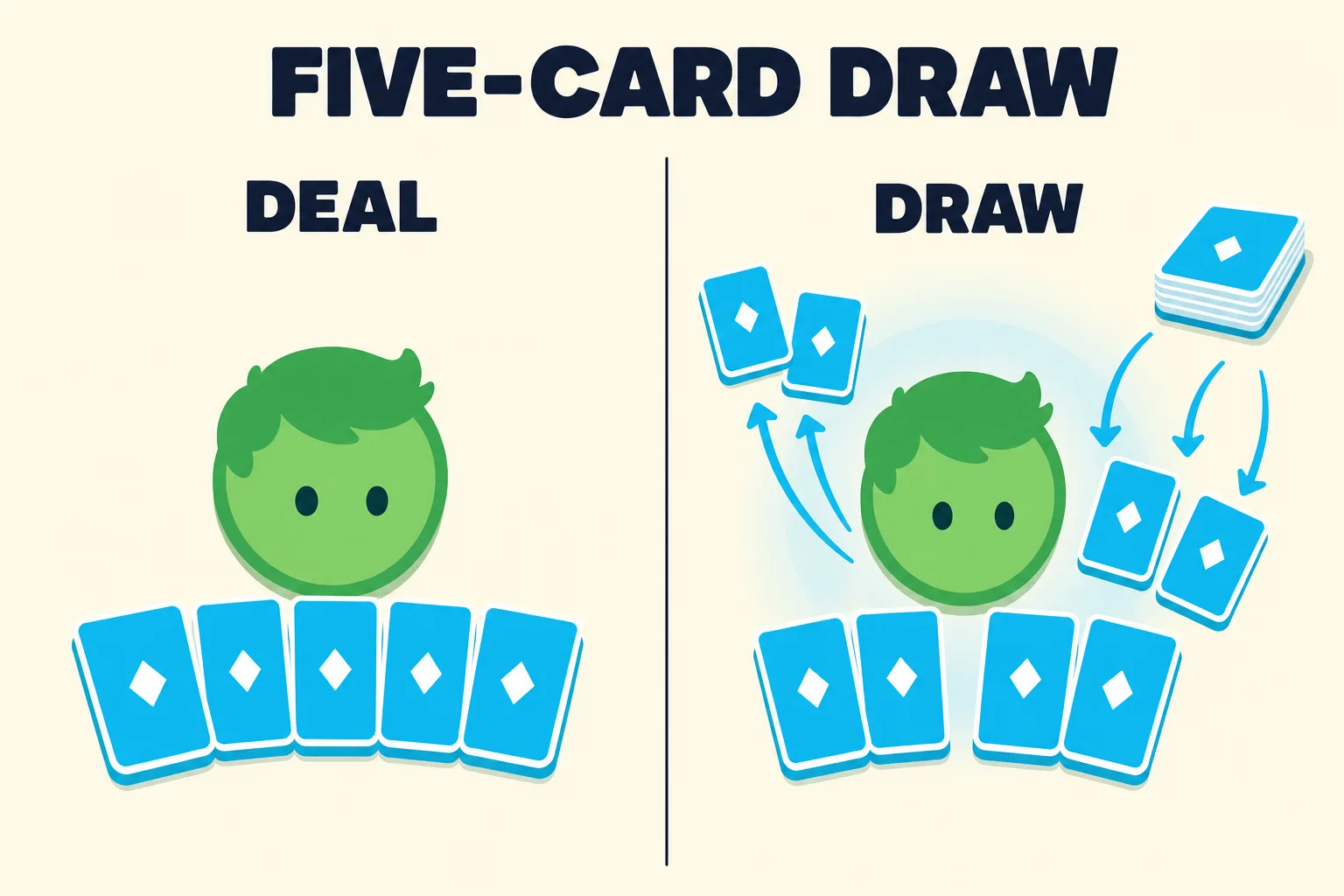
The mental shortcut is simple. Hold’em players read the board to figure out what hand they can make. Draw players read each other to figure out what hand the opponent is making. The cards never leave anyone’s hand. The information you have is your own five cards, plus how many cards each opponent threw away.
Related terms
- No-limit Texas Hold’em: the dominant community-card variant and the cleanest contrast.
- Omaha: four hole cards plus a community board, with the rule that you must use exactly two cards from your hand.
- Stud: seven-card stud, where some cards are dealt face up and there is no draw.
- Hand rankings: five-card draw uses the standard high-hand ladder.
How five-card draw differs from Texas Hold’em
| Element | Five-card draw | Texas Hold’em |
|---|---|---|
| Cards each player sees | Five private | Two private + five shared |
| Community board | None | Flop, turn, river |
| Betting rounds | Two (predraw, postdraw) | Four (preflop, flop, turn, river) |
| Forced bets (typical) | Ante from each player | Small blind + big blind |
| Information about opponents | Their draw count + betting | Board texture + betting + position |
| Key skill emphasis | Reading opponents, bluff frequency | Board reading, range construction, position |
The biggest practical difference: in Hold’em the board changes the hand four times. In five-card draw the hand only changes once, on the draw, and only for players who chose to draw. After that, every card is locked in.
When five-card draw matters most
Most cash games and tournaments today are no-limit Hold’em or pot-limit Omaha. Five-card draw shows up in a few specific places:
- Home games. It’s still the easiest variant to teach a table that has never played poker. Two betting rounds and one decision (what to keep, what to throw) keep the rules small.
- Mixed-game rotations. Tournaments and some cash games rotate through draw, stud, and hold’em variants. Five-card draw is rarer than 2-7 triple draw or badugi in modern mixed games, but home rotations still include it.
- Learning hand rankings. Because five-card draw only ever uses the standard high-hand ladder (no low hands, no shared board, no “best five from seven”), it’s a clean place to drill which hand beats which.
- Video poker. Most casino video poker machines are mechanically a single-player jacks-or-better five-card draw against a paytable. Practicing the live game makes the machines easier to read.
Poker Skill is built for Texas Hold’em, and its first lessons drill the same high-hand ladder, from one pair against two pair up to the straight flush and the royal.
It matters less in modern online cardrooms. Most online sites no longer spread it as a stand-alone game.
Example: a single hand of five-card draw
Everyone antes, the cards come out, and you look at a pair of kings. You bet, two players call, and at the draw you keep the kings and take three cards. One opponent takes one card, the other takes three. On the second betting round the one-card draw bets into you. That is the whole game in one paragraph: your hand, their draw counts, and what they do after them.
The hand played out street by street, with the draw arithmetic and what each draw count usually means, is in five card draw rules and how to play.
Common mistakes
1) Treating it like Hold’em
New players wait for “the flop” to develop their hand. There is no flop. The hand is over after one draw. Bet and call sizes have to be calibrated to a two-round game, not a four-round game.
2) Drawing four to a single ace
Drawing four cards announces “I have nothing but one card I’d like to keep.” Even when you do hold an ace, drawing four against opponents who drew one or stood pat is rarely profitable. Most strong players recommend drawing four only as a defensive move from the big blind in an unraised pot.
3) Ignoring the draw counts
The single most informative event in the hand is what each opponent does on the draw. Pat usually means a made hand (straight, flush, full house, or better). One card usually means a four-card flush, four-card straight, or two pair drawing to a full house. Three cards means a pair. Failing to update on those signals is leaving the most useful piece of information on the table.
4) Overvaluing two pair against many drawers
Two pair is strong heads-up but loses fast in a multiway pot where opponents drew to flushes, straights, or improved pairs. The more players still in postdraw, the less impressed two pair should be.
FAQ
Is five-card draw still played?
Yes, but mostly in home games, mixed-game rotations, and a few specialty events. Most public cardrooms no longer spread it as a stand-alone cash game. Video poker machines use the same mechanical structure, which is why the rules feel familiar even to people who have never sat at a card table.
How many cards can you discard in five-card draw?
Most rule sets allow each player to discard from zero up to four cards on the single draw step. Some house rules allow drawing all five (often after declaring it and showing one card before the discard) but the four-card cap is the more common standard. Drawing zero is called standing pat and signals a made hand.
Does five-card draw use the same hand rankings as Texas Hold’em?
Yes. Standard high-hand rankings apply: high card, pair, two pair, three of a kind, straight, flush, full house, four of a kind, straight flush, royal flush. Lowball draw variants (deuce-to-seven, ace-to-five) flip the ranking, but those are different games. Plain five-card draw is a high-hand game.