


Stud (Seven-Card Stud)
Seven-card stud is the no-community-cards poker variant. Each player gets three down cards plus four exposed cards across five betting rounds, with antes and a bring-in.
Stud (Seven-Card Stud): the no-community-cards poker family
What stud is and how the rules work
Seven-Card Stud is the classic no-community-cards poker variant. Each player is dealt seven cards over five betting rounds (three face down for only that player to see, four face up for everyone at the table to see), and at showdown the best five-card hand from those seven wins. There is no shared board. The first three cards arrive together on third street: two down, one up. Single cards then arrive on fourth, fifth, and sixth street, each face up. Seventh street, sometimes called the river, is the final card and is dealt face down. Action opens with antes paid before the deal and a forced bring-in from the player showing the lowest face-up card on third street; from fourth street onward, the highest exposed hand acts first. Most cardrooms deal stud as fixed-limit, with bets doubling from the small bet (third and fourth street) to the big bet (fifth, sixth, and seventh street).
How to play seven card stud: full rules and betting covers the deal, the bring-in, every street, and the betting in full.
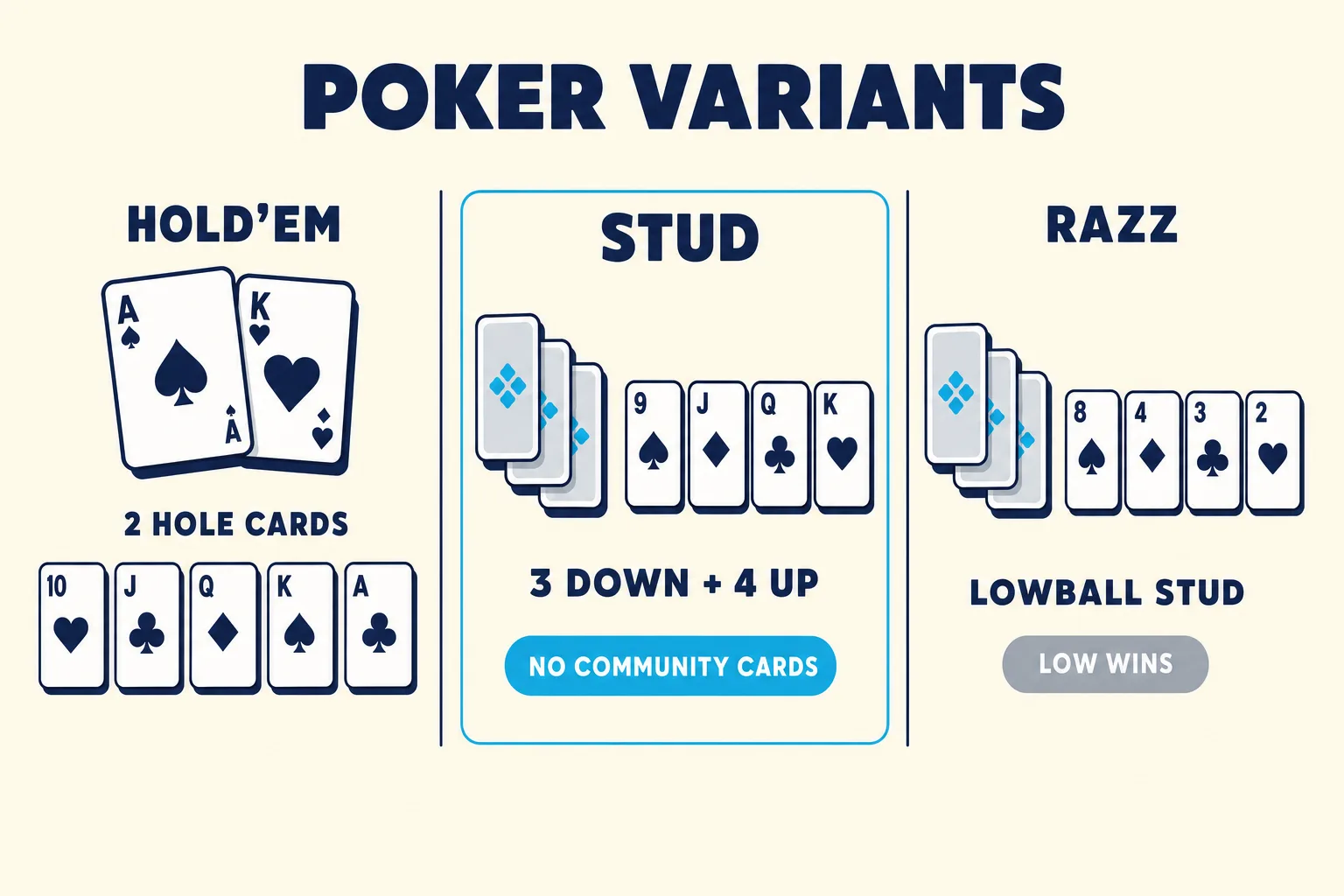
The stud family at a glance
Most players who say “stud” mean seven-card stud high. The family is wider than that, and the differences matter at the table.
| Variant | Cards per player | Goal | Low qualifier | Typical betting |
|---|---|---|---|---|
| Seven-card stud (high) | 7 (3 down, 4 up) | Best high hand wins | n/a | Fixed-limit |
| Seven-card stud 8-or-better (stud hi-lo) | 7 (3 down, 4 up) | High and qualifying low split | 5 unmatched cards 8 or below | Fixed-limit |
| Razz | 7 (3 down, 4 up) | Best low hand wins | Ace-to-five low; straights and flushes don’t count against the low | Fixed-limit |
| Five-card stud | 5 (1 down, 4 up) | Best high hand wins | n/a | Fixed-limit |
| Texas Hold’em (for contrast) | 2 (both down) + 5 community | Best high hand wins | n/a | No-limit typical |
Stud high is the parent. Stud hi-lo adds a low-hand split with the standard eight-or-better qualifier; if no player makes a five-unpaired-cards-eight-or-below hand, the high hand wins the entire pot. Razz strips the high side away entirely; the best low wins, and the wheel (5-4-3-2-A) is the nuts. Five-card stud is the older, sparser cousin and is rare today outside specific home games.
When the no-community-cards rule changes your decisions
Seven-card stud uses the same hand rankings as Hold’em (royal flush, straight flush, quads, full house, flush, straight, trips, two pair, pair, high card), and the ranks are still ace-high. The information shape is what changes, and it changes everything about how you read hands.
- You build your hand from your own seven cards. No shared board, no community cards to lean on. If you need a heart for a flush, you need to draw it yourself; nobody else’s heart helps you.
- Four of every player’s cards are face up. You can see your opponents’ four exposed cards by seventh street. Their three down cards are hidden, but every up card on the table is information you should track. Hand reading in stud is largely the discipline of watching what other players show.
- Antes and the bring-in replace blinds. Every player pays an ante before any cards are dealt; on third street, the lowest face-up card brings it in with a forced bet. The opening action is positional in a card-driven sense, not a seat-driven sense; your “position” depends on your door card, not on a button.
- The action driver flips after third street. From fourth street onward, the highest exposed five-card-hand-so-far acts first. A pair on the board changes who opens. So does showing big cards versus small cards, even when nobody has paired.
- Live cards drive draw decisions. A flush draw with two of your suit already dead in opponents’ hole cards (visible as their door and up cards) is much weaker than the same draw with all of your suit live. Stud players count outs against what’s been folded or shown, not just against the deck.
Hold’em trains you to read your two cards and add the board. Stud trains you to read seven cards and watch four cards in front of every opponent at the same time.
Poker Skill teaches Hold’em alone, so it trains the Hold’em half of that contrast, as in its Best Five Basics lesson, where you build the strongest five from your two cards and the board.
Where stud sits in the variant family
Seven-card stud is the older parent of the stud family and the home format for the WSOP’s mixed-game rotations. Stud high-low eight-or-better adds the split-pot dimension that the Omaha family also uses; the eight-or-better low qualifier and the wheel as the nut low are the same idea applied to stud’s seven-card structure. Razz inverts the goal entirely (lowest hand wins, and aces play low for straights) but keeps the deal pattern, the bring-in, and the antes. Five-card stud is mostly historical at this point; you are far more likely to see it dealt as part of a dealer’s-choice rotation than as a scheduled cash or tournament.
The shift from NLHE to stud is less about new betting moves and more about a new information surface. Hold’em hides hands until showdown; stud reveals four of seven cards along the way. Players who already track ranges in Hold’em pick the variant up faster than they expect, because the same hand-reading instincts apply; they just have new evidence (the up cards) to read with.
Stud checklist
- Count your starting hand: three cards on third street, two down and one up.
- Antes plus the bring-in from the lowest door card open the action; the high exposed hand opens from fourth street on.
- Build your final hand from any five of your seven dealt cards; there is no shared board to lean on.
- Track every up card in front of every opponent. It is the variant’s biggest edge over Hold’em.
- Most stud is dealt fixed-limit with a small bet on third and fourth street and a big bet from fifth onward.