


Hand history
A hand history is the saved record of one poker hand: who played, what they did on each street, the cards shown, and the pot. The raw material every honest review starts from.
Practice this in Poker Skill. Re-deciding on the same cards is what Run it back is for: it replays a finished Practice vs AI game on the same deals, with Coach Max coaching your decisions.
Get the free appHand history: the raw record of every decision you made
What a hand history is and why it matters
A hand history is the saved record of a single hand of poker: who was at the table, who acted in what order, the bet sizes, the board cards, the cards shown at showdown and the pot at the end. Online rooms write one to disk for every hand you play; a live room keeps no such file, so a live player’s record is whatever notes they take. It is the raw material every honest session review is built from. Without it you are reviewing your memory of a hand, which is the part most likely to be wrong.
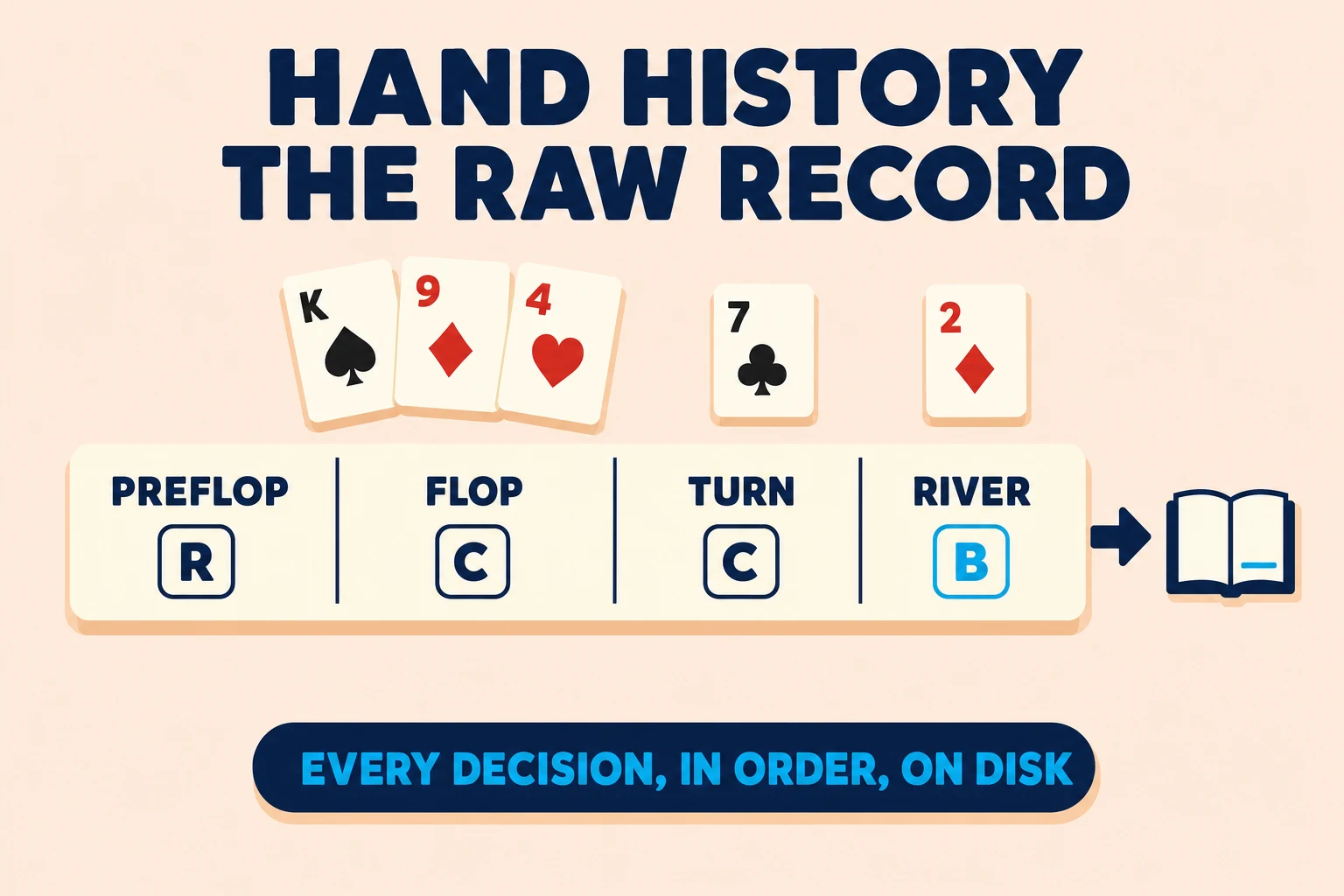
The mental shortcut: a hand history is a transcript, and the verdict comes from the review. The job of the file is to be honest about what happened. Your own review of a hand history asks one question of each decision in it: was it the best one you had with the information you had at the time?
Related terms
- Session review: the workflow that turns a stack of hand histories into next session’s edge.
- HUD: the live-stats display fed by every hand history saved on your computer.
- Variance: the noise a small history is mostly made of.
- Expected value: what a long history lets you measure honestly.
- Tilt: the state in which you should not be opening last night’s hand history.
- Bankroll management: the part of your game that sample-size discipline most directly protects.
What’s actually inside a hand history
The exact format differs by poker room, but every hand history file carries the same core fields:
- Who was at the table. Player screen names, seat numbers and the stack each player started the hand with.
- The blinds and the stakes. Small blind, big blind, ante if any and any straddle.
- Your hole cards. The two cards you saw, plus any other player’s cards that were exposed at showdown.
- The action, street by street. Preflop, flop, turn, river: who acted in what order and whether they checked, called, bet, raised or folded, with the exact bet sizes in chips.
- The board. Each community card as it was dealt, in order.
- The pot. The size of the pot as it built, including any side pots and the rake the room took.
- The result. Who won, what they showed if it went to showdown and how much each player ended up with.
- A timestamp. When the hand was dealt, which is how trackers stitch hands into sessions.
A complete hand history is an exact, replayable record of every decision every player made, and a tracking program reading those files can put them in front of you again whenever you want.
Where hand histories come from
| Source | What you get | Friction |
|---|---|---|
| Online cash and tournaments | Auto-saved to disk in your room’s hand-history folder, or emailed at the end of a tournament. Typically every hand at every table you play is captured. | None; it just happens. The rare friction is finding the folder the first time. |
| Live poker | No file: the room keeps no hand history, so the record is a paper tally or phone-notes entry with hand number, position, stack, action and result. Tedious but workable. | High friction. Rarely captures bet sizes accurately. Use only for the hands you marked. |
| Imported into a tracker | PokerTracker, Hold’em Manager and similar tools point at the hand-history folder, parse every file and give you a queryable database plus a HUD. | One-time setup; ongoing maintenance is automatic. |
Online players almost always end up using a tracker because the volume of files makes per-hand review impractical. Live players almost always end up with a notebook because the volume is small enough to manage by hand.
How to actually use one
A hand history is only useful if you do something with it. The four-step shape below is the working drill. Think of it as the rough equivalent of an athlete reviewing game tape.
- Open the hand from the start. Pull up the file in your room’s replayer or your tracker, and walk the hand forward from the deal. The point is to see the hand the way you saw it at the table, before you knew which card came on the river.
- Pause at every decision point. Stop on each street where you had to act, and re-ask the same questions you would ask in the moment: what is the opponent’s range here, what odds is the pot laying me, what is my equity against that range and what does my own bet (if I bet) accomplish?
- Re-decide, then compare. Write down what you would do now, before peeking at what you actually did. When your two answers differ, the gap is the lesson; when they match, check whether your reason was right or whether you got lucky to land on the same answer for the wrong reason.
- File one sentence per hand. A lesson you cannot summarize in one plain-English sentence is a lesson you have not finished thinking through. “BB defending offsuit ace-rag against the cutoff puts me in too many bad turn spots, so fold more or 3-bet more” is the working shape.
That four-step drill is what a session review is built around: the hand history is the input, and the lessons file is the output.
Common mistakes
1) Judging decisions by their results
The most expensive habit in hand-history review is judging a decision by the river. A bad call that happened to win was still a bad call; a correct fold of a hand that would have hit the miracle river was still a correct fold. If your review reaches different verdicts depending on which card came last, it is grading the cards, and the file is teaching you the wrong thing.
2) Only opening the biggest pots
A stack-off with kings against aces preflop is exciting and almost never instructive, since there was nothing to decide. The pots worth re-reading are the ones where the action got hard: the marginal call on the turn, the river bet you didn’t know how to size, the spot where you tanked for thirty seconds and then guessed. One of those turn calls sits in Poker Skill’s Give Up on Purpose lesson: facing a lead on A♦ K♦ 3♥ 4♥ with A♣ T♦, top pair with a ten kicker is still “plenty alive”, so you call.
3) Reading sample-size signal into noise
Your last session’s winrate is mostly variance. A few thousand hands is a story your hand-history file is not yet qualified to tell, and a winrate needs a very large sample before it settles into something believable. Stat boxes that read your last few sessions and conclude you are crushing or losing are reading noise. Use small samples for decisions; use large samples for self-assessment.
4) Reviewing on tilt
A bad session that ends with an angry hand-history scroll almost always concludes that the bad beats were the cause and the line was correct. The same session reviewed two days later, when you can ask the run-bad-or-play-bad question honestly, often finds two structural mistakes that quietly cost real money. Cool down first, then open the file.
5) Treating the file as private but acting as if it isn’t
Hand histories include opponent screen names and your own play. They are evidence: useful when you share a single hand with a coach or study partner, less useful when you paste a whole session into a public forum. A short, redacted snippet sent to one trusted reader is fine. Dumping everything you played last week into a public thread is a habit that creates problems before it produces lessons.
FAQ
How long should I keep my hand histories?
Indefinitely if you have the disk space; the files are tiny relative to anything else on a modern computer. The two reasons to keep them long-term are tracker accuracy (a longer database means more reliable stats on regulars you keep facing) and your own sample-size honesty (your real winrate at a given stake takes a serious number of hands to surface). The one reason to prune is privacy: if you stop playing somewhere, archive the folder offline rather than leaving it in a sync’d cloud directory.
What tools do I actually need to open one?
Less than the marketing for those tools suggests. The plain-text hand-history file is human-readable in any text editor, which helps for debugging or sharing one hand. A replayer (built into most rooms, or part of any major tracker) plays the hand back visually, which is what you want for re-deciding. A tracking program (PokerTracker, Hold’em Manager and similar) imports the whole folder and gives you a database plus the HUD, which is where the volume of online play makes a tracker pay for itself. Start with the room’s replayer; add a tracker when the questions you want to ask the data outgrow what scrolling can answer.
Can I share a hand history with a friend or coach?
Yes, and it is one of the most useful things you can do with one. The honest practice is to share the smallest unit that carries the question: one hand, with screen names redacted to “BB” / “CO” / “Hero” and similar role labels, sent to a trusted reader who can see the spot fresh. Sharing a whole session into a public forum is rarely as useful and creates downside (privacy, opponent-data exposure, low-quality replies) that a short, focused share avoids.