


Session review
The post-session study habit of marking the hands you were unsure about, re-deciding them away from the table, and writing down what to change next session.
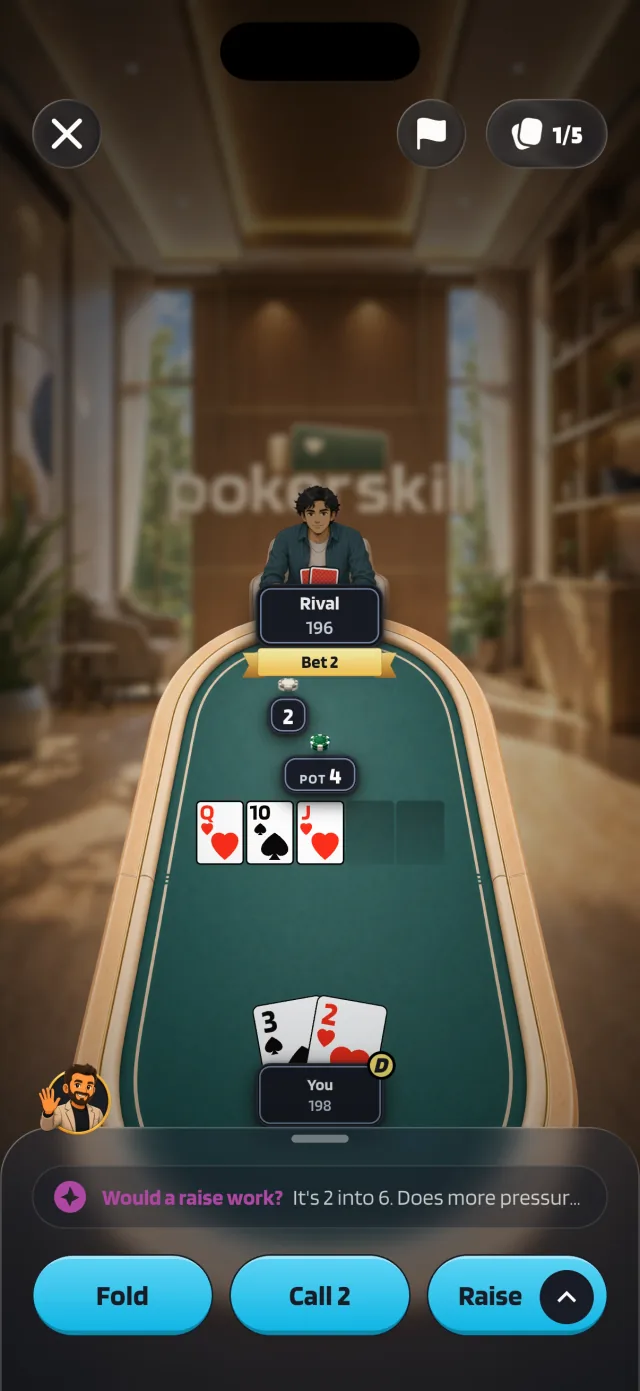
Practice this in Poker Skill. Practice vs AI reviews your play after each game, with Coach Max grading your decisions against the strategy for the spot, so the grade follows the decision rather than the card that came after.
Get the free appSession review: turning sessions into the next session’s edge
What a session review is and why it matters
A session review is the post-session habit of going back through the hands you played, picking out the spots where your decision did not come easily, and re-deciding them away from the table. It is the difference between playing a thousand hands and learning from a thousand hands. The session is where you collect evidence; the review is where you turn that evidence into the next session’s expected value.
The mental shortcut: a session review is not a verdict on the night. It is a search for the two or three decisions that, repeated over the next thousand hands, will quietly cost you the most money. Find those, and the night was useful regardless of the result.
Related terms
- Variance: the noise a real session review separates from signal.
- Downswings: a stretch where review is the most valuable and the hardest to do honestly.
- Tilt: the state in which you should not be reviewing.
- Expected value: the lens every reviewed decision is held up against.
- Exploitative deviation: one common output of a good review session.
- Solver: the deepest end of the review toolchain.
What a real session review actually looks like
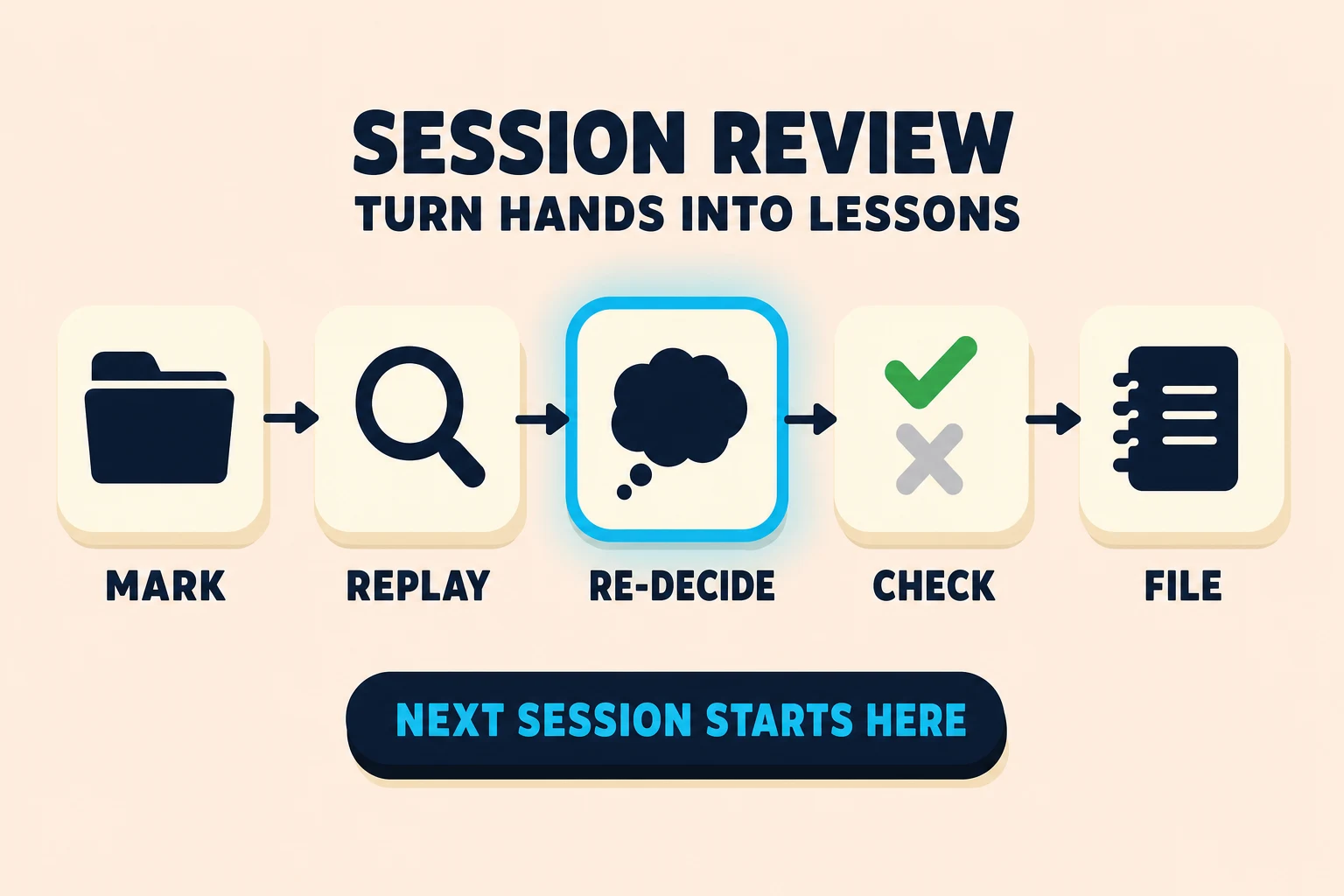
The five steps below are the working shape. They are short on purpose — a review that takes longer than the session it covers will not survive contact with a busy week.
- Mark hands during play. While you play, flag any spot where you were not sure of your action. Most poker rooms let you tag hands; a paper tally of “hand 17, BB vs CO turn raise” works fine if your room does not. The mark is the trigger; the analysis happens later.
- Replay the hand from the start. Pull up the hand history, hide the result if your tool allows it, and walk through the action street by street. The point is to see the hand the way you saw it at the table, not the way you see it now that you know what came on the river.
- Re-decide each street, asking the same questions you would ask in the moment. What is the opponent’s range here? What odds is the pot laying me? What is my equity against that range? If I bet, what does the value-and-bluff mix look like? Spending two minutes re-asking those questions is the whole drill.
- Check the assumption. When your re-decided line differs from what you actually did, the gap is the lesson. When they match, check whether your reason was right or whether you got lucky to land on the same answer for the wrong reason.
- File the lesson in plain English. One sentence per hand: “Defending BB against CO 2.5bb open with offsuit ace-rag puts me in too many bad turn spots — fold more or 3-bet more.” A lesson you cannot write in one sentence is a lesson you have not finished thinking through.
The review is a workflow, not a project. Five hands a session, ten minutes a session, is more than most players do and more than enough to keep improving.
When to do it (and when not to)
The right time to review depends on what you are reviewing for.
- Right after the session, briefly. A short cool-down read of the worst spots while the table dynamics are still in your head is useful — but only if you are not steaming. If your hands are still tight and you are still telling yourself the story of the bad beat, the review you do now is not honest.
- The next day, properly. This is where the real learning happens. The hand is fresh enough to remember the read; you are far enough away from the result to evaluate the decision instead of the outcome.
- Weekly, in a batch. Block out one slot a week to walk through the marks from the prior week. Look for repeats — the same spot turning up four times means the leak is structural, not situational.
- Never while tilted. Review on tilt does not produce learning. It produces rumination dressed up as study. Step away, sleep, and review tomorrow.
The “never” is the load-bearing rule. A bad session that ends with an angry review almost always concludes that the bad beats were the cause and the line was correct. A bad session reviewed two days later, with the run-bad/play-bad question asked honestly, often finds two decisions that quietly cost real money.
Example: one orbit, one mistake, one lesson
Say you played a session and marked one hand to look at. The action:
- 6-max NLHE cash, 100bb effective. CO opens 2.5bb. You are in the BB with A♣ J♥ and call.
- Flop comes K♦ 9♠ 4♥. You check, CO bets 1/3 pot, you call with ace-high and a backdoor wheel.
- Turn 7♣. You both check.
- River 2♦. You check, CO overbets 1.25× pot, you tank-fold. You win the next pot fine and move on, but the spot felt off.
In review the next day, you replay the hand and re-decide street by street.
The flop call survives the re-decide. Ace-high with a backdoor draw and one overcard to a king is a defensible bluff catch on a board where CO’s c-bet range is wide. The turn check from CO is the interesting moment. CO checked back the turn, then overbet a brick river. What does that line actually look like — what hands does CO have that bet 1.25× pot here?
When you map it out, CO’s range for this exact line skews toward two pairs that turned scared (rare) and busted broadway draws (much more common). Ace-high is a bluff catcher in that map. The fold was probably not the worst decision, but it was a fold made because the bet was scary, not because the math said fold.
The lesson — one sentence, filed in plain English: Against an unknown CO who checks back turn then overbets a brick river, my ace-high default should be call, not fold; tighten the call only against opponents I have read as not bluffing rivers.
That is one hand, ten minutes of work, and a structural change to a spot you will face dozens of times in the next month. That is what a session review is for.
Common mistakes
1) Reviewing on tilt
The single most common failure mode. Doing the review while the loss is still loud means the review confirms the story you are already telling yourself: the river was unfair, the call was right, the villain runs hotter than every player on earth. Real review wants the same emotional posture as a chess post-mortem. Tilt does not deliver that posture. Cool down first; review after.
2) Reviewing only the hands you lost
The biggest pots are not the most informative. A stack-off with kings against aces preflop has nothing to teach. The hands worth reviewing are the spots where the decision was hard — including the ones you won because the river bailed you out and the ones that felt easy at the table but should have been hard. Mark hands by decision-difficulty, not by pot size.
3) Outcome-thinking (“I won so it was right”)
Judging a decision by the result it happened to produce is the most expensive habit in poker. A bad call that happened to win was still a bad call. A correct fold that would have hit the miracle river was still a correct fold. The point of review is to evaluate the decision against the information you had, not against the card that came. If your review is reaching different verdicts depending on the river, you are reviewing results, not decisions.
4) Reviewing without writing anything down
A lesson you remember on Sunday and forget by Wednesday is not a lesson; it is a thought. Write the verdict down, even one sentence. The act of summarizing forces you to commit to what you actually learned, and the file becomes the input to next week’s review — the place you check to see whether the same leak is showing up again.
FAQ
How long should a session review take?
Less time than the session it covers, and almost always under thirty minutes. Five marked hands at three to five minutes each is the working target. A review that bloats into an hour is a review that has stopped finding lessons and started rationalizing the night. When you run out of marked hands, you are done. Go do something else and come back tomorrow.
Should I review every session, or only losing ones?
Every session you marked hands in, which is most of them. Reviewing only losing sessions teaches you that play is fine when you win, which is exactly the outcome-thinking trap that keeps mistakes invisible. The biggest learning gains often come from spots in winning sessions where you got lucky. Those are the spots where the leak is hidden by the result.
What tools do I actually need?
Less than the marketing for those tools suggests. Your room’s hand-history download plus a notebook covers the first hundred reviews. A tracking program (PokerTracker, Hand2Note, or similar) makes the marking and filtering faster once your volume justifies it. Equity tools like Equilab help when you are checking a specific call against a range. A solver is the deep end and only earns its complexity once you have reviewed enough hands to know which spots to ask it about. Start with the notebook; the tools come when the questions get more specific than the notebook can answer.