


Hand review
Replaying one hand from a session away from the table, street by street, to compare your in-game decision against the one you would make with time to think.
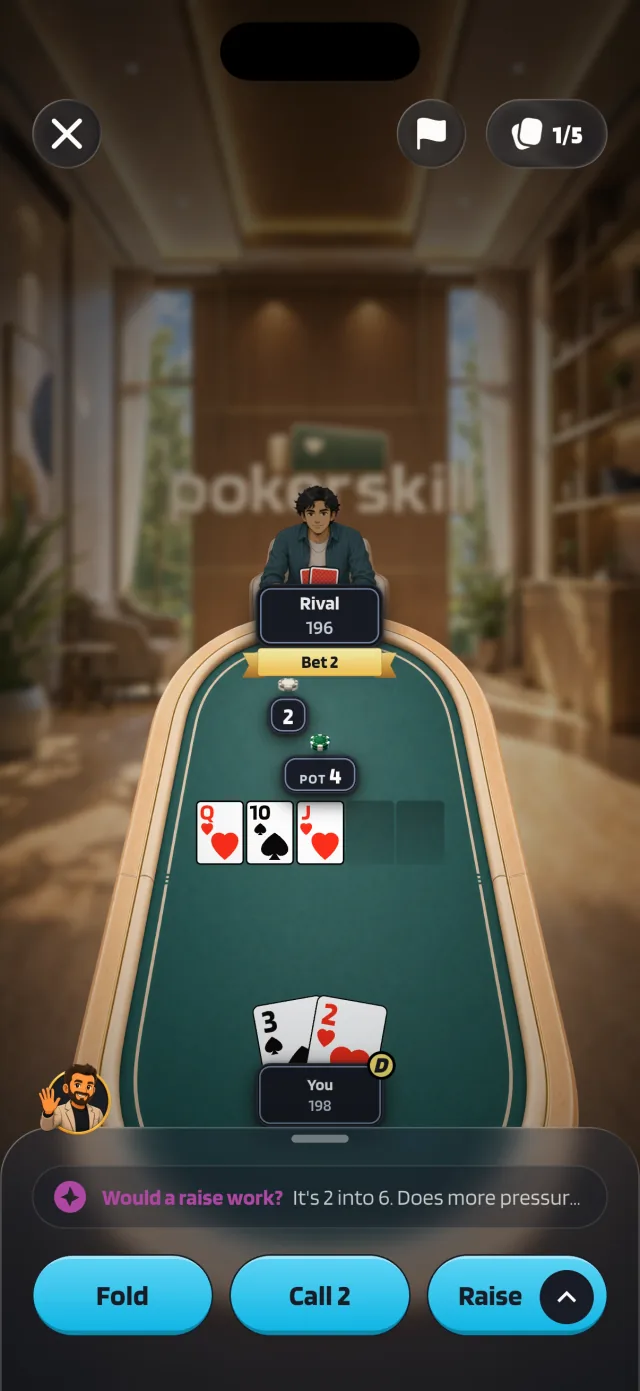
Practice this in Poker Skill. After each Practice vs AI game, where you play full hands against AI opponents, Coach Max, the coach at the table, judges the choice itself, whatever card came next.
Get the free appHand review: replaying one decision to find the lesson
What a hand review is and why it matters
A hand review is the practice of taking a single hand you played and replaying it away from the table, street by street, with time to think. You re-decide each action as if you were seeing it for the first time, then compare your re-decided line to what you actually did. The gap between the two is the lesson. A session review covers a whole session at the level of pattern; a hand review zooms in on one decision and asks what your in-game self missed.
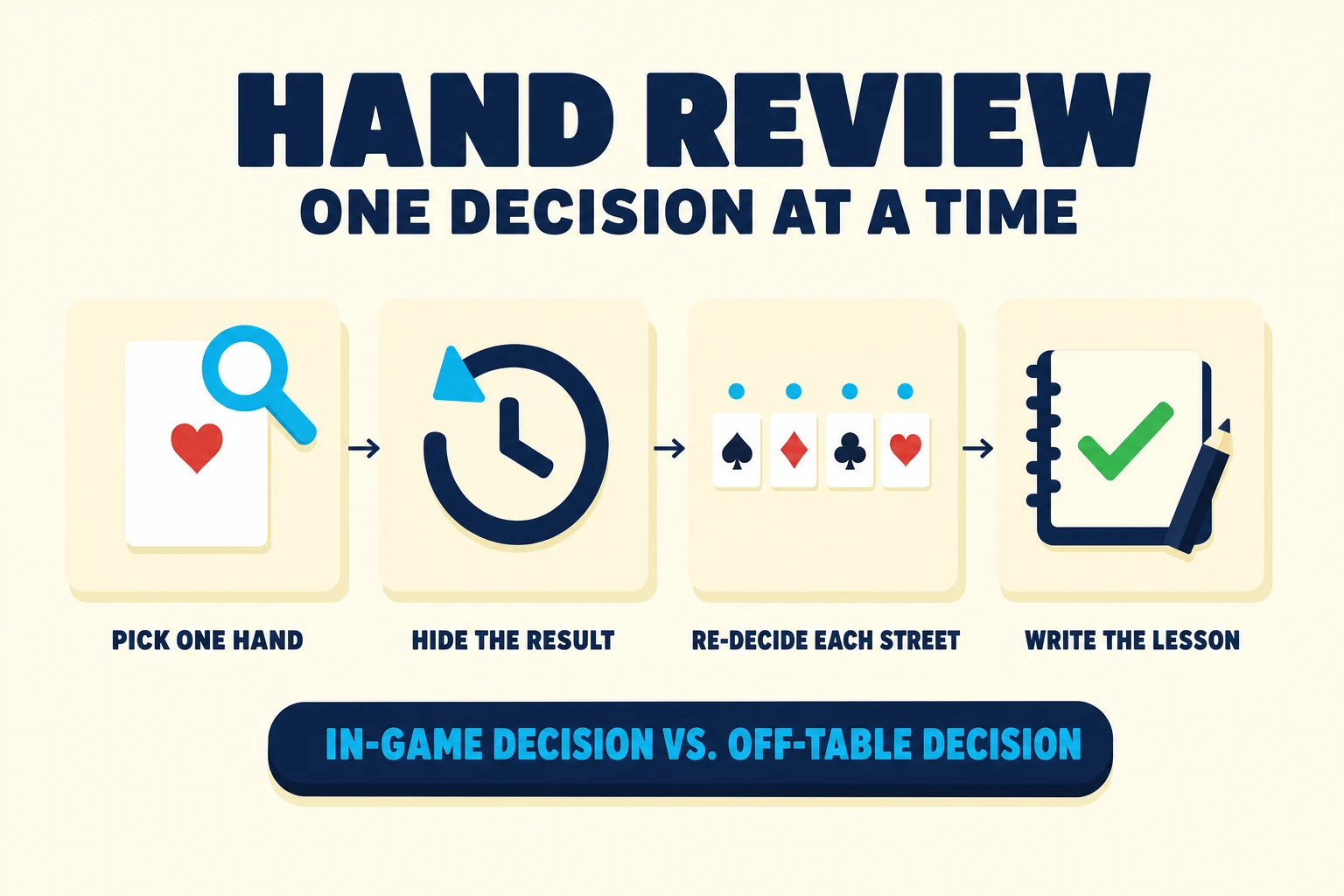
The mental shortcut: a hand review is not a verdict on whether you won the pot. It is a search for the moment your decision-making process did not show up cleanly. Find that moment, fix the process, and the same spot stops costing you in the next session.
Related terms
- Session review: the broader workflow that hand review sits inside.
- Expected value: the lens each re-decided action is held up against.
- Equity: the quantity you re-estimate at each re-decided street.
- Range: re-decide for the whole range first, then locate your specific hand inside it.
- Solver: the deepest tool in the review chain when a spot resists plain reasoning.
- Exploitative deviation: a common output once a review names a specific opponent leak.
Hand review vs. session review vs. just looking at the hand again
Three things often get called “review” and produce very different outcomes. The table is the cheap separator.
| What you do | What you actually study | Useful for |
|---|---|---|
| Hand review | One decision in one hand, re-decided cold. | Diagnosing what your in-game self missed in a specific spot. |
| Session review | The whole session, scanning for repeats and patterns. | Seeing structural leaks that show up across many hands. |
| Looking at the hand again | The river card and the result. | Reinforcing whatever story you already told yourself at the table. |
The third row is the one that masquerades as the first two. Reopening the hand history to confirm “yeah the river was unfair” is not review — it is rumination with a hand-history viewer open. The two real options leave the result to one side and ask what the decision looked like.
A practical pairing: mark hands during a session, run a session review the next day to pick the one or two spots that were structurally hard, and run a hand review on each of those. The session review tells you which hand to zoom into; the hand review does the zooming.
When a hand is worth reviewing
The biggest pots are not the most useful. The hands worth marking are the ones where your decision-making process did not show up clearly, regardless of pot size. In rough order of priority:
- Spots where the decision did not come easily. You hesitated, you were not sure of your action, you ended up clicking something and shrugging. The presence of friction is the signal — what you decided when you were unsure is exactly the decision worth re-deciding.
- All-in or call-off spots. These reduce to math: opponent range, your equity against that range, the price you are getting. A wrong call-off costs a stack at a time, so even small process errors are expensive.
- 3-bet, 4-bet, and other heavy-action preflop spots. Big preflop pots collide ranges that are by definition narrower and stronger; the cost of misreading is amplified.
- Hands you played on a read or a tell. Was the read real, or did you talk yourself into one? Reviewing these is how you build a calibrated sense of when your reads are worth acting on.
- Hands that felt easy at the table but should not have been. A spot where the answer felt obvious and the result was bad usually means the process skipped something the river then exposed.
By contrast, hands that fully match your standard process (pre-decided open, pre-decided fold, pre-decided 3-bet for value) are low priority. There is little to learn from re-deciding a spot you would re-decide the same way every time.
Example: replaying one tough turn spot
Say you played a 6-max NLHE cash session, 100bb effective, and marked one hand. The action:
- CO opens 2.5bb. You defend BB with K♠ T♠ and call.
- Flop comes Q♠ 9♠ 4♥. You check. CO bets 1/2 pot. You call with a flush draw and two overcards.
- Turn 8♣. You check. CO bets 3/4 pot. You call.
- River 2♦. CO bets pot. You hesitate, then fold. You win the next pot fine and move on, but the spot felt off.
The next day, you replay it cold. The flop call survives the re-decide easily — flush draw plus two overs against a wide cutoff continuation range is a defended hand by every honest map.
The interesting moment is the turn. You re-decide the turn for your whole defending range, not just K♠ T♠. Your range here contains pair-plus-draw combos that want to raise, pure flush draws that want to call, made hands like Q-x that want to call, and air that wants to fold. K♠ T♠ sits among the pure draws, a clear call against a 3/4-pot bet given the price and the redraw on a spade river.
That is exactly what you did. The action that wants attention is the river. Once the spade missed, K♠ T♠ collapsed to king-high with no showdown value. CO’s pot-sized river bet maps to two pairs and sets at the top, and busted gutshots and missed straight-draw combos at the bottom. With king-high, you are not bluff-catching against any of CO’s value hands and not outflopping any of CO’s bluffs; the fold is fine on the river.
The lesson lives one street earlier. The turn call price was correct, but the call also locked you into a river where missed flush draws end the hand with zero showdown value. Against a player who triple-barrels rivers credibly, the turn raise (turning the combo into a semi-bluff that picks up fold equity now and caps CO’s range for the river) is the alternative the in-game version did not consider. One sentence, filed in plain English: Against a strong turn double-barrel that polarises CO’s range, K♠ T♠ on the spade-draw turn is a candidate for a raise, not a call, when CO is the type of player who barrels rivers. That is the lesson. Repeat over the next month, and the same spot stops being a leak.
Common mistakes
1) Outcome thinking (“I won so it was right”)
The single most expensive habit in poker review. Judging a decision by the card that came is the flaw of hindsight: you lose the hand and instantly see what was wrong with the line, but the real question is why you did not see that information at decision time. A bad call that happened to win was still a bad call; a correct fold the river would have rewarded was still a correct fold. If your verdict on a decision changes when you change the river card, you are reviewing results, not decisions.
2) Reviewing only your own hand instead of the whole range
Re-deciding only what you specifically held is the slow path to the wrong answer. Strong study replays the spot for your entire defending range first, then locates your specific hand inside that map. K♠ T♠ on a flush-draw turn is a different decision when the rest of your range contains many made hands than when it does not. If you only ever re-decide for the cards you held, you stay stuck inside a hand-versus-hand mental model and miss why the line was right or wrong for everything else in your range.
3) Reviewing on tilt
Doing the review while the loss is loud means the review confirms whatever story tilt is telling you — the river was unfair, the call was right, the villain runs hotter than every other player on earth. The same hand reviewed two days later, with the run-bad/play-bad question asked honestly, often finds two decisions that quietly cost real money. The clean-room emotional posture of a chess post-mortem is the bar; tilt does not deliver it. Cool down first. Review tomorrow.
4) Reviewing without writing anything down
A lesson you remember on Sunday and forget by Wednesday is not a lesson; it is a thought. One sentence per reviewed hand, in plain English, filed somewhere you will reread it. The act of summarizing forces you to commit to what you actually learned, and the file becomes the input to next week’s session review, the place you check to see whether the same leak is showing up again under a different board texture.
FAQ
How long should a single hand review take?
Five to fifteen minutes is the working range for a routine spot. A spot you genuinely do not understand can stretch to thirty minutes once you start checking equities or building a small range chart. Longer than that usually means the question has gotten bigger than one hand can answer, and you are now studying a category — a different exercise, often better served by a structured lesson or a solver session.
Do I need a solver to review one hand?
No. A notebook and the hand history cover the first hundred reviews comfortably; an equity calculator earns its place once you find yourself estimating the same number twice. A solver is the deep end, useful when a specific spot resists plain reasoning, but only valuable once the easier review chain has narrowed the question down. Most hand reviews never need one.
How is a hand review different from “going over the hand with friends”?
Talking through a hand with friends is a useful input, but it is not the same exercise. Friends bring different reads, different default plans, and different priors; you usually leave the conversation with several plausible re-decisions instead of one. A real hand review still happens in your head, with your own ranges and your own opponent map. Use the conversation to surface options you missed, then go run the cold replay yourself and pick which one survives.