


Protected Range
A protected range keeps enough strong hands in a given line - especially your checks - so opponents cannot overbet it cheaply on later streets.

Practice this in Poker Skill. The Lead and Donk Bets lesson builds this kind of checking line out of position, checking pocket aces and bottom set along with the air so the check never gives the hand away.
Get the free appProtected range: keeping strong hands in every line
Definition: what a protected range is
A protected range is a range that still contains enough strong hands in a given line - usually a checking or calling line - that an opponent cannot blast it with overbets and assume you have nothing. The protection is not a feature of one hand; it is a feature of how you build the whole range that took that action. If your checks always include some sets, two pair, and overpairs, your checks stay credible. If your checks only ever contain medium pairs and busted draws, the range is unprotected and easy to attack.
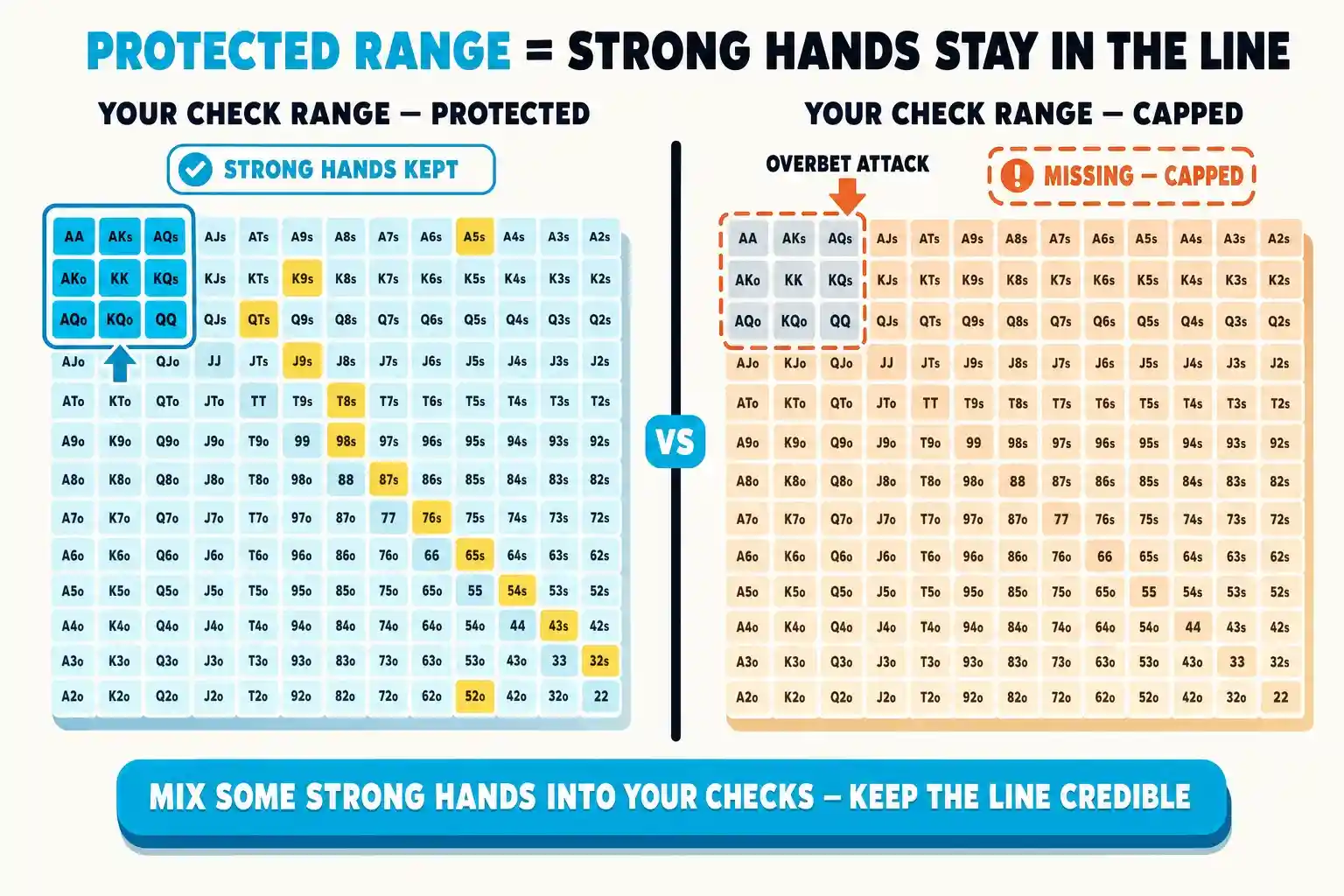
Plain English: protect your range means do not let one branch of your strategy become face-up. Mix some strong hands into the lines where you would otherwise look weak, so that line still threatens to call - or raise - when an opponent fires.
A useful mental shortcut:
- Strong hands left in the line = the line is protected.
- Strong hands stripped out of the line = the line is capped, and a thinking opponent will overbet it.
Related terms
Protected range vs capped, polarized, and range advantage
These four terms get used interchangeably and they are not the same idea. They live on different axes.
| Term | What it describes | Axis |
|---|---|---|
| Protected range | A line still contains credible strong hands | Range construction within a line |
| Capped range | A line is missing the top of the range | The failure mode protection prevents |
| Polarized range | A range splits into value + bluffs, no medium hands | Shape of a single range |
| Range advantage | Your overall range has more equity than theirs on this board | Comparison between two ranges |
Protection is about whether one of your lines keeps strong hands. Polarization is about how a single range is shaped. Range advantage is a comparison. A protected checking range can be polarized, condensed, or merged - the protection part is whether the strong hands are present, not how the rest of the range is built.
This also explains why “protect your range” is not the same as “deny equity with a bet.” Equity denial is a per-hand decision about one bet’s job. Protection is a range-level decision about how often a strong hand stays in a particular line so that line is hard to attack later.
When protecting your range matters most
Protection earns the most when a single street can change the size of the pot a lot - which is most of the time in 100bb 6-max cash. The spots where it carries real weight:
- In position on a dry, static flop. If a c-bet doesn’t fold out enough hands or get called by enough worse, the in-position raiser checks back. That checking range needs to keep some top pairs and overpairs, or the turn becomes an overbet target.
- Out of position with a wide preflop range. Big-blind defenders who only check-raise their nutted hands leave the rest of their flop check pure-defense. A turn overbet then runs through the whole call-flop-call-turn line.
- On paired or low-card flops where the betting range is narrow. If you only bet trips and overpairs, your checks are face-up as the rest. Mixing some trips into checks closes that read.
- Multi-street planning where stacks are deep. The deeper the stacks, the bigger an opponent’s overbet can be on the river, and the more an unprotected line bleeds.
When protection matters less:
- Short stacks. With 30bb effective, the stack will often go in by the turn, so the river overbet threat that punishes capped lines hardly exists.
- All-in or nearly-all-in spots. No future streets means no future overbets to worry about.
- Highly dynamic boards where every turn shifts range advantage so much that protection is less useful than just betting big with a polar range now.
Example: the A-8-2 check-back
Consider 6-max NLHE cash, 100bb effective. You open A♣K♦ from the button. The big blind calls. The flop is A♥ 8♣ 2♦ rainbow.
Two ways to play A♥K♣ here:
- Bet always. This treats AK as automatic value and protects nothing. After several thousand hands a thinking opponent notices: when you check this flop, you never have an ace. They start raising your turn checks and floating wide on the flop, knowing your check range is medium pairs and missed broadways.
- Mix in a check-back some of the time. Maybe 30 percent of your A-high hands check the flop. Now your checking line carries top pair, second pair, and air. When you check the flop, the big blind cannot lead the turn for two-thirds pot and expect you to fold AK. Their bluffs lose value. Your checking range is protected.
The math: against a typical big-blind defending range, AK on A-8-2 has roughly 75 percent equity. A small c-bet wins the pot a lot when called, but a check-back keeps the stronger ace combos in the line that gets the most attacked on later streets - the line you check.
The key idea is not “you should slowplay AK.” It is “your check range needs to credibly contain hands like AK so the big blind cannot fire away when you check.” How often you mix is a frequency question. Whether you mix at all is the protection question.
Common mistakes that cap your range
1) Raising every strong hand on the flop
The most common version of this mistake is raising every set, two pair, and overpair on a wet flop. The check-call line then becomes pure draws and one-pair hands. On a brick turn, your check-call is exploitable: the opponent fires a big bet, your range can never raise, and your folding frequency goes up. Mix a few sets into the check-call line and the threat returns.
2) Treating the check-raise line as nuts-only
If your turn check-raise is only straights and sets, opponents will start barreling small and pulling out before you can punish them. A protected check-raise carries some bluffs that block the value combos you cannot have - second-nut blockers, gutshots with backdoors. The protection is mutual: bluffs protect your value, and value protects your bluffs.
3) Confusing protection with slowplaying
Slowplaying a hand is one tactic that supports protection. It is not the same goal. A player who slowplays AA every time is not protecting their range - they are running a pattern that leaks once opponents notice. Protection means mixing: sometimes the strong hand goes into the bet line, sometimes into the check line. The mix is the protection, not the slowplay itself.
4) Protecting in spots where it does not matter
A range needs no protection when there are no future streets to defend against. Open-shoves on a 12bb stack do not need protection - the action ends preflop. A river bet on a runout where you cannot be raised does not need protection. Spending discipline on protection in those spots is wasted; spending it on flop and turn lines where overbets loom later is where the dollars are.
FAQ
What does it mean to protect your range in poker?
Protecting your range means keeping enough strong hands in each of your lines - especially your checking and calling lines - so that an opponent cannot blast that line with overbets and force you off everything. Practically, it usually shows up as occasionally checking a hand strong enough to bet, so your check range stays credible on later streets.
Is protecting your range the same as protecting your hand?
No. Protecting your hand usually means betting to deny opponents cheap draws - the equity denial idea, which is about one hand on one street. Protecting your range is about the structure of all the hands you could have in a given line, across many similar spots. The two ideas can point at the same bet sometimes, but the reasoning is different and the decisions diverge often enough that they are worth separating.
Should I always protect my range, or are there spots where I should not bother?
Protect aggressively in deep-stacked, multi-street spots where overbets loom on later streets. Skip it when the action is about to end - short stacks, all-in or near-all-in spots, river decisions where you cannot be raised. Protection costs frequency you spend elsewhere, so spend it where future overbets can actually punish a capped line.