


Table selection
Choosing which cash-game table and seat to sit at based on opponent quality. Picking softer opponents is often a bigger edge than out-playing tougher ones.
Table selection: choosing the seats that pay you
What table selection means
Table selection is the skill of choosing which cash game to sit in, and which seat to take inside that game, based on the players already there. The ideal target is a table where you are clearly stronger than most of the field, with the loose, aggressive opponents to your right and the careful regulars to your left. In cash games this is usually a bigger edge than any preflop range chart you can memorize, because you keep the option to stand up.
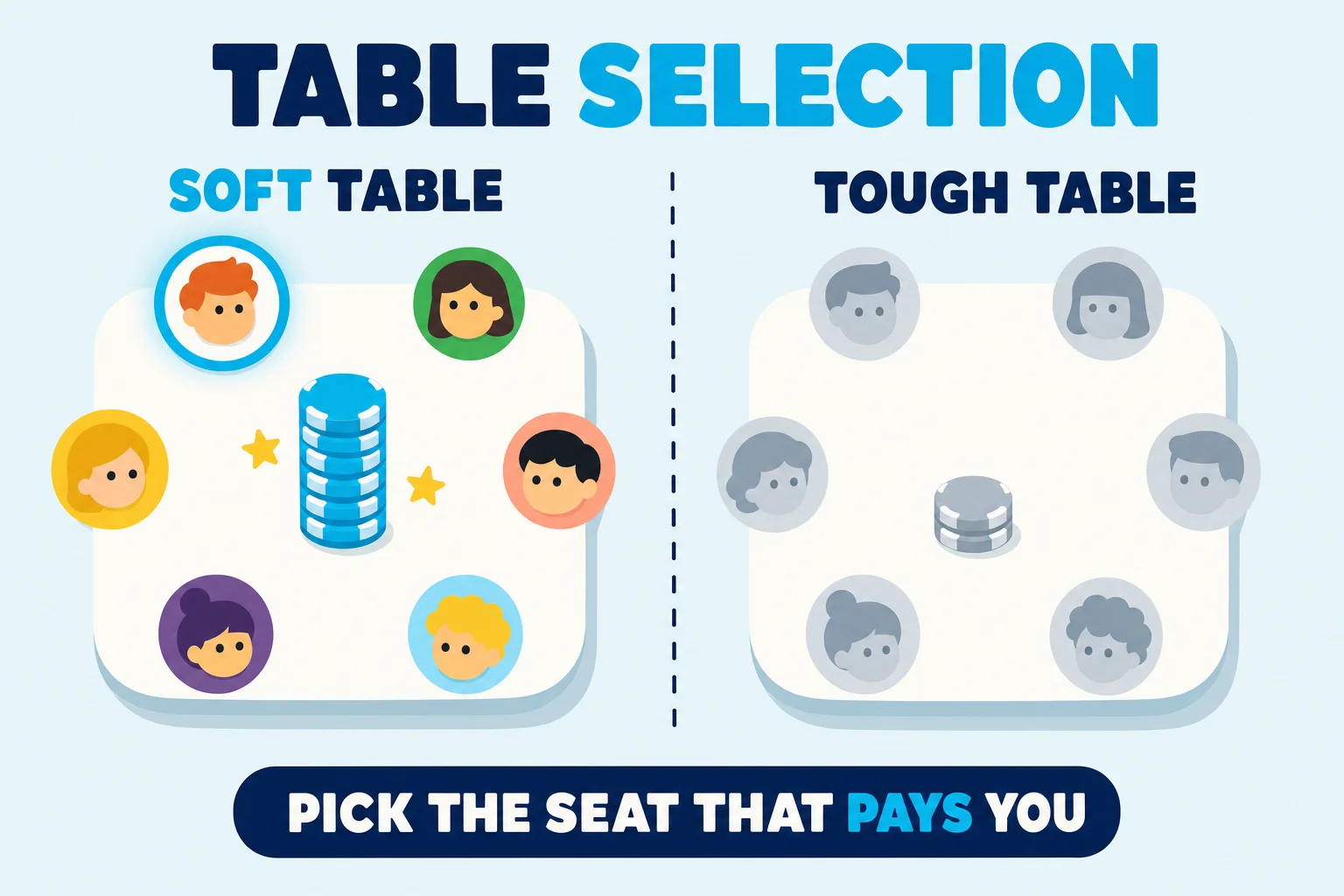
The mental shortcut: a strong player at a great table beats a great player at a tough table. A green light is a casual, talkative crowd with big average pots. A red light is a serious, headphoned table with steady raises and small pots. If the lobby has both, get on the change list and move when the better seat opens.
Related terms
- A calling-station is the type of opponent table selection most wants you sitting next to.
- A loose-passive seat full of limps and calls is the archetypal soft-table profile.
- A nit signals a tighter, tougher game and a smaller stealable pot.
- A regular seat to your left turns position against you and shrinks the win rate.
- The effective-stack sets how much money is actually in play between you and the big losers.
- Table selection is one branch of broader exploitative-play: choose where to sit before choosing how to play.
Soft tables vs tough tables: what to scan for
| Signal | Soft table | Tough table |
|---|---|---|
| Players talking and joking | Yes, often | Rare, mostly silent |
| Sunglasses and headphones | One or none | Most of the table |
| Average pot size | Large for the stake | Small relative to the blinds |
| Limpers preflop | Common, often multi-way | Rare, opens get respected |
| Showdowns shown down | Wide and surprising | Mostly strong holdings |
| Stack distribution | Mix of full and over-100bb | Lots of short stacks at 6-max |
| Your opens get 3-bet | Almost never | Frequently and from anywhere |
The cleanest single tell is average pot size. If small pots are getting fired three streets and called down by Q-high, the seat is paying you to take it. If every pot is a min-raise and a fold, the lobby has a better game somewhere else.
When table selection matters most
- Live cash, low-to-mid stakes. Live rooms have the widest skill spread and the slowest games. One soft seat for an evening can carry a week of online study.
- Short-handed play (6-max or less). Each player swings the table dynamic harder, so a single regular to your left costs more, and a single loose limper to your right pays more.
- Higher rake or time charges. Once the house is taking a real cut, you need a measurable edge over the field to break even. Softer games are how that edge gets paid.
- Online lobbies with multi-tabling regulars. The table you join is often a regular’s tenth table; the soft seats turn over fast and reward fast scanning.
- Stake jumps. When you move up, the field tightens. Picking a softer table at the new stake matters more than your usual edge at the old stake.
Table selection matters less when the format chooses the seats for you: tournaments, fast-fold pools, and home games where seating is fixed. Even there, the signals still help you decide whether to play the session at all.
Example: scanning a six-max lobby
It is a Friday night and you sit down to a $1/$3 online pool with three open six-max tables. You have a few minutes to choose; you give each lobby a fast read.
- Table A. Average pot $14, three players over 200bb, one player under 30bb, two seats with VPIP above 40%. Two open seats: one to the left of the biggest stack, one to the right.
- Table B. Average pot $7, all five seats stacked between 90 and 110bb, lobby VPIP under 20%. One open seat between two unfamiliar names.
- Table C. Average pot $9, two players above 150bb, three between 50 and 80bb, lobby VPIP around 28%. One open seat to the right of the biggest stack.
The right pick is Table A, the seat to the left of the biggest stack. The high pot size and the two loose seats price in the table’s softness. The seat puts the deepest, loosest opponent on your right, where their open-limps and squeezes act before you do. Table B is the trap: small pots, tight VPIP, even stacks, no obvious mistake-maker. Table C is mid-grade, playable if A fills, but the one open seat hands position to the deep stack.
Poker Skill has no cash games to choose from, but its CO vs One Caller lesson practices what that seat is for, raising pocket tens after a limp to play the limper heads-up.
Sit at Table A, get on the change list anyway, and re-scan in 30 minutes. If the deep loose stack busts and a regular fills the seat, the table has flipped and the change list pays for itself.
Common mistakes
1) Sitting first, scanning later
The biggest leak is taking the first seat the lobby offers without checking the other tables. The session fee is paid the moment you sit, so the cheapest move is to read every available game first and rank them before clicking a seat.
2) Sticking out of ego
A bad session can pull a winning player into the wrong story: they play tighter, get respected less, and stay because moving feels like admitting the table won. Cash-game books are blunt about this: ego is what costs the money. If your raises stop getting respected and your reads stop landing, the table has more information about you than you have about them, and a different seat is the cheapest reset.
3) Refusing to take an obvious seat change
When the seat to the left of the biggest losing player opens up, take it. Many players freeze because moving feels obvious or rude; the practical advice is to move quietly and use a neutral excuse so the table does not tighten up around you. The seat change is one of the few free profit moves in cash poker.
4) Reading the lobby off one stat
Stack sizes alone do not tell you the game is good. Average pot size, players-to-flop frequency, the spread of stack sizes, and the visible behavior of the table all matter together. A table with deep stacks but small pots and tight VPIP is a hard game wearing a soft costume.
FAQ
How long should I stay at a soft table?
As long as the conditions hold. Treat it as opportunity-driven, not clock-driven: stay while the game is good, leave when the dynamic changes. Concrete leave triggers include the key fish busting and reloading short, two regulars showing up to your left, your raises getting called down rather than folded, and your own focus slipping.
Is table selection still worth it for a winning regular?
Yes, and arguably more. The win rate of a steady winner is largely the gap between their game and the field’s. A soft seat widens that gap; a tough seat narrows it. Even a strong player has a hard time beating high rake at a tight table, and the same edge prints far more at a loose one.
Does table selection matter in tournaments?
Less, because the seats are assigned. You can still scan your starting table once the cards are in the air, take notes on who is wide and who is tight, and adjust opens, 3-bets, and bluffs accordingly. Some live rooms allow a casino seat-change list during a tournament; if your room does, get on it.