


10NL
10NL is the online shorthand for $0.05/$0.10 No-Limit Hold'em cash, the top rung of micro stakes. A full 100bb buy-in is $10.

Practice this in Poker Skill. Every preflop lesson is dealt at 100 big blinds, the depth of a full 10NL buy-in, so the opening decisions you’d face here get practiced with no real money in play.
Get the free app10NL: $0.05/$0.10 No-Limit Hold’em online cash
What 10NL means
10NL is the online shorthand for No-Limit Texas Hold’em cash with $0.05 / $0.10 blinds. The label points to the buy-in tier rather than the blinds: the “10” is the maximum buy-in in dollars, which corresponds to a full 100 big blind stack at the $0.05 small blind / $0.10 big blind level. You will see the same game written as NL10 on some sites and tracking software, and as $0.05/$0.10 NL in books and live-style notation. All three describe the same table.
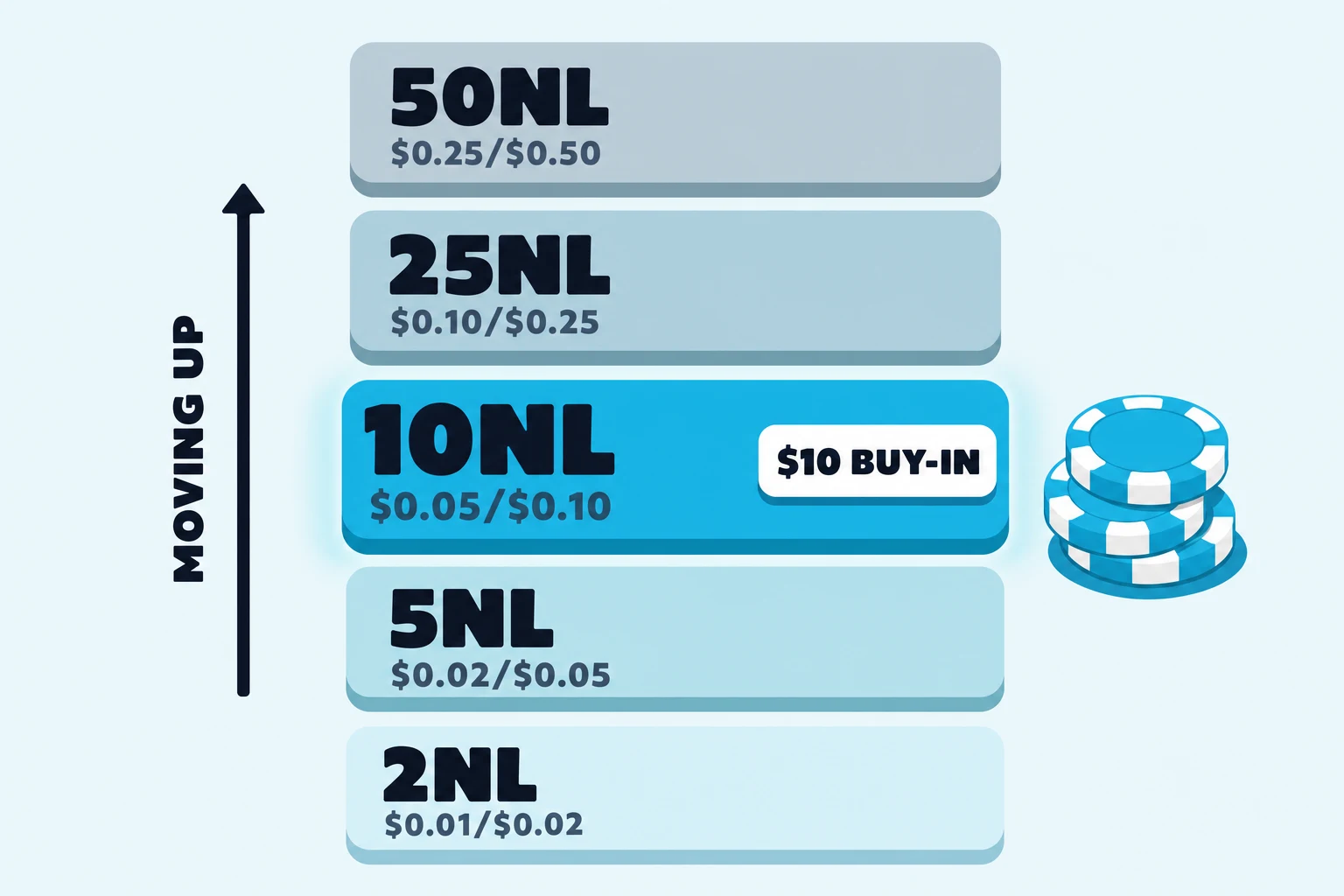
10NL belongs to the micro-stakes band, which spans roughly $0.01/$0.02 (2NL) up to $0.05/$0.10 (10NL). The rung above, 25NL ($0.10/$0.25), is usually treated as the bottom of the small-stakes band on most rooms. The 10NL game is almost entirely an online phenomenon; live cardrooms quote stakes by blinds and rarely use the NL shorthand at all.
Related terms
- Micro stakes: the parent band 10NL sits at the top of.
- Small stakes: the next band up, where 25NL and 50NL live.
- Cash game: the format 10NL is played in, with chips that equal real money.
- NLHE: the rules of the game played at every NL rung.
- Big blind: the unit stakes are quoted in (10NL has a $0.10 big blind).
- Stack depth: why a $10 buy-in still plays as a 100bb table.
- Rake: the per-pot fee that takes a noticeable share at this level.
- Bankroll management: the buy-in math that gates moving up to 25NL.
How 10NL compares to its neighbors
10NL is the top of the micros and the last rung before the small-stakes ladder begins. It plays differently from 5NL just below and from 25NL just above.
| Rung | Blinds | 100bb buy-in | Band |
|---|---|---|---|
| 5NL | $0.02/$0.05 | $5 | Micro |
| 10NL | $0.05/$0.10 | $10 | Micro |
| 25NL | $0.10/$0.25 | $25 | Small |
| 50NL | $0.25/$0.50 | $50 | Small |
The pool tightens as the rungs climb. Average opponents at 5NL include a lot of brand-new players testing real money for the first time; at 10NL the population shifts toward casual recreational players plus a layer of multi-tabling beginners trying to grind out a clear winrate; at 25NL the average opponent has more reps and the loosest leaks start to disappear. Rake takes a noticeably smaller share of each pot at 25NL than at 10NL, because the cap is similar across the band but the pots are bigger.
When 10NL matters most
The label is more useful than it looks. Knowing that a game is 10NL frames decisions you would otherwise have to figure out by sitting down and watching.
- When you pick a starting rung. 10NL is a common first stop for players who already know NLHE rules and want to play cash with real money attached. The buy-in is small enough to absorb early mistakes, large enough that the result feels real.
- When you set a session bankroll. A typical session at 10NL might cover one to four buy-ins of risk, or $10 to $40. That sizing keeps a single bad night from threatening the full bankroll.
- When you plan a move up to 25NL. Most communities treat 25 to 40 buy-ins as a reasonable cushion for moving up at the micros, which means a 10NL grinder is usually thinking about 25NL once their bankroll is somewhere between $625 and $1,000. Books frame this as bankroll adequacy and variance tolerance rather than a fixed rule.
- When you read advice from higher stakes. Strategy that works at 100NL or 200NL often leaves value on the table at 10NL. The pool is looser, fold equity is lower, and value bets pay more often than thin bluffs.
- When you account for rake. Rake takes a meaningful share of every 10NL pot. A line that is a small winner at gross pot odds can be a small loser once the rake is removed, especially in three- and four-way pots.
Example: a typical 10NL pot
You are six-handed at 10NL with a 100bb stack ($10). The room takes 5% rake capped at $0.50. A loose recreational player limps under the gun for $0.10. You raise to $0.40 from the cutoff with ♠A♠Q. The big blind calls. The limper calls. Three players take the flop and the pot is $1.20.
Flop ♠Q♣9♥4. The big blind checks. The limper checks. You bet $0.80 for value, just under two-thirds of the pot. Both players call. Pot is now $3.60.
Turn ♣7. Both players check to you. You bet $2.00 for thin value against second pair, third pair, and small flush draws. The big blind folds. The limper calls. Pot is $7.60.
River ♥2, a clean blank. The limper checks. You bet $3.00 for thin value. The limper calls and shows ♣Q♦8 for top pair, weaker kicker.
- Gross pot at showdown: $1.20 preflop + $1.60 flop + $4.00 turn + $6.00 river = $12.80.
- Rake taken: 5 percent of $12.80 caps at $0.50.
- Net pot you scoop: $12.30.
The hand turned on three small value bets against an opponent who would not fold once they had a piece. No bluff was attempted. The line works because of who the opponent is, not because the math at 10NL is special.
Common mistakes at 10NL
1) Treating 10NL like a smaller version of 100NL
Solver-style ranges built for 100NL or higher leave value on the table at 10NL. The pool 3-bets less, folds less, and calls down with a wider range of weak top pairs. A direct copy of a 100NL preflop chart will be too tight, too balanced, and too dependent on fold equity that does not exist at this rung.
2) Bluffing into stations
Multi-street bluffs need an opponent who can fold. 10NL pools have plenty of players who call any single bet with bottom pair or a backdoor draw. The fix is usually narrower than people expect: bluff less, value bet more, including thin value with second and third pair on safe rivers.
3) Moving up before the bankroll is ready
The jump from 10NL to 25NL is a 2.5× step in blinds and buy-in. A 10NL winner with a $200 bankroll is one bad session at 25NL away from being back at 10NL with less. Most micro-grinders treat 25 to 40 buy-ins for the next rung as the working cushion, and treat any single deep downswing as a signal to drop back to the rung that is already beaten.
4) Forgetting rake on every marginal pot
Capped rake takes a heavier share of a small pot than a big one. A close flop call that breaks even at gross pot odds is a small loser at net pot odds at 10NL. The right reflex is to lean toward folding when a call is borderline, and to lean toward the line that wins the pot earlier.
FAQ
Is 10NL the same as NL10?
Yes. 10NL, NL10, and nl 10 are interchangeable notations for the same game: $0.05/$0.10 No-Limit Hold’em cash. The first form is more common on US-facing sites and most poker forums; the second form shows up more on European sites and on some tracking software. The literal form $0.05/$0.10 NL is what books and live cardrooms use.
How much money do I need to play 10NL?
A single full buy-in is $10 at 100 big blinds. A working session bankroll is two to four buy-ins, or $20 to $40, which absorbs normal variance for one sitting. A more cushioned bankroll for grinding 10NL over many sessions and possibly moving up to 25NL is usually framed as 25 to 40 buy-ins, or $250 to $400. Books treat the move-up decision as bankroll adequacy and variance tolerance rather than a fixed buy-in count, so the exact number depends on how much swing you are willing to ride out.
What kind of player will I see at 10NL?
The 10NL pool is mostly casual recreational players and beginners who have moved up from 2NL or 5NL. You will see frequent multiway pots, loose preflop calls, sticky flop calls with bottom pair and weak draws, and very few well-balanced 3-bet ranges. A simple, tight, value-heavy game plan does most of the work; the bigger edge at this rung comes from patience and pot selection rather than fancy postflop lines.