


Cold deck
A poker hand where the cards line up so badly the loser had no real way to fold. Used as a slang sister to cooler, often as the verb cold-decked.
Practice this in Poker Skill. Grading the decision instead of the result is how the Daily Puzzle works: you get one spot a day, every option in it is graded, and no runout ever changes the grade.
Get the free appCold deck (also “cold-decked”)
What cold deck means
A cold deck is a poker hand where the cards line up so badly that the player on the losing side had no real way to fold. In modern No-Limit Hold’em it is used the same way as a cooler — two strong holdings collide, the loser was already behind when chips went in, and the runout did not save them. The verb form, “cold-decked,” is the common slang for being on the receiving end. The phrase comes from old card-room cheating, where a stacked or pre-arranged “cold” deck was swapped in mid-game; today the cheating sense is gone and only the fatalistic flavor of “the cards were stacked against me” remains.
There are three usages worth keeping straight:
- The single hand cold deck. Identical in meaning to a cooler. Set over set, KK preflop into AA, smaller full house into bigger full house. The cooler entry is the canonical home for these matchups.
- The verb form, “cold-decked.” “I got cold-decked” means “I lost a cooler.” Past tense, passive voice, no claim that anything was misplayed.
- The session-long “deck got cold.” A live-poker idiom for a long stretch of unplayable starting hands. The technical name is being card-dead; the deeper anchor is variance, not a cooler.
Related terms
The decision-review test is the same one cooler uses: would I make the same play face-up? If yes, the loss was either a cold deck or a bad beat. If no, the cold-deck label is hiding an overplay.
Cold deck vs cooler vs bad beat
Three labels, three different shapes. Naming the right one is how a hand goes from “I ran bad” to “I learned something.”
| Frame | What the label says | Was the loser ahead at all-in? | Was a fold available? |
|---|---|---|---|
| Cold deck | The cards lined up to lose; same situation as a cooler | No — already behind when chips went in | No — strong vs stronger |
| Cooler | Two strong hands clash, no fold available | No — already behind when chips went in | No — strong vs stronger |
| Bad beat | Strong hand was the favorite at all-in and got run down | Yes — favorite at the moment chips went in | Maybe, but the call was correct |
Cold deck and cooler are the same hand wearing two names. The technical writers prefer “cooler”; the live-poker dialect prefers “cold deck” and the verb “cold-decked.” A bad beat is a different shape — the loser was ahead at the moment of all-in and got drawn out on a later street. Casual talk smears these together, and the smear costs review time. A loss that gets called a cold deck when it was really a bad beat (or a suckout) hides which fix the player needs.
When a hand really is a cold deck
These are the matchups NLHE strategy books treat as canonical coolers; cold-decked is the same set of spots in slang. Each is rare; together they explain almost every honest cold-deck claim.
- Pocket kings vs pocket aces preflop, all-in for stacks. KK has roughly 18-20% equity. When you have KK, the chance the table holds AA is about 1 in 26. Folding KK preflop in a normal cash spot is not a habit strong play wants. Going broke is the price of getting paid the other times.
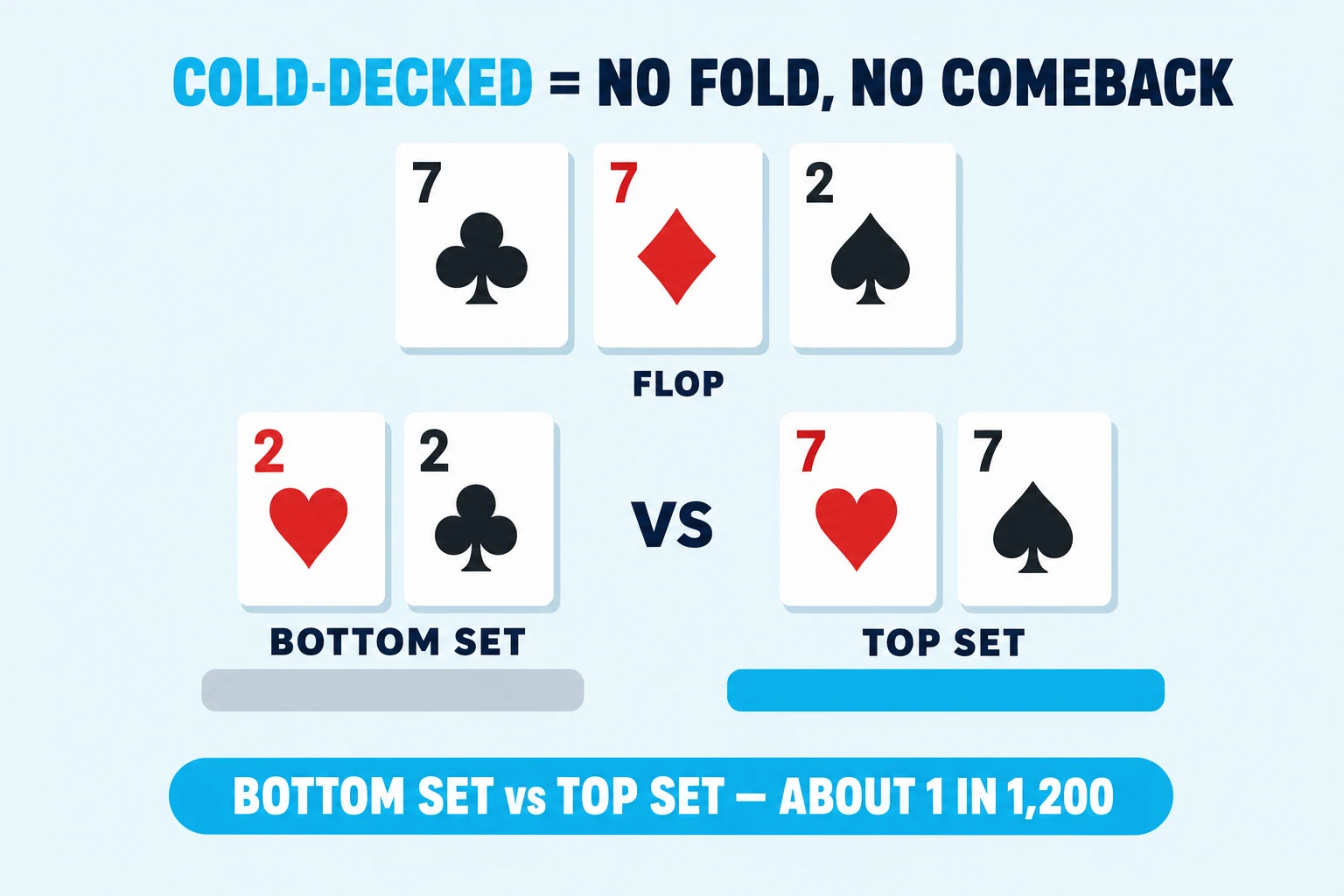
- Set over set on the flop. Bottom or middle set collides with top set. Across the field this is roughly 1 in 1,200 hands when both players hold a pocket pair. The lower set is drawing thin, the higher set is stacking off, and neither hand was foldable to standard postflop pressure.
- Bigger full house over smaller full house on a paired river. Both players make a full house when the river pairs the board, and the kicker decides it. Most of these complete on the river itself, exactly when both ranges are already committed.
A non-cold-deck example for contrast: an overpair facing a flop check-raise on a low connected board. The overpair is one pair. The check-raising range is loaded with sets, two pair, and combo draws that have it crushed or close. Stacking off and saying “I got cold-decked” is the most common version of the misuse.
Example: bottom set vs top set on the flop
The textbook cold deck, walked at 6-max NLHE cash, 100bb effective stack.
Setup: You open 7♠7♥ to 2.5bb from the cutoff. The button calls. Both blinds fold. Pot is 6.5bb going to the flop.
Flop: 7♣ 7♦ 2♠. You have flopped quads — but for the same teaching example, suppose you held 2♥2♣ instead and your opponent held 7♥7♠. You have bottom set. The opponent has top set. The pot is 6.5bb.
Action: You bet 4bb. The button raises to 14bb. You re-raise to 36bb. The button jams 100bb. You call.
The math:
- Bottom set vs top set on a non-flush, non-straight flop runs about 4% / 96% to the river, with a quads draw on a single deuce out and a runner-runner higher full house hidden in the deck.
- The pot at the moment of call is roughly 175bb (your 36bb + their 100bb + the dead 6bb). You’re putting in another 64bb to win 111bb. Break-even equity is 64 / (64 + 111) = about 37%. Your 4% is nowhere near the line; EV(call) is about 0.04 × 111 - 0.96 × 64, which is roughly -57bb compared to folding.
The face-up test: if both hands turn over before the runout, the call is a clear chip-EV mistake. So why is bottom set still a cold deck and not an overplay?
Because the question isn’t “what was the EV face-up?” It’s “what was the EV against the range that jams 100bb after a flop raise war?” That range is heavy with bigger sets, the rare overpair that misplays, and a small pile of bluffs. Bottom set crushes the bluff portion and is in front of overpairs that get there. The number gets pulled down by the higher-set combos that show up roughly 1 in 1,200 times you flop a set, but the call is correct against the range. Folding bottom set on the flop on this board concedes too much money the other times. The line was reasonable. The cards just sat where they sat.
That is what “cold-decked” names: a defensible line that meets a hand it could not fold, in a spot that does not repeat often.
Common mistakes when calling a hand a cold deck
1) Stacking off with an overpair and calling it a cold deck
An overpair is one pair. Even AA on a low rainbow flop is one pair. When the villain check-raises a connected board for two-thirds pot and jams the turn, the range is overweight on sets, two pair, and the rare big draw. Stacking off and saying “I got cold-decked” hides the leak: the player paid off a range that had them crushed. The fix is reading the board and the line, not folding fewer overpairs across the board.
2) Using “cold-decked” for a bad beat
The slang travels. “I got cold-decked” gets used after losing AA to 7-2 when 7-2 rivers a deuce, which is a bad beat, not a cold deck. The mechanism is opposite: in a bad beat the loser was a favorite when chips went in and got drawn out; in a cold deck the loser was already behind. Different fixes. Bad beats need patience; cold decks need acceptance. Mixing them up muddles every review session.
3) Calling a card-dead session a cold deck
A live-poker stretch of unplayable hands sometimes gets framed as the deck “running cold.” The deeper name for the run is variance, and the framing is more useful: the hands you got dealt were a sample, and the sample will normalize. Cold-deck-as-session does not exist as a separate strategic concept; treating it as one tilts the next hour’s decision-making.
4) Letting “cold-decked” become tilt cover
The next ten hands after a real cold deck are where most of the damage actually shows up. The instinct is to win the chips back, and the cold-deck label is a story that justifies looser calls and bigger bluffs as “earning back what was taken.” Real cold decks are almost free of moral content. Treat them like a rake bill: a cost of doing business that does not change how the next hand should be played.
FAQ
Is a cold deck the same thing as a cooler?
For the single-hand sense, yes. “Cold deck” and “cooler” both name a hand where two strong holdings collide and the loser had no real way to fold. The verb form (“I got cold-decked”) is the only piece the cooler entry doesn’t carry on its own. If you want the canonical strategy framing, the cooler entry is the longer write-up; this entry is the slang home and the verb form’s anchor.
What does “cold-decked” mean when a player says it?
“Cold-decked” is past-tense slang for losing a cooler. “I got cold-decked” usually means a strong hand collided with a stronger one for stacks and there was nothing reasonable to do about it. It does not by itself imply cheating, even though the term came from a cheating practice (a stacked deck swapped in mid-game) in the 19th century.
Can the deck really run cold for a session?
Statistically, a session of unplayable starting hands is just a small sample of variance. The deck doesn’t have a memory and the cards don’t know the player’s results. The “deck ran cold tonight” framing is fine as venting; treating it as a strategic concept is where it goes wrong, because it can justify loosening up in spots that don’t reward the loosening. The fix for a card-dead stretch is the same as the fix for a real cold deck: keep the decisions clean and let the sample grow.