


Punt
A punt is one self-inflicted bet, raise, or call that throws away a stack you should have kept. The line had a fold available, the player ignored it, and the chips left the seat.
Practice this in Poker Skill. The Give Up on Purpose lesson practices giving up on the turn, checking ace-nine when a king lands that fits the caller instead of firing again.
Get the free appPunt: throwing chips at a pot you should have given up
What a punt is
A punt is one self-inflicted bet, raise, or call that gives away a stack the player did not have to lose. The line had a fold available. The player ignored it. The chips left the seat. Books in the No-Limit Hold’em corpus describe the same behavior under nearby labels — spew, blasting off, getting felted, tilting off — and treat it as a decision-making error rather than a card-runout problem. The shape is short: one decisive action, a clear cheaper alternative, and a stack now sitting on the other side of the table.
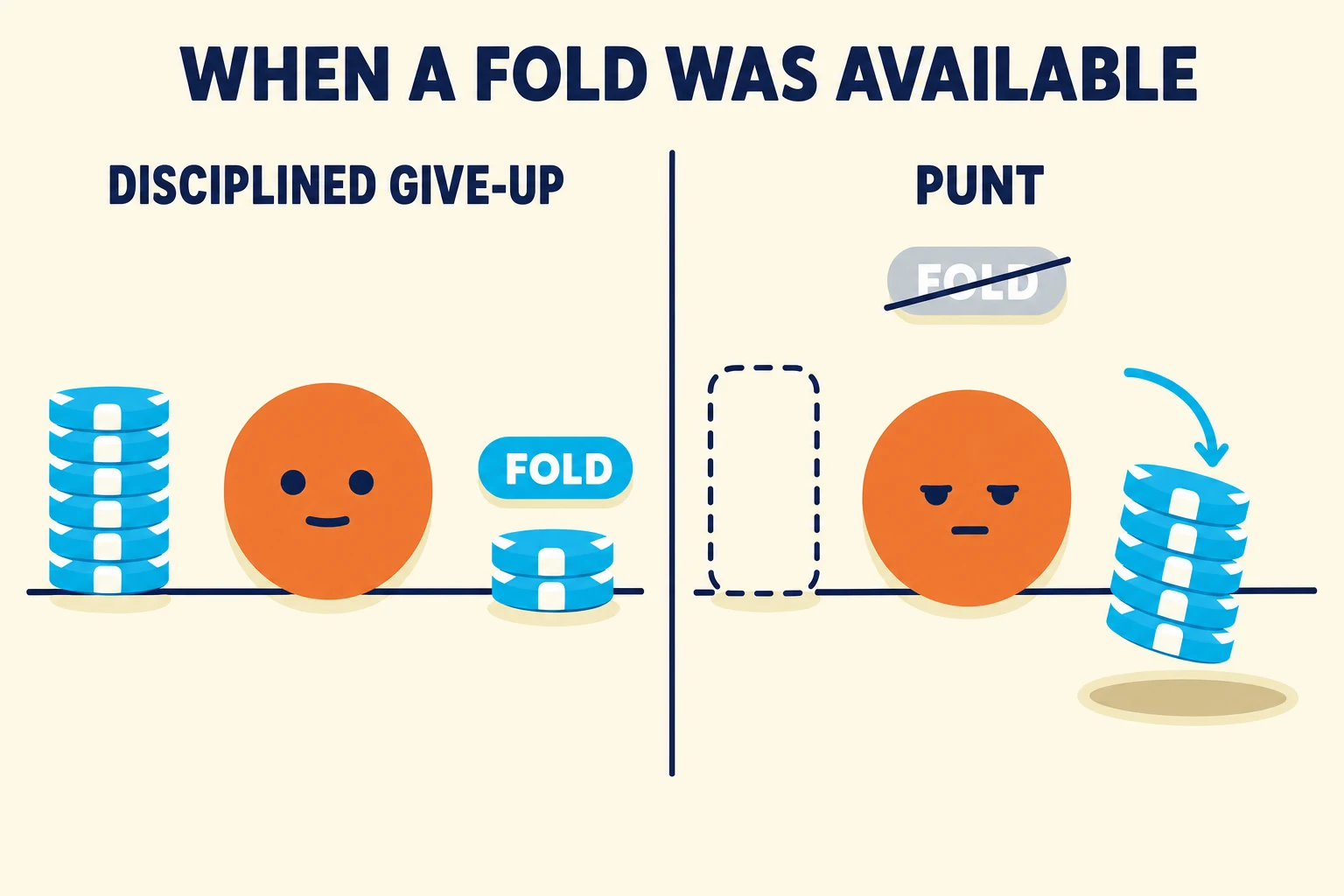
The recognizable signature is short:
- The chips went in on one decision, not across a slow leak of a session.
- A clean fold (or a smaller line) was visibly available before the bet was made.
- The line does not survive a face-up review: replayed with both hands turned over, the player would not make it again.
Related terms
Punt vs cooler vs bad beat vs missed bluff
Same losing pot, four different shapes. Sorting which one really happened is most of the work in any honest review.
| Frame | Was a fold available? | Where the equity sat | What the loss is teaching |
|---|---|---|---|
| Punt | Yes — clearly, before the chips went in | Player was behind or had no fold equity, and chose to push anyway | A decision-making leak. Fixable. |
| Cooler | No — the loser was never folding given the spot | Loser was already behind; both strong hands were going to commit | Almost no lesson. Cost of doing business. |
| Bad beat | Maybe — but the call was correct on the math | Loser was the favorite when chips went in; villain hit a long-shot draw | Patience. The math was right; the runout was not. |
| Missed bluff (planned) | Not really — the bluff was part of a balanced line that occasionally fails | Player had a planned give-up if the runout went wrong; it just got called this time | Almost none if the line itself was sound; review the read, not the chips. |
A punt is the only category on this list with a fix the player owns. Calling a loss a cooler when it was a punt buries the lesson; calling a punt a bad beat moves the cause to the cards. The face-up test is the cleanest separator: would I make the same play with both hands turned up? If no, it was a punt.
When the label “punt” really fits
Not every losing hand is a punt, and not every long bluff is one either. The label fits when the player chose the bigger loss over the smaller one for a reason that did not survive contact with the spot.
Where a punt is usually the honest label:
- A river overbet jammed with bluff-catcher strength on a board where the opponent’s range is mostly strong made hands and a sliver of showdown value. The opponent’s line did not credibly include enough air; calling the jam was the leak.
- A turn check-raise made in frustration after the player had been bluffed on a previous hand, with no read or range support for the move on this board.
- A 4-bet shove with a hand that does not beat the calling range, made because the player “felt committed” rather than because the math approved it.
- A planless triple-barrel: the c-bet flop, second-barrel turn, and river jam were all made without a give-up plan, and the river jam went into a range that almost never folded.
- A deep-stack call-down with one pair on a wet board, against a line whose strong-hand frequency the player had already counted off and ignored.
Where the loss looks like a punt but is something else:
- A correct call-down with a bluff catcher where villain happens to show up with a hand. If the read on the line was right and the math approved the call, one losing showdown does not turn the call into a punt.
- A planned bluff on a runout that gives the opponent a fold-able range; the bluff just got picked off this time. The line was sound; the result is variance.
- A clear cooler shape, like pocket kings into pocket aces preflop at 100bb, or set-over-set on the flop. Both hands had no fold; the chips were always going in.
- A bad beat: favored at the moment of all-in, drawn out on a later street. The chips moved because of the runout, not because of the decision.
The honest review test is the same one the books point at: would the same hand, played face-up against the opponent’s range, be the same line? If yes, the chips just went the wrong way. If no, the line was a punt.
Example: 100bb 6-max NLHE cash, the river-jam punt
100bb effective, $1/$2 6-max NLHE cash. Hero opens A♣J♣ from the cutoff to $6. The big blind, a tight regular who has folded most preflop confrontations all session, calls.
Flop: J♥ 8♥ 4♠. Big blind checks. Hero c-bets $7 into $13 with top pair, top kicker. Big blind calls.
Turn: 6♣. Big blind checks. Hero bets $20 into $27 for value and protection against draws. Big blind raises to $58. Hero calls. Pot is $143; effective stack remaining is $109.
The check-raise is the moment the line should slow down. The big blind’s check-raise range on a wet J♥ 8♥ 4♠ 6♣ board is loaded with two pair (J-8 suited, 8-6 suited, J-6), sets (8-8, 6-6, 4-4), turned straights (7-5 and 9-7), and combo draws (flush draws with a gutshot). A-J has top pair, top kicker. Against the check-raise range as described, A-J is behind most of the made hands and racing the draws. The book line here is to call the turn with the plan that strong-river-action means fold; bet-fold preflop equity does not carry that far.
River: 2♦. Big blind leads for $80, sizing up small for them on a brick. Hero shoves the remaining $109. Big blind calls with 8♣8♠ for a turned set.
Where the punt enters the line: the river jam over a $80 lead bet. With one pair on a J-8-4-6-2 board after a turn check-raise, the opponent’s range almost never folds to the jam. Two pair, sets, and turned straights call instantly. The bluff-catcher hands the opponent might keep are limited and overweight to draws that already missed. The face-up version of the line — both hands turned over before the river action — is a clear bet-fold or check-call decision, not a jam. The jam is the punt.
The cleaner river plays were either call the $80 lead and snap-fold a raise, or check behind if hero had checked back the turn instead of calling the check-raise. Both lines preserve roughly $109 the actual line gave away. The hand the cards dealt was a strong second-best hand on a bad board; the chips that went in on the river were the player’s own.
Common mistakes
1) Calling every losing hand a punt
The opposite of treating coolers as punts is treating real coolers and bad beats as punts. Pocket kings into pocket aces all-in preflop at 100bb is not a punt; it is a cooler. A correct flush-draw call that misses on the river is not a punt; the math approved the call. The label only earns its keep on losses where the line itself was the cause. Mislabeling everything a punt is its own leak. It makes the player tighten up where they should not, and miss the lessons where they should.
2) Punting under tilt and not naming it
The corpus explicitly links tilt to “tilting off all your money” through mistimed aggression and bad decision-making. The dangerous case is the player who knows they are on tilt and continues to play under it, then labels the resulting punt a cooler in the post-mortem. The fix the books point at is not technical: it is a stop-loss before the session, a real break after a bad beat or a cooler, and the willingness to leave the table when the next decision will not go through the same filter as the calm ones did.
3) Over-bluffing rivers without a give-up plan
A planned bluff is a bluff that has a runout map: if the river is X, fire; if it is Y, give up. A punt-shaped bluff has no map, just an instinct that “they will fold to enough pressure.” On wet boards, against ranges loaded with strong made hands, the give-up is what protects the value bets the player makes the rest of the night. Firing a third barrel into a range that almost never folds is not bold; it is one of the cheapest punts available. The fix is to draft the give-up plan on the turn, not the river.
4) Calling off a river overbet without a real read
The hero-call shape of a punt is its own genre. The disciplined call has a read-supported answer to what hands is the opponent betting like this with that I beat?, usually some quantity of credible bluffs in the range. The leak shape has no answer beyond “they could be bluffing.” The book test is whether the line and the runout actually create credible bluffs in villain’s range. If the answer is “not really,” calling is the punt and folding is the disciplined line. The loss of one big bet is much smaller than the rest of the stack.
5) Deep-stack punts that look like value
The 100bb shape and the 250bb shape of the same hand are different problems. As stacks deepen, two-pair and set-over-set punishment grows faster than the equity of one-pair hands. A player used to calling off 100bb with top pair on a coordinated board will keep doing it at 200bb and 300bb without noticing the line has stopped being correct. The punt here looks like a value bet to the player making it; the bigger pot just happens to come from a hand that has them crushed. The fix is the same one the books always point at: think effective stack, and update the threshold before the river arrives, not after.
FAQ
What is a punt in poker?
A punt is one self-inflicted bet, raise, or call that gives away chips the player should have kept. The line had a fold or a smaller alternative available, and the player took the bigger loss anyway. The textbook examples are a planless river jam, a hero call against a line that almost never bluffs, and a 4-bet shove made on feel rather than range math. Punts are not card-runout losses; they are decision losses, which is what makes them fixable. The honest test is the face-up review: would the same line survive with both hands turned over?
Is a punt the same as a cooler?
No. A cooler is two strong hands meeting and neither one folding given the spot — pocket kings into pocket aces preflop at 100bb is the textbook version. A punt is a self-caused stack loss where a fold was clearly available and the player ignored it. Calling a real cooler a punt punishes a fine line; calling a punt a cooler hides the leak. The cleanest separator is the same one books use for review: was the loss because of what the cards did, or because of what the player chose? If the cards just sat where they sat, it was a cooler. If the player chose the bigger loss over the smaller one, it was a punt.
How do you stop punting?
The corpus answer is not a single drill; it is session discipline. Set a stop-loss before sitting down — three buy-ins is the small-stakes default — and treat cash poker as one long session rather than a series of standalone results. Ask the four review questions on every hand you stack off: was this a value spot or a guesswork spot, was I continuing because the math supported it or because I did not want to fold, is this opponent the type who folds to pressure, and was the implied-odds story real? When the answers turn into hand-waving, the next aggressive line is usually a punt. The discipline is to slow the line down before the chips do.