


Crying Call
A crying call is a river call you make expecting to lose, because the pot odds say folding too often would cost more than this one bet ever will.
Practice this in Poker Skill. Refusing to fold too often starts on the flop in the defender lessons: A♥ 7♣ calls a bet on Q♦ 7♠ 2♥, because middle pair with the best kicker beats the missed hands that bet.
Get the free appCrying call
What a crying call is
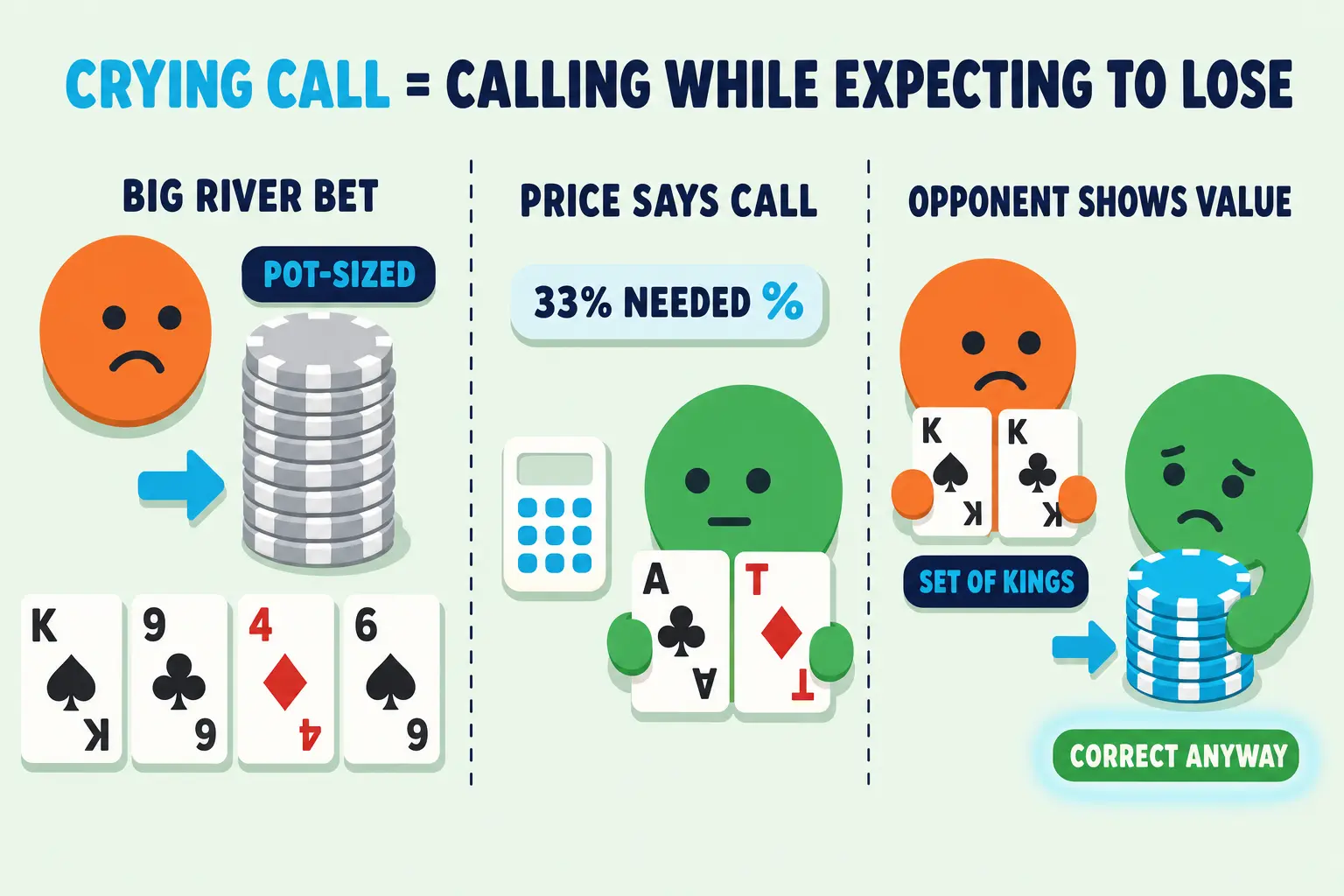
A crying call is a river call you make expecting to lose. The pot is big, the bet looks loud, and your hand has gotten worse on every street. You call anyway because the price the pot is laying says folding the whole class of hands you’ve gotten here with would cost more than paying this one bet off. The name is theatrical; the math is not. A crying call is the reluctant face of a bluff-catch, made when your read says villain probably has it and your defense frequency says you still have to pick off the bluffs that occasionally show up.
Three calls feel similar at the table and behave very differently long-term:
- Crying call. You expect to lose, but you call because the price clears your defense threshold and your line has to keep some bluff-catchers in it.
- Hero call. You expect to win, because something specific (the line, the size, the blockers, a population read) flips villain’s range toward bluffs. The price still has to clear, but the read does some of the work.
- Station call. You call because folding feels uncomfortable. You don’t price the bet, don’t read the line, don’t check blockers. The pattern leaks money even on the times you happen to win.
A crying call is not a guess. The reason you can write down before clicking call is “I have to defend something here, and this hand is the cheapest defense I’ve got.” That is a poker reason. “I want to see what he had” is not.
Related terms:
Crying call vs hero call vs station call
| Decision | Trigger | What you’re pricing | Long-run result |
|---|---|---|---|
| Crying call | Big bet, polarized line, your hand is the cheapest defense unit you’ve got left | Pot odds vs. minimum defense frequency | Break-even or small loss on the hand, profit on the strategy that keeps you from over-folding |
| Hero call | Big bet, polarized line, plus a structural reason villain’s range tilts toward bluffs | Pot odds vs. estimated bluff frequency, supported by a specific read | Profit on the hand when the read is real |
| Station call | ”I just want to see it” | Nothing; the price isn’t actually checked | Net loss across thousands of repetitions |
The honest difference: a hero call expects to win the pot in front of it; a crying call expects to lose it and still be net profitable across the spots that look like it. A station call doesn’t think about either.
When this matters most
Crying calls show up in spots where the river bet looks loud and your hand looks small, but folding everything that looks like your hand would let villain run the whole street with anything:
- Pot-sized river bets after you’ve shown weakness. You called the flop, called the turn, and the river bricks. Villain bets pot. Your bluff-catcher needs about 33% to break even, and you have to defend roughly half your range to stop villain from auto-profiting on bluffs. If your hand is the cheapest defense unit you’ve got left, it stays in.
- Polarized lines on busted-draw runouts. When obvious draws miss, the river bet that “represents” them is exactly the bet you’re being asked to fold to. The math here is the cleanest because villain’s range really does split into nuts and air.
- Big multiway pots where you’ve been calling down. The pot is huge from earlier streets, the river bet is small relative to that pot, and your one-pair hand will lose to value most of the time. Pot odds still say call. The hand feels bad even when the call is right.
- Short-stack rivers where the bet is most of villain’s stack. When the bet size makes the call automatic for stronger parts of your range, the same logic forces marginal hands like top pair, weak kicker into a cry-call so your overall defense isn’t transparent.
Crying calls don’t matter on under-bluffed lines, against passive players who never bluff rivers, or when the bet sizing is consistent with thin value rather than polarization. Same call, different ecosystem, different result. If villain’s range is mostly value, MDF stops being a useful framing; you fold and accept that this is a part of his range your line can’t beat.
Worked example
You’re 100bb deep in 6-max NLHE cash on the button. The cutoff opens to 2.5bb, you call A♣ T♦ on the button. The flop is K♠ 9♣ 4♦. Cutoff c-bets one-third pot, you call. Turn is the J♣. Cutoff bets two-thirds pot. You call again, planning to give up on most rivers. River is the 6♠. Pot is around 30bb. Cutoff bets 30bb, exactly pot.
Walk it through:
- Price. You need 30 / (30 + 30 + 30) = 33% to break even. Add a touch for rake and call it 35% needed.
- What you can beat. Your ace-high beats every missed gutshot, every busted backdoor flush draw (♣ on the flop, ♣ on the turn), and the occasional T-x he might double-barrel as a turn semi-bluff. It loses to every pair of kings, every J-x he turned into a hand, every set, and the slowplays.
- Range shape. A pot-sized river bet from his preflop opening range polarizes hard: he doesn’t size up like this with second pair for thin value. Range is roughly value (K-x with a real kicker, J-x that turned into a hand, sets, the rare two-pair) and bluffs (busted gutshots, busted backdoor flush draws, A-Q he turned into a stab).
- Defense pressure. If you fold every hand worse than top pair on this runout, his bluffs print. Minimum defense frequency on a pot-sized bet is roughly 50% of the range that arrived at the river. Ace-high with backdoor blockers is one of the cheapest things you’ve got that beats his bluff combos.
- The cry. You expect him to show up with a king or a jack more often than not. You call anyway, because the alternative is a strategy that auto-folds rivers whenever villain bets pot. He shows K♠ J♠. You lose this one. You keep that exact call in your range, because the spots where he showed up with A♥ Q♥ for a busted backdoor are the same shape, and across both your range is fine.
The call looks like a leak in the moment because middle ace lost to top two. It isn’t. The call is the cheapest defense unit your line has left, and folding it would teach the whole opening pool that your river-fold frequency is high enough to bluff into.
Common mistakes
1) Calling on emotion instead of price
Cry-calling is uncomfortable, and that discomfort gets confused with bravery. The right cry-call is a math call, not an emotional one. Before calling, you should be able to write down the price (“I need ~33%”), the bet size, and one sentence on why your hand is the cheapest defense option in your range. If you can’t, you’re guessing or stationing, not crying.
2) Cry-calling under-bluffed lines
Some lines simply don’t bluff enough to clear the price. A live-poker passive flop, a passive turn, then a giant river bet from a player who never check-raise-bluffs is the canonical example. The pot odds still print on paper, but the actual bluff frequency is near zero, so calling here is the inverse of cry-calling. The math wants the price to clear villain’s bluff frequency; if his bluff frequency is near zero, no price clears it.
3) Anchoring on absolute hand strength
“It’s only ace-high.” On a polarized river, absolute hand strength stops being the yardstick; what matters is whether your hand beats villain’s bluff combos and whether you can afford to fold this whole class of hands. Top pair weak kicker on a wet river is often the same call as ace-high on a dry one: both mostly beat his bluffs and lose to his value, and both are protecting your defense frequency.
4) Holding the wrong blocker
A great-looking cry-call goes from break-even to losing when your hand blocks villain’s bluffs. Holding the K♠ on a missed-flush board kills the natural busted draws and turns the same ace-high from a defense unit into a fold. Blockers don’t justify wild calls; they tip already-close decisions, and they can tip them either way. When your hand removes his bluffs, the cheapest defense unit becomes the next hand class up, not this one.
FAQ
Is a crying call the same as a hero call?
No. Both are bluff-catches, but the emotional framing matches the underlying math. A hero call is when you expect to win and the read justifies it; a crying call is when you expect to lose and the price plus your defense frequency justify it anyway. Hero calls tell stories at dinner. Crying calls show up in your win rate without you noticing.
How do I know when a crying call is profitable?
Three checks. One, the price: write down the equity you need against the bet size. Two, the line: ask whether villain’s prior streets are consistent with the polarized story his river size is telling. Three, the defense map: ask what your range does on this river if you fold this hand class. If folding here lets villain auto-profit by bluffing wide, the call is on, even when the hand itself looks too weak to be involved.
When should I just fold instead of crying off a chip?
Fold when villain’s line is structurally short on bluffs and his sizing is consistent with thin value, when your hand is dominated by his value combos and not even ahead of his bluffs, or when the price is so bad that even a generous bluff estimate doesn’t clear it. Crying calls work because the alternative would let bluffs print. When that alternative isn’t true, the call is just a slow leak with sound effects.