


Story
A story in poker is the picture your betting line paints across streets: the hand you are representing. Bluff catches and hero calls hinge on whether the story adds up.
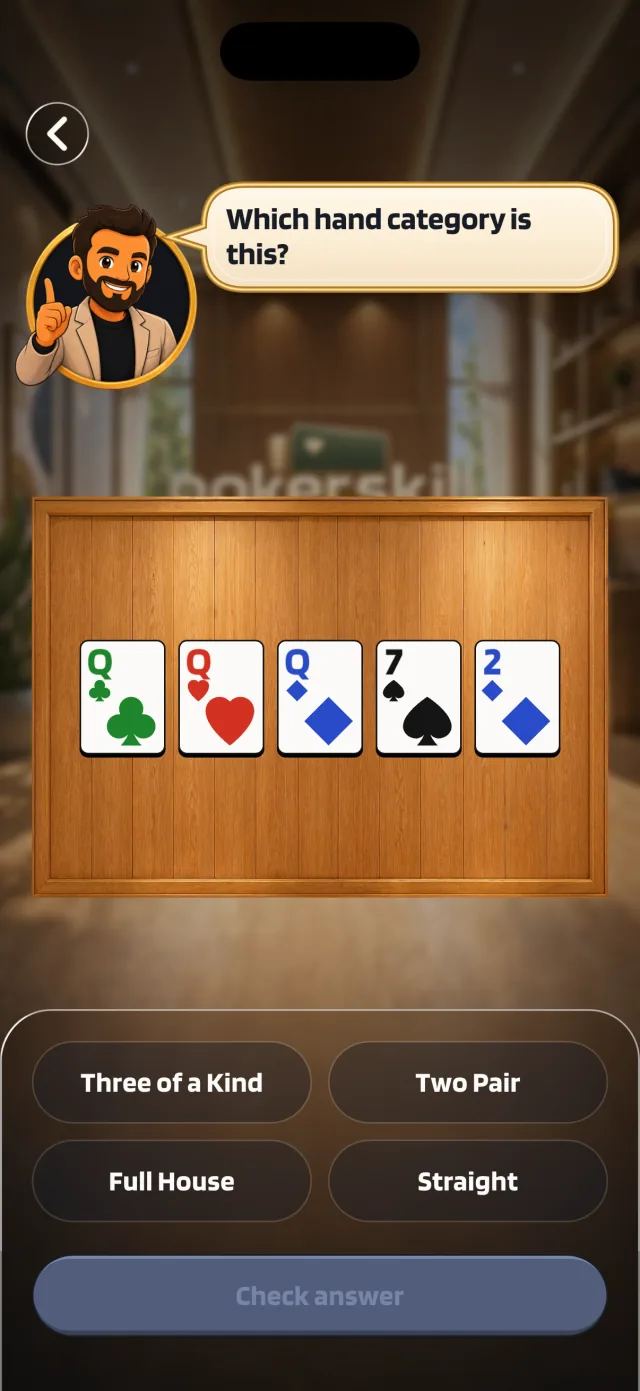
Practice this in Poker Skill. The turn capstone, Put It Together, asks the two questions a story has to answer on every turn: what your hand is now, and whose card just landed.
Get the free appStory
What a story is in poker
A story is the hand a betting line claims to be. Across preflop, flop, turn, and river, every bet, check, raise, and fold adds another sentence to a picture of what you are holding. The picture either makes sense given the action and the board, or it doesn’t.
Calling something “the story” is shorthand for the whole sequence read together. A single bet has no story. A line across three streets has one, and opponents respond to that line, not to any single chip you push forward.
How they differ from a line
A line and a story are close but not identical. The line is the literal sequence of actions; the story is what that sequence claims about the hand.
| Concept | What it is | Why it matters |
|---|---|---|
| Line | The literal chain of decisions across streets (raise, c-bet, barrel, shove) | Names what happened |
| Story | The hand the line is representing: the believable holding behind those actions | Names what the line is selling |
| Hand reading | Narrowing the opponent’s range from their line + board + position | The reader’s process for judging the story |
A bluff line and a value line can use the exact same physical actions; the story they tell only differs in which hands credibly take that line. That’s why a bluff catch is a bluff catch — the actions look like a value bet, but the story behind them doesn’t add up.
When a story matters most
A story carries the most weight in three spots.
- Multi-street pots where a thinking opponent is reading you. Against a player who tracks each street, a coherent line earns folds; a sloppy line gets looked up. Single-bet pots barely have a story to tell.
- Bluff catches and hero calls. When you face a big river bet and the line in front of you doesn’t fit a value hand, the math collapses to one question: does the story credibly contain enough value combos to justify this sizing, or is the only honest read that this is a bluff? When the answer is the second one, the call gets made.
- Triple-barrel and overbet lines. Big sizing lines are story-heavy by design. Their credibility is earned across all three streets — the flop sets it up, the turn sustains it, the river closes it. A river overbet without a coherent flop and turn behind it is the most readable bluff in poker.
It matters less when the pot is small, the opponent is not paying attention, or the reader is a calling station who plays their cards instead of yours.
Worked example
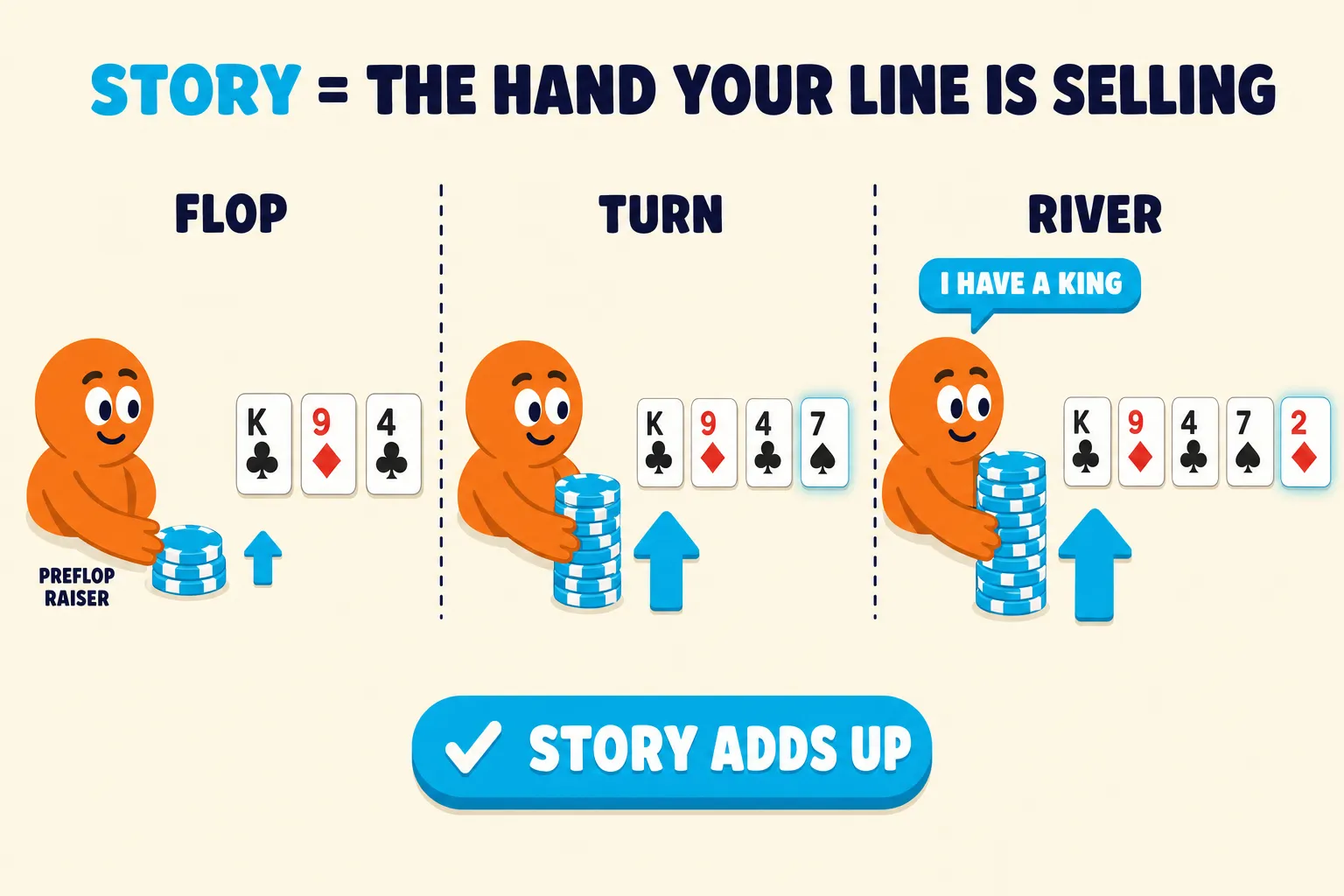
A story that adds up. You open the cutoff with A♠Q♠. The big blind defends. The flop is K♣ 9♦ 4♣, a board that hits your range better than the big blind’s. You c-bet 33% pot. They call. The turn is the 7♠. You bet again, larger now, around 70% pot. They call. The river is the 2♦, a brick. You go for an overbet, around 130% pot.
Read the line back: a preflop raiser putting in growing pressure on a king-high board with backdoor equity that ran cold. Every street’s action fits the story of “I have a king or better.” Your range across these three actions is loaded with K-Q, K-J, A-K, and the occasional turned set or two pair. The story adds up. Many holdings in your opponent’s range — middle pair, third pair, busted backdoor flush draws — should fold to that line.
A story that breaks. Same opening, same flop, same flop call. But on the turn 7♠ you check. The big blind bets 75% pot. You call. The river 2♦ comes. The big blind shoves for over the pot.
Now read it back from your opponent’s seat. They opened weak by betting a turn after the preflop raiser checked, then sized up enormously on a brick river. Sets and two pair would usually have raised by now or sized smaller for value. The combos that fit a river overbet are mostly bluffs that picked up showdown desperation, plus a thin slice of slow-played monsters. The story is not “I had it the whole time.” The story is “I am turning a missed draw or a giveup-line into a triple-barrel-on-the-river pretender.” Against most opponents, this is where a hero call lives.
Common mistakes
1) Putting an opponent on one hand instead of a range
Hand reading is range narrowing, not single-hand guessing. If the only way the opponent’s line makes sense is one specific hand, you are usually wrong. The right read names two or three plausible holdings consistent with the line, then checks whether the bet looks more like the value half or the bluff half of that range.
2) Folding to any big bet because “they have to have it”
Big sizing scares folds. That fear is what the bluffer is selling. The instinct that says they have to have it is the same instinct that pays off every overbet bluff, because most players have not actually checked whether the story behind the bet contains enough value combos. When the line is incoherent and the sizing is huge, the call gets made far more often than the gut wants to.
3) Telling stories that contradict the board
The story has to fit the cards on the table, not just the actions. Betting bigger on a brick river than on a draw-completing turn says “I value-bet bricks the largest” — a holding profile that barely exists. Sizing has to scale with how the runout actually changed equity, or the line stops being credible.
4) Forgetting that triple-barrel bluffs in cash are usually called
Live cash players call rivers a lot, often 70–80% of the time against the average player. A multi-street bluff line works against capped, thinking opponents on the right textures, and falls apart against anyone who plays one-pair-no-kicker for stacks. The credibility of the story matters less than the calling tendencies of the seat across from you.
FAQ
What does it mean to “tell a story” in poker?
Telling a story is making a sequence of bets that together represent a specific kind of hand. Each bet matches the next; the picture across all the streets is consistent with one believable holding. When the line is told well, opponents fold the hands that don’t beat the story. When it isn’t, the line gets called.
When does a story “not add up”?
A story stops adding up when the action breaks the believable holding. Common breaks are sizing that doesn’t match the runout (huge river bets on bricks after passive earlier streets), passive lines on streets that scream value, sudden line changes with no card-driven reason, and barrel sizes that have no value hands behind them. Hero calls live where these breaks live.
Are story and line the same thing?
They overlap but aren’t the same. The line is the literal action sequence. The story is the hand the action sequence is selling — what the line is for. Two players can take the same line with completely different stories behind it (one bluffing, one value-betting), and the reader’s job is to figure out which one is across the table from them.