


Sizing Tell
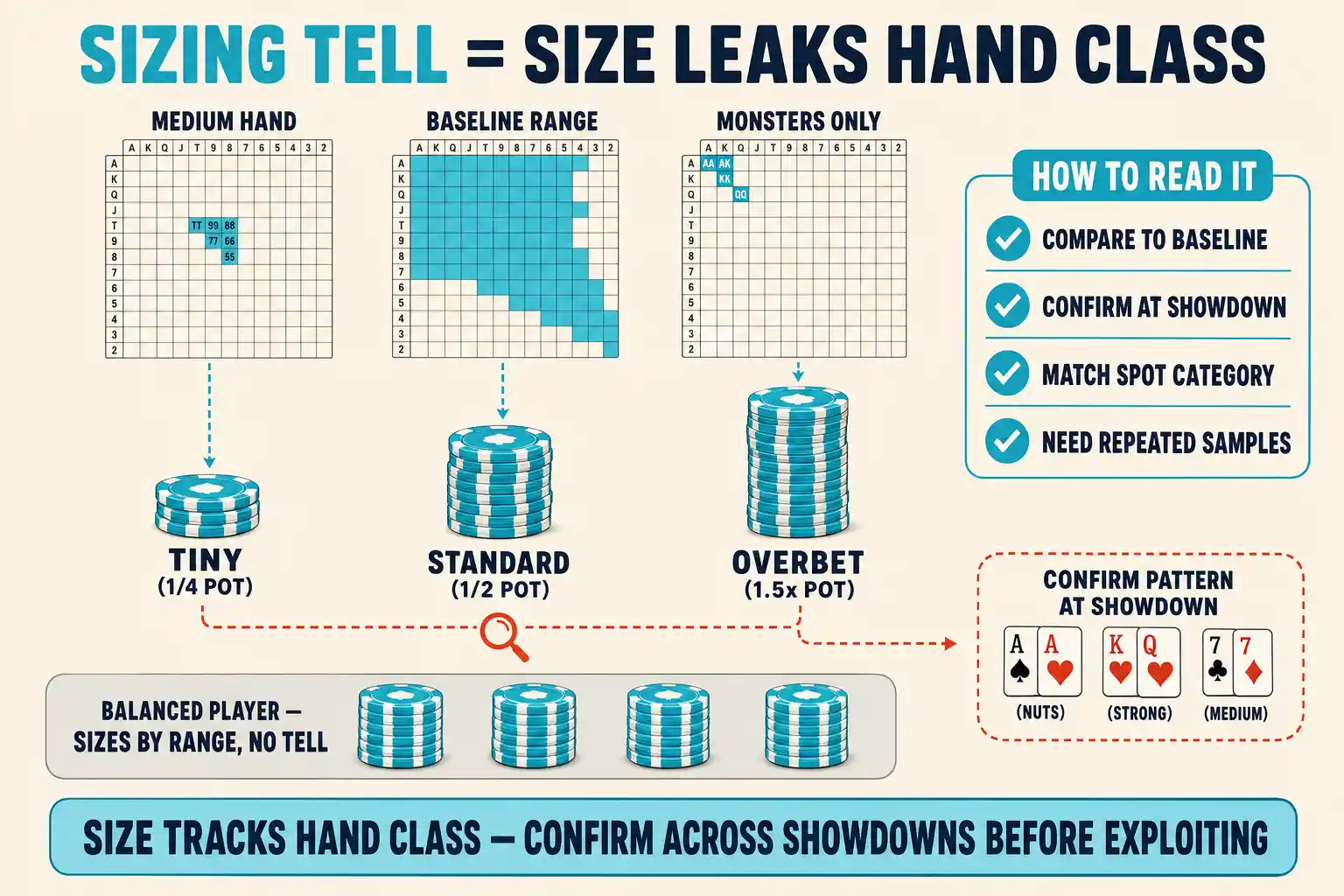
A sizing tell is information inferred from a player's bet-size pattern when the size they pick correlates with strength, weakness, protection, or uncertainty. It is not the strategic choice of size itself. It is the leak created when an opponent picks sizes by hand class instead of by range, so their size carries information you can read. A single weird size is not a tell. The pattern only becomes useful after you compare it against the player's baseline and confirm it through showdowns or repeated folds and calls.
Sizing Tell: when bet size leaks information
What a sizing tell is
A sizing tell is the information you can infer when an opponent’s bet-size pattern correlates with their hand class instead of their full range. The size they pick starts to track strength, weakness, protection, or uncertainty. That correlation is the leak. You did not extract a hand from them. You extracted a piece of evidence that narrows what they can have, the same way timing patterns and posture cues do.
A sizing tell is not the same thing as bet sizing. Bet sizing is the strategic choice of how big to bet. A sizing tell is what happens to an observer when that choice stops being range-based and starts being hand-based. One is your problem to solve at the table. The other is your opponent’s leak to read.
Related terms
- Bet sizing: the strategic choice itself, before any opponent reads it.
- Player read: the broader picture of one specific opponent. A sizing tell is one input into a player read.
- Table image: how the table sees you. The mirror of a sizing tell, pointed back at yourself.
- Value bet and Bluff: the two action categories whose ratio a sizing tell most often distorts.
- Overbet and block bet: the two non-standard sizes that most often carry sizing tells when used without a balanced range behind them.
- Showdown: the only confirmation that a suspected sizing tell is real and not coincidence.
Sizing tell vs neighboring concepts
The terms around a sizing tell get blurred constantly. Each one points in a different direction.
| Concept | What it describes | Direction |
|---|---|---|
| Sizing tell | Information leaked by a size pattern that tracks hand class | Read on opponent |
| Bet sizing | Your strategic choice of how big to bet | Your own decision |
| Tell | Any behavioral cue that narrows a range | Read on opponent (broad) |
| Timing tell | Information from speed of action | Read on opponent (speed) |
| Player read | Aggregate read on one specific opponent | Read on opponent (synthesis) |
| Table image | The table’s read of you | Read on you (their direction) |
A sizing tell is one signal feeding a player read, the way a timing tell or a posture cue would. Treating it as if it were the whole player read is the most common framing mistake. Treating it as if it were the same thing as bet sizing is the second most common.
When a sizing tell actually matters
Knowing the sizing pattern only helps when the next decision turns on what the opponent has, not on what you should bet.
- A river spot where you are deciding whether to call a non-standard size against a player whose previous non-standard sizes have all gone one way at showdown.
- A turn spot where the opponent has switched from their baseline half-pot to a block bet, and their previous block bets have shown up as medium hands wanting to control pot size.
- A flop spot where the opponent overbets a board that hits their range. If their previous overbets have all shown up as the very top of their range, their bluff frequency in this size is plausibly low.
- A multi-street value-betting decision where the opponent’s call sizes on previous streets have been smaller than baseline only with medium pairs, larger than baseline only with strong made hands.
It does not matter when the size in question is consistent with a balanced range, when you do not have a baseline for that opponent, or when the line ends without a showdown that could confirm or deny the read.
How to spot one without making it up
A single weird size from a stranger is not a tell. The pattern only earns the name after you have:
- A baseline for that player. What size do they normally pick in this spot category? If you do not know, you do not have a tell yet, you have a guess.
- At least a few repeats of the non-baseline size in the same spot category.
- At least one or two showdowns or strongly implied confirmations (clear folds, clear value calls) that anchor what the size meant when they used it.
- A reason to believe the player picks sizes by hand class. New players, recreational players, and many infrequent players do this. Solid regulars often do not, because their size tree is range-based by design.
If those four conditions are not met, the size pattern is noise. Acting on it is closer to inventing a read than using one.
Reads like this sit outside Poker Skill, which trains your own decisions instead, in lessons and in Practice vs AI games against AI opponents with Coach Max coaching you.
Common patterns worth watching
A small set of size-pattern leaks shows up often enough at low and middle stakes to be worth naming.
Tiny river sizes only with medium hands
A player who never block-bets the river except when they have a medium hand they want to call but cannot raise. Their tiny river bets become a near-pure showdown-value tell. The exploit is to raise more often when they take that line, because their range is capped.
Overbets only with very strong hands
A player who only overbets the river or the turn with their best hands. Their overbets become a near-pure value tell. The exploit is to fold marginal made hands more cheaply than you would versus a balanced overbettor, and skip bluff-catch calls that would beat their bluff range but not their value range.
Defensive small sizes when unsure
A player who shifts to a smaller size when they have a hand they are not sure about, and a standard or larger size when they are. Their small sizes become an uncertainty tell, which often maps to bluff-catchers, weak top pairs, and second pairs. The exploit is to apply more turn and river pressure when the small flop size shows up, because their range is capped and protection-driven.
Sizing up flops to “protect” against draws
A player who only sizes up the flop when their hand is a vulnerable made hand needing to charge draws, and uses their baseline size with everything else. Their oversized flop bet becomes a single-pair-protection tell. The exploit is to fold thin draws that are not getting price, and to raise less often as a bluff against the size, because their range is concentrated in calls.
These are common because they are how many players actually learn to size before they learn to balance. Reading them is reading the leak, not the player.
Common confusion
Confusing a sizing tell with bet sizing
Bet sizing is your decision before anyone else has reacted. A sizing tell is what an observer infers about a player whose size picks track their hand class. They live on opposite sides of the same action.
Confusing one weird size with a tell
A single non-standard size is a data point. A tell is a pattern. Most opponents who size weirdly once will size weirdly again for unrelated reasons. The read does not exist until the pattern repeats and a showdown confirms it.
Confusing a sizing tell with a timing tell
Timing is speed. Sizing is amount. They can both narrow a range. They are independent inputs and they should not be substituted for each other in your notes.
Treating regulars like recreationals
Sizing tells are far thinner against regulars who size by range. The same observation that is a clean tell against a recreational player is a coincidence against a regular until proven otherwise. If your read assumes a hand-class-based size tree, check whether the player you are reading actually has one.
Acting on a tell from one direction only
If you only ever see a player’s non-standard size when they have value, you are seeing a sample, not a complete pattern. Watch how the same size resolves when they have nothing. If they never use it as a bluff, the tell is real. If they sometimes do, the size is more balanced than you thought.
Worked example
You are 6-max $1/$2 cash, two hours into a session against the same opponent. They have shown down four times in size-relevant spots.
- Hand 1: They check-called flop, check-called turn, and bet $14 into a $90 river pot with second pair. Showed.
- Hand 2: They led the river for $12 into a $80 pot with middle pair plus a missed gutter. Showed.
- Hand 3: They overbet the turn for $180 into a $90 pot with top set. Showed.
- Hand 4: They overbet the river for $250 into a $120 pot with a flush after the flush card came. Showed.
That is a baseline. Their tiny river sizes have shown up as medium hands wanting to control the price. Their overbets have shown up as the very top of their range. Two patterns, two showdowns each, all consistent.
Now you are on the river of a fifth pot. You hold A♣J♠ on a 9♠ 7♥ 4♦ 2♣ Q♥ runout. You bet flop, they called. You bet turn, they called. The river queen brings no flush card and no obvious draw home. You check. They bet $20 into a $135 pot.
Without the sizing pattern, this is a pure bluff-catcher decision. With it, the read is not magic but it is real. Their tiny river sizes have not shown up as bluffs, they have shown up as medium hands wanting cheap showdown. Ace-high almost certainly does not beat a medium hand in their range. Folding, or raising for value if you held a hand that crushed Qx and 9x, both become more attractive than the default call. The sizing tell did not give you a hand. It moved your decision.
The same read disappears the moment they show down a missed bluff for a tiny river size. One contradicting showdown does not break a strong tell, but two does. Re-baseline before the next pot.
Practical use checklist
- Build a player baseline before calling any single size a tell.
- Note non-standard sizes by spot category (flop, turn, river, in-position vs out-of-position) so you compare like with like.
- Confirm with showdowns. A pattern without a showdown anchor is a guess.
- Treat one weird size as data, not as a tell.
- Default to assuming regulars size by range until repeated showdowns prove otherwise.
- Use the read to refine range inference and exploit choice. The practical value is cleaner decisions, not predicting the hand.
FAQ
How is a sizing tell different from bet sizing?
Bet sizing is the strategic choice of how big to bet. A sizing tell is information that leaks when an opponent’s size choice tracks their hand class instead of their range. They sit on opposite sides of the same action.
How many showdowns does a sizing tell need before I can use it?
Use the same discipline you would for any player read. One showdown is suggestive, two is the start of a pattern, three or more in the same spot category is a usable read. Watch for the contradicting showdown that resets it.
Do sizing tells exist online?
Yes, more reliably than physical tells, because the action is logged and re-readable. Online play removes posture and gaze, but bet size and action speed survive. Note size by spot category in your hand-tracking notes and compare across sessions.
Are sizing tells useful against regulars?
Less. A solid regular’s size tree is built around their full range, not their current hand class, so the correlation that creates the tell is not there. Treat sizing tells as a recreational-player exploit by default, and only against regulars when repeated showdowns force you to.