


Thin Call
A river call against a small bet where your hand only barely beats the opponent's value range. The price clears, but the edge is small and the call rarely scoops a big pot.
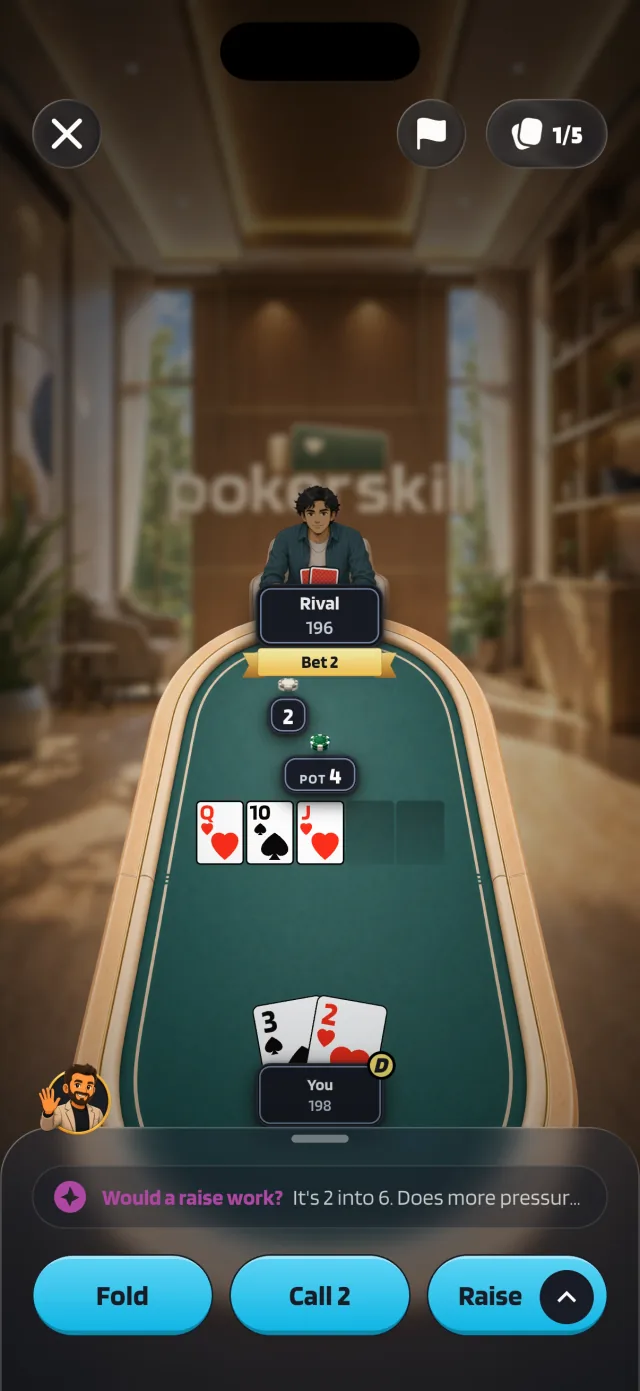
Practice this in Poker Skill. Facing a small river bet in Practice vs AI, full hands against AI opponents, Coach Max can set the bet beside the pot and ask which hands bet like that, so you can judge whether yours beats enough of them.
Get the free appThin call
What a thin call is
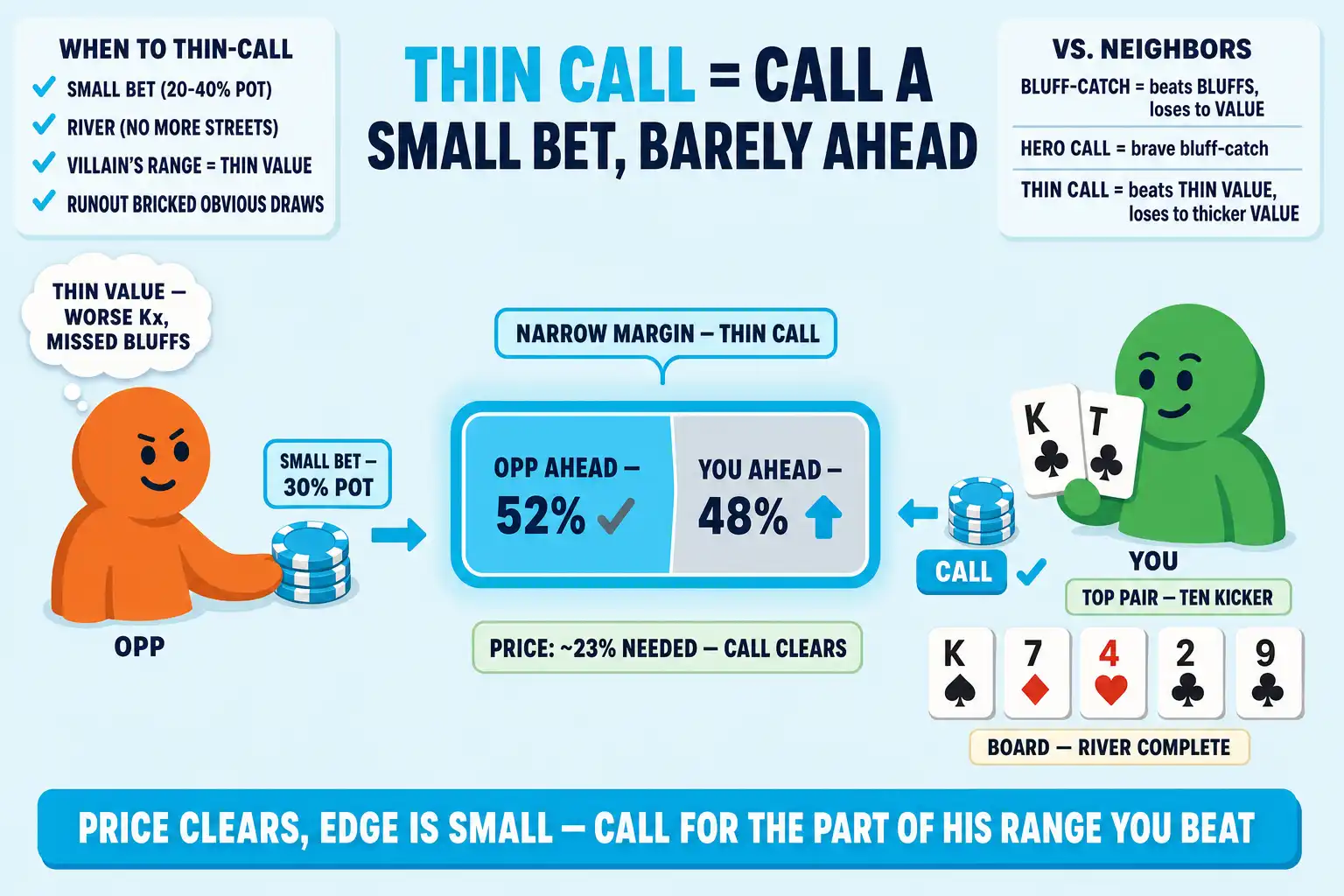
A thin call is a call against a small river bet with a hand that barely beats the opponent’s value range. The price is good, the hand has real showdown value, and the call comes out slightly profitable across enough of villain’s small-bet combos. It is not a bluff-catch; you are not calling because you think villain is bluffing, you are calling because villain is also value-betting hands you happen to beat. The edge is small, the pot you scoop is small, and that is the whole point. The call earns a few extra big blinds across the river decisions where folding would have been free money the other way.
Thin call vs neighbors
Three small-pot river calls feel similar at the table and behave very differently long-term:
- Thin call. You face a small bet on a runout where villain’s range looks like thin value: worse one-pair hands he is trying to milk, plus a few missed bluffs as a side dish. Your hand beats some of the worse value combos and loses to the better ones. The small price means you only need to beat a slice of his range to call profitably.
- Bluff-catch. You face a polarized bet, usually larger, on a runout where villain’s range is mostly nuts plus mostly bluffs. Your hand beats his bluffs and loses to his value. You are pricing the bluffs, not the thin value. (See bluff-catch for the polarized-range version.)
- Hero call. A bluff-catch where the surface optics feel brave: a big bet, a scary line, a small absolute hand. The math is the same as a routine bluff-catch; the costume is louder. (See hero call.)
A thin call is also not a station call. A station call ignores the line, ignores the price, and clicks call because folding feels uncomfortable. The thin call has a structural reason: small sizing, capped value range, runout that didn’t complete obvious draws, and a hand with real showdown value. The reason has to be writable in one sentence before the call.
Related terms:
How a thin call differs from a bluff-catch and a hero call
| Decision | Villain’s bet looks like | What you beat in his range | Long-run result |
|---|---|---|---|
| Thin call | Small value bet, 20-40% pot, on a brick runout | His worst value combos plus a thin sliver of bluffs | Small but positive across the population |
| Bluff-catch | Polarized bet, often pot or larger | His bluff combos; loses to all his value | Profitable when he is bluff-heavy enough to clear the price |
| Hero call | Big polarized bet that feels scary | Same as bluff-catch (bluffs only) | Same math as a bluff-catch; the bravery is mostly cosmetic |
| Station call | Any bet | Nothing reliably | Net loss across thousands of repetitions |
The clean way to tell a thin call from a bluff-catch at the table: ask what kind of value range the sizing implies. A small river bet usually says “I have a worse value hand and want a call from your similar value hand.” A big river bet usually says “I am polarized, nuts or air, and I want you to choose.” Thin calls answer the first sentence; bluff-catches answer the second.
When this matters most
Thin calls earn the most when several of these line up:
- Small bet on the river. A small bet means you only need to be right a small fraction of the time. A 30% pot bet asks for about 23% equity to break even; a 25% pot bet asks for 20%. Your hand only has to beat that slice of villain’s small-bet range.
- Capped lines. When villain’s earlier action ruled out his strongest hands (a flop check-call, a turn check-back, a small turn bet that strong hands would have grown), his river bet range concentrates on medium-strength value. That is the range a thin call beats most of.
- Runouts that brick obvious draws. When the river card doesn’t complete the flush, the open-ender, or the obvious gutshot, villain’s bluff frequency on a small bet drops, but his thin-value frequency rises. The medium hands that were checking back the turn now bet small for value. Your one-pair hand lives in the part of the matchup that pays off.
- Opponent types where thin value is the dominant range. Calling stations rarely bluff but love to bet a worse pair for value; their small river bets are exactly the population this call beats. Aggressive regulars also bet thin in position, just with more bluffs mixed in. Both populations are thin-call-friendly.
Thin calls don’t matter much against nits, against under-bluffed lines where the small bet still represents a real value range, or on runouts that complete the draws villain was chasing. Same call, different ecosystem, different result.
Worked example
You are 100bb deep in 6-max NLHE cash on the button. The cutoff (a typical regular) opens to 2.5bb, you call K♣ T♣ on the button. The flop is K♠ 7♦ 4♥. He c-bets one-third pot for 2bb into 6bb, you call. Turn is the 2♣. He checks. River is the 9♣. Pot is around 12bb. He bets 4bb (about a third of the pot) into your top-pair-weak-kicker.
Walk it through:
- Price. You need to win 4 / (4 + 4 + 12) = 20% to break even on the call. Round up for rake and call it 23% needed.
- Value combos. His turn check capped his stronger one-pair hands; sets, two pair, and KQ would mostly bet the turn for protection on a board that turns scary. The hands betting small on the river for value here are mostly worse Kx (KJ, KT, K9 with the river pairing) and the occasional 99 that improved. Your KT beats KJ, KT (chops), some K9s if he plays it that way, and ties the wheel of K-rag combos.
- Bluff combos. A small river bet from a regular usually carries a few missed gutshots and backdoor draws as a thin bluff bucket: JT chasing the runner-runner that bricked, or 86 that picked up a gutshot on the turn and gave up on a small price. There aren’t many, but they exist.
- Math. If his small-bet range on the river is roughly 70% worse-or-equal Kx and small pairs you beat or chop, 20% better hands (KQ, AK he checked back turn for trickery, slowplayed sets), and 10% missed bluffs, you are well above the 23% threshold. Call.
The call books a small profit that disappears into your win rate. It is not a hero call. It is a thin value bet from villain’s side and a thin call from yours, against a price small enough that the slice of his range you beat carries the day.
Poker Skill’s lessons stop at the turn, so the closest they come is a flop call in the Defense Capstone, where top pair of tens with a weak kicker calls a fair-sized bet instead of folding or raising.
Common mistakes
1) Calling because the bet is small
A small bet by itself is not a thin call. The line still has to make sense for thin value, and your hand still has to beat enough of that range. Calling 30% pot with second pair on a wet runout where villain led every street is closer to a station call than a thin call. The price is one input; the range read is the other.
2) Calling down with a hand that already lost
Thin calls live or die on the river card. A K-T-c hand that called the flop and turn for top-pair-decent-kicker becomes a fold on a river that pairs the seven (his straightforward two-pair line) or completes the obvious flush. The earlier streets do not entitle you to a river call. If the river puts your hand behind the part of his range that bets small, fold.
3) Ignoring the betting action from earlier streets
A small river bet after a check-call, check-call, check-back, bet line tells a different story than a small river bet after bet, bet, bet. The first looks like a regular trying to extract from medium hands; the second looks like sizing tells consistent with thin value all along. The earlier-street pattern decides which value bucket you are pricing.
4) Talking yourself into thin calls against nits
Against very tight players, the small river bet still tends to be a value bet they are confident in. Their thin-value range is tighter than yours, which means the slice of their small-bet range you beat is smaller than your math assumes. Tighten thin calls against nits; save them for regulars and stations where the underlying small-bet range is what your math is built on.
FAQ
How is a thin call different from a bluff-catch?
A thin call beats the bottom of villain’s value range. A bluff-catch beats his bluffs. Both calls answer a river bet; they just price different parts of his range. Thin calls usually face small sizings that imply medium value; bluff-catches usually face polarized sizings that imply nuts or air. The price math is the same (required equity vs. estimated win rate), but the range you are reading and the part you are beating are different.
What price makes a thin call worth it?
The break-even price comes from the bet size. A 25% pot bet needs ~20% equity, a 30% pot bet needs ~23%, a half-pot bet needs ~25%, a two-thirds bet needs ~29%. Add a few percent for rake. Above that threshold, the call clears as long as the slice of villain’s range you beat is bigger than the threshold. Below it, fold even if your hand looks fine in a vacuum: the pot odds didn’t earn the call.
Should I thin-call more often as I move up in stakes?
Probably less, not more. Lower-stakes regulars and recreational players bet small on the river to extract value from the medium hands you are calling with: that is the population thin calls were built for. Higher-stakes regulars bet small for thinner value but also balance with more bluffs, which pulls the call toward bluff-catch territory and pulls your bottom-of-range thin calls into folds. Pick a call-down frequency that matches the player pool, not the level of stakes you wish you were playing.