


Three-Way Pot
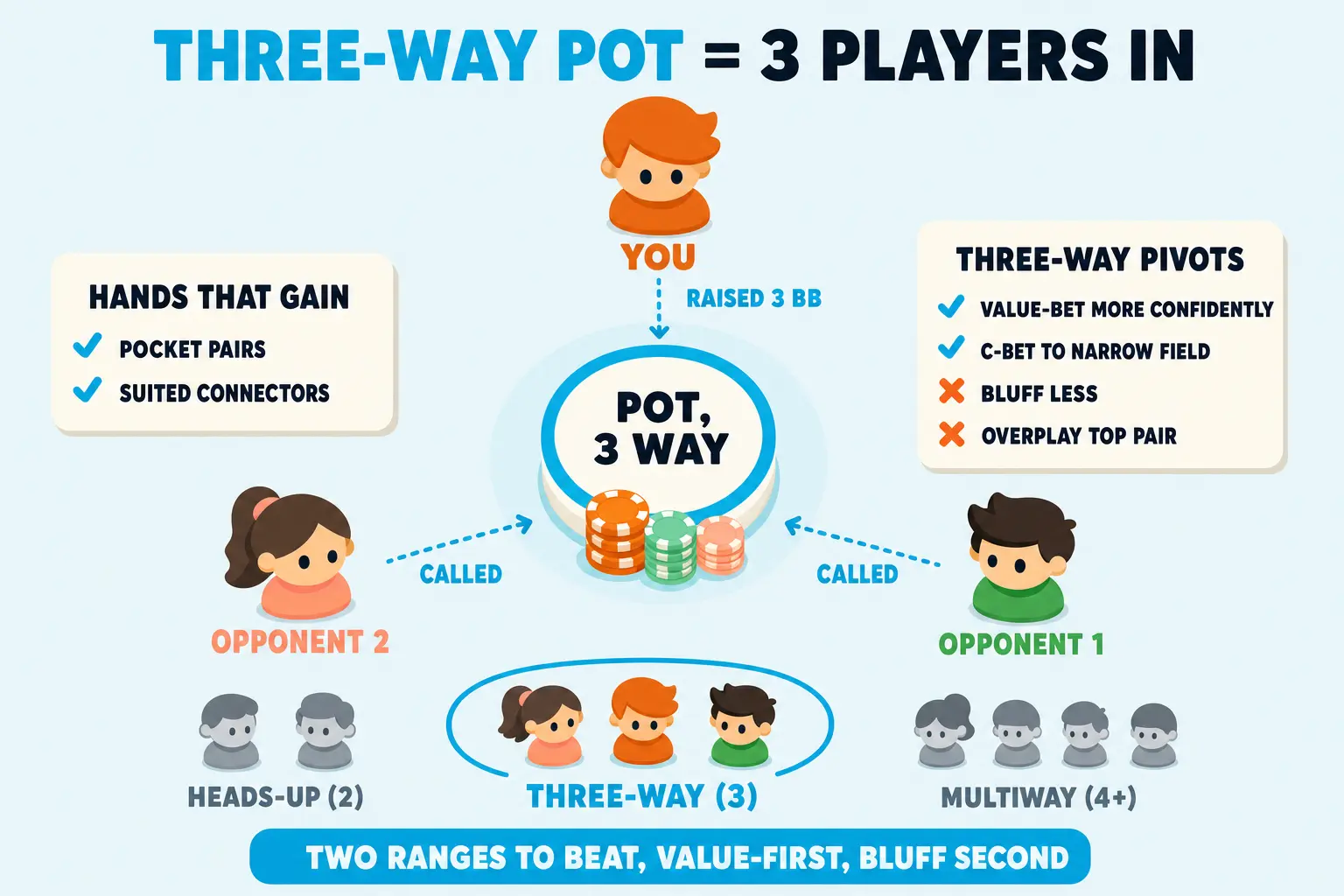
A three-way pot has three players still in the hand. Bluffs leak more often than heads-up, top pair loses value, and pocket pairs gain when three players see the flop.
Practice this in Poker Skill. The Multiway Continuation Bets lesson checks a weak ace back three-way, keeping the pot small rather than betting one pair as if it were clean value.
Get the free appThree-Way Pot (No-Limit Texas Hold’em)
What a three-way pot is
A three-way pot is a hand where three players are still contesting the same pot. It is the smallest version of a multiway pot, and it is the first stop on the way from heads-up play to bigger multiway spots. The presence of a second opponent changes the math: you cannot read one villain in isolation, your bluffs run into two ranges instead of one, and your hand strength has to survive against everyone who calls. Three-way pots show up most often when the preflop raiser gets one in-position caller and a big blind defender, or when a limped pot picks up the small blind and big blind. They are common enough to be their own category and different enough from heads-up to deserve their own decision rules.
Three-way pots versus heads-up versus larger multiway
The pivots between formats are sharp enough to draw on a single table.
| Format | Players in the pot | Bluff frequency | Top-pair value | Hands that gain |
|---|---|---|---|---|
| Heads-up | 2 | Highest; many flops miss both players | Strong value hand | Wide opens, broadways |
| Three-way | 3 | Lower; at least one of two villains calls more often | Slimmer; play more to narrow the field | Pocket pairs, suited connectors |
| Multiway (4+) | 4 or more | Lowest; bluffs rarely get through | Often a bluff-catcher at best | Pocket pairs, suited aces, rundowns |
Three-way is not “heads-up plus one.” A second opponent doubles the chance someone connected with the board, which kills cold bluffs first and trims thin value second. It also doesn’t quite play like a four-handed pot: there are still only two ranges to read, position matters more than range coordination, and a focused continuation bet still does work when the flop favors your perceived range.
When the three-way distinction matters most
- C-bet decisions. A heads-up c-bet often fires near the top end of your range; three-way, the c-bet is selective and aimed at narrowing the field rather than auto-firing. The boards where it still prints are the ones that hit your raising range and miss the two callers’ continuing ranges.
- Bluff frequency. Stone-cold bluffs that work heads-up start to leak chips three-way because at least one of two opponents calls more often than expected. Default to giving up missed flops unless you have real equity or strong blockers.
- Value betting. When you think you have the best hand three-way, nearly always bet; slowplaying invites two opponents to outdraw you. Value bets often double as field-narrowing bets, which is a different intent than maximum-extraction lines you’d take heads-up.
- Side-pot scenarios. Three-way pots are where side pots first appear. If one player goes all-in, the main pot caps at their contribution and any further chips between the two remaining stacks build a separate side pot. The two players still betting are now running a private contest while the all-in player can only win the main pot.
- Pot control lines. Checking back marginal made hands gets cheaper three-way: a bet has to beat two opponents’ calling ranges, while a check passes the burden of action to the player behind you.
Worked example
CO opens to 3bb with K♠Q♠. BTN flat-calls. BB defends. Three-way to a flop of J♠T♦4♠.
Heads-up versus the BTN, this is a near-automatic c-bet: the open-ender plus flush-draw plus two overcards adds up to a lot of equity, and one continuing range is easy to pressure. Three-way changes the read. The BTN’s flat range and the BB’s defending range together make it likely at least one player has connected with the J or T or holds a draw of their own. A right-sized c-bet (1/3 to 1/2 pot) is still defensible, but its job is now to narrow the field, not to fold both opponents out. If both villains call, the turn becomes a pot-control street unless you actually improve. If either villain raises, the three-way structure makes it harder to bluff back; releasing the draw and conceding the pot is often the right call.
Common mistakes
- Bluffing as if it were heads-up. A three-way bluff has to get past two ranges, not one. A line that prints heads-up against a sticky caller can hemorrhage chips when a second opponent is sitting behind with a real piece of the flop.
- Overplaying top pair. Top pair is a value hand heads-up; three-way it is closer to a strong bluff catcher. With heavy action against you on the flop, slowing down or folding tends to beat piling in three streets of bets.
- Mis-sizing for multiple callers. Sizes calibrated for one continuing range often undershoot three-way. A player calling in a multiway pot frequently has a real hand and may be calling for value, betting that another opponent comes along too.
- Reading only the first opponent. Three-handed, the second player’s line carries information of its own. When one villain leads after a draw completes, the second can be pot-controlling a medium-strength hand, so both lines have to be read separately, not lumped together.
FAQ
How is a three-way pot different from a multiway pot?
Every three-way pot is technically a multiway pot, since multiway just means three or more players still in the hand. The reason “three-way” gets its own label is that the strategic pivots from heads-up to three-handed are sharper than the further pivots to four- or five-way. With three players you still have two manageable ranges to read; with four or more, hand-reading collapses and the right baseline becomes “value-bet, almost never bluff, fold rather than call when uncertain.”
Are three-way pots common in 6-max cash games?
Yes. The most common path is an open with one in-position caller and a big blind defense, which puts three players to the flop. Limped pots that pick up both blinds also play three-way, and so do many 3-bet pots where a fourth player has folded in between. They are common enough to be a default planning case, not an edge case.
Should you bluff in a three-way pot?
Less often than heads-up, but not never. The bluffs that still work are the ones where the board strongly favors your perceived range and misses both callers’ continuing ranges, where you have real equity if called, and where the sizing actually narrows the field. Cold bluffs without those props tend to run into one of two opponents who decided to call, and you light chips on fire chasing a fold equity that is no longer there.