


Three-Bet Range
A three-bet range is the set of hands you re-raise with after another player has opened. It's a hand set, not an action, and the shape depends on the opener's seat, your seat, stack depth, the opener's tendency to fold or call, and the 4-bet risk waiting behind you.
Practice this in Poker Skill. The Small Blind vs CO Open lesson makes every hand a 3-bet or a fold, and suited king-queen 3-bets there, since a call lets the big blind in cheaply.
Get the free appThree-bet range: the hands you choose to re-raise with after an opening raise
What a three-bet range is
A three-bet range is the set of starting hands you re-raise with after another player has opened the pot. It’s a hand set, not an action. The 3-bet is the verb; the three-bet range is the slice of your overall range that takes that verb at a given seat, against a given opener, at a given stack depth. Strong hands tend to land here; weak hands fold; many medium hands either flat into a calling range or stay folded. The shape of what’s left is your three-bet range.
For the ranges themselves, by seat and against each opener, use the 3-bet range charts.
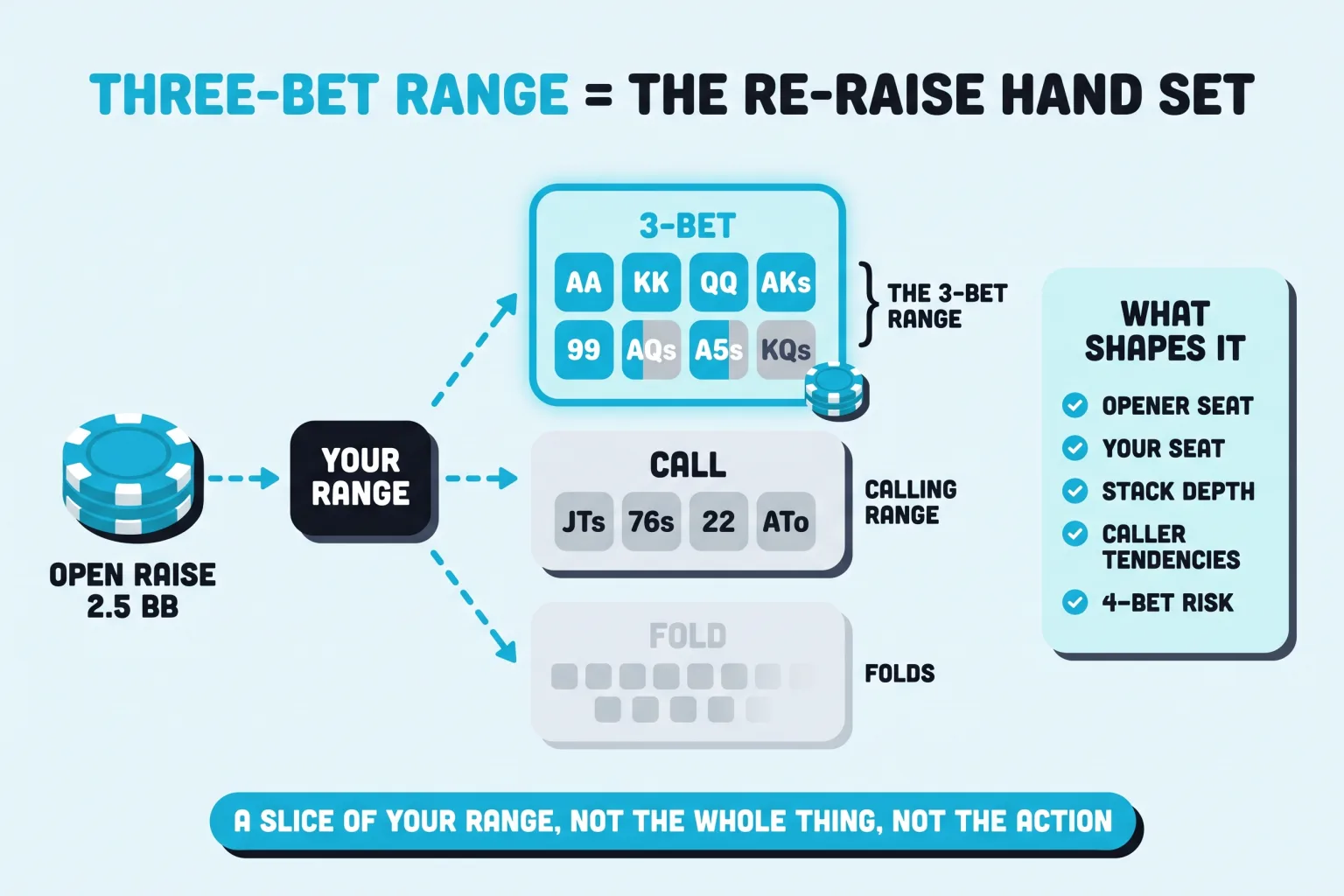
A useful mental shortcut: the three-bet range answers the question “out of every hand I could be dealt facing this open, which ones do I re-raise with?” The 3-bet itself answers a different question: “what just happened on the felt?” Same family, different layer.
Related terms
Three-bet range vs the neighbors people tangle it with
| Term | What it names | What it does NOT name |
|---|---|---|
| Range | The full set of hands a player can hold at a decision point | One specific fork of that set |
| 3-bet | The action: the third bet preflop | A set of hands; it’s the verb |
| Three-bet range | The slice of your range that takes the 3-bet fork | The slice that calls or folds |
| Opening range | Hands you raise first-in when nobody has voluntarily entered | Hands you re-raise after an open |
| Calling range | Hands you continue with by calling, not folding or raising | Hands you re-raise with |
| Squeeze | A 3-bet specifically after an open and at least one caller | A normal heads-up 3-bet |
| 4-bet | The fourth bet (re-raising over a 3-bet) | The 3-bet itself |
The two collisions that come up most: people mix up the action with the set. “I 3-bet that hand” describes one decision; “my 3-bet range from the button is wider than from UTG” describes a hand set across many decisions. And the opening range and three-bet range both live preflop and both contain raises, but the opening range fires when nobody has entered, and the three-bet range fires only after someone has.
Four shapes a three-bet range can take
A three-bet range can be built in a few common shapes. They aren’t competing dogmas; they’re tools you pick based on what you want from the spot. Each shape exists in a real entry on this site, and each one slices a different chunk of the 13-by-13 starting-hand grid.
- Value-heavy. Only your premium hands re-raise: roughly the top 2–3% of holdings, like AA, KK, QQ, and AK. Easy to play, near-impossible for opponents to put in trouble, but heavily readable: an alert opener will fold every 4-bet bluff and call only with hands that flop well against premiums.
- Linear range. The top block of your range in rank order, walked downward without gaps. Premiums plus the next tier of strong hands (TT+, AK, AQs) all 3-bet for value. No bluffs, no skips. Linear works well when the opener calls 3-bets too often, because every hand you re-raise is genuinely ahead of their continuing range.
- Merged range. Premiums plus medium-strength hands that can still extract from worse, like 99, AJs, KQs, without intentional bluffs. Merged ranges target opponents who call wide; the goal is wider value, not fold equity.
- Polarized range. Premiums on top, deliberate bluffs on the bottom (often suited blockers like A5s, A4s, KTs), with the middle-strength hands deliberately not in the 3-bet range. They flat-call instead. The barbell shape builds fold equity from the bluffs and gets paid by the top, while the middle stays cheap.
The right shape is the one that matches the opener and the seats behind. A nit who folds every 3-bet rewards polarization; a calling station rewards linear or merged; a maniac who loves to 4-bet pulls you back toward value-heavy. The same hand can belong in your 3-bet range against one opener and your call range against another.
What shapes the range
Five inputs do most of the work. None of them are about your two cards in isolation.
- Opener seat. Wider opens mean weaker average hands. A button open is much wider than a UTG open, so the average hand the opener holds is weaker, and your three-bet range can stretch wider against them, both for value (more dominated hands to extract from) and for bluffs (more opens that fold).
- Your seat. Position decides how the rest of the hand plays. Three-betting in position with the button lets you control pot size on every later street; three-betting from the blinds means every postflop street is played out of position, so your range tightens and tilts toward hands that don’t need much information to play well.
- Stack depth. At 100 big blinds, 3-bet pots stay manageable and bluff 3-bets keep some implied value if they get called. Shorter stacks (40 BB, 25 BB) push the range toward value: bluffs lose room to maneuver postflop, and stack-to-pot ratios start funneling you toward all-in spots. Deeper stacks (200 BB+) widen the value side and shrink the bluff frequency, because being out of position in a giant pot is brutal.
- Caller tendencies. How does the opener react to a 3-bet? Frequent folder rewards polarized bluffs. Frequent caller rewards linear or merged. Frequent 4-bettor rewards a tight, value-heavy core with very few bluffs. Read drives shape more than chart memory does.
- 4-bet risk behind you. Even if the opener never 4-bets, the seats behind them might. A loose 4-bettor in the small or big blind shrinks your bluff frequency from any seat that 3-bets into them, because 4-bets torch the bottom of a polarized range first.
When the three-bet range matters most
The shape you carry into a session decides three things at once: how often the pot ends preflop, how often you go to a flop with initiative, and which postflop trees you’re likely to walk down.
- Late-position battles. Button versus cutoff, or button versus hijack, is where the three-bet range gets the most exercise. Wide opens, fold equity from the seats behind, and in-position postflop play all push toward an active 3-bet range with both value and bluffs.
- Big-blind defense facing a steal. When the small blind folds and the big blind faces a button or cutoff open, the calling fork is wide because of the price discount, but the 3-bet fork still earns its keep: polarized 3-bets from the BB pressure wide late-position opens and cap the opener’s range.
- Squeeze spots. When an open is followed by one or more callers, the 3-bet becomes a squeeze, and the range narrows and tilts more toward value plus blocker bluffs because two players have to fold for the bluff to work.
It matters less in spots where almost no hand wants to re-raise: short stacks where the choice is jam-or-fold, or table dynamics where every 3-bet immediately gets 4-bet, collapsing the bluff frequency to roughly zero.
Example: button vs cutoff open at 6-max, 100 BB
You’re playing 6-max cash, 100 BB effective. The cutoff opens to 2.5 BB. The seats behind the cutoff are folded. You’re on the button. Your three-bet range here is one of the busiest in the game, because the cutoff opens wide, you have position on every postflop street, and only the small and big blind sit between you and seeing a flop.
A reasonable shape, illustratively, mixes a value core, a merged tier, and a polarized bluff slice:
- Value core: TT+, AK. These hands re-raise for straight value: they’re ahead of the cutoff’s continuing range and play well in a 3-bet pot in position.
- Merged add-ons: 99, AQs, KQs. These hands do well against the cutoff’s wider calls. KQs is happy when called by AJ or AT; AQs has equity and playability.
- Polarized bluff slice: a small block of suited blockers like A5s, A4s, and a couple of suited connectors that flop reasonably. They take the same 3-bet sizing as the value hands, deny credible 4-bet combos through the ace blocker, and make occasional flushes and straights when called.
Out of the same dealt cards, hands like JTs, 76s, and 22 stay in the call fork rather than the 3-bet fork. They realize equity well as flats in position, and they don’t gain much from bloating the pot preflop.
Now flip seats. Same opener (cutoff to 2.5 BB), but you’re in the small blind instead of the button. The shape changes: your value core tightens to QQ+ and AK because you’ll be out of position the whole hand, your merged tier shrinks because medium hands play badly OOP in 3-bet pots, and your bluff slice tightens to the strongest blockers (A5s and a few other suited aces). The same hand, KQs say, was a clear 3-bet from the button and is closer to a fold-or-3-bet mix from the small blind. The seats moved; the right hand set moved with them.
These are example shapes, not chart claims. Different solvers, different stake levels, and different opponent reads produce different specific cells. The point is that “three-bet range” has internal structure, and that structure changes seat by seat.
Common mistakes
1) Treating the three-bet range as one hard chart
A range is a target, not a contract. Players who memorize one button-vs-cutoff 3-bet range and apply it to every cutoff opener miss every read the table is offering them. A nit in the cutoff and a maniac in the cutoff open with totally different averages; the right 3-bet response moves with the opener, not just with the seat. The chart is the starting point. The judgment call is what you do with it after the table tells you who’s actually opening.
2) Carrying the same range out of position as in position
In-position 3-bet ranges and out-of-position 3-bet ranges aren’t the same shape. In position, medium hands like KQs and 99 earn their keep because postflop play is easier. Out of position, those same hands under-realize equity and play badly in the bloated pot you just created. Wholesale-copying a button range into the small blind is a common leak that shows up as miserable postflop spots more than as obvious preflop errors.
3) Bluff 3-betting an opener who never folds
Polarized 3-bet ranges depend on the bluff slice generating folds. Against an opener who calls every 3-bet and 4-bets only AA-KK, the bluff slice loses its job: A5s isn’t getting folds and isn’t beating the calling range when called. Against that profile, swap the polarized shape for a merged or linear shape: re-raise hands that beat the actual continuing range and stop trying to fold out a player who won’t fold.
4) Ignoring 4-bet risk behind the opener
A bluff 3-bet from the cutoff with a button who 4-bets often is a different proposition than the same 3-bet against a tight button. The 4-bettor punishes the bottom of a polarized range first: it’s where the equity is lowest and the fold-to-4-bet number is highest. When the seats behind threaten 4-bets, shrink the bluff slice or drop it entirely; the value core can still 3-bet, but the polarization loses its edge.
FAQ
How is a three-bet range different from a 3-bet?
A 3-bet is one action: the third preflop bet in a sequence. A three-bet range is the set of hands that fire that action across many spots from a given seat at a given depth. The action is a single decision on the felt; the range is the strategy behind it. Two players can both make a 3-bet with AA and look identical in that one moment while having totally different three-bet ranges, because the rest of their range is doing different things.
Should I memorize three-bet ranges by position?
Memorize the shape and the adjustments. If you can describe what your three-bet range looks like from the cutoff vs the button vs the blinds (what the value core is, whether you carry bluffs, how the shape changes against a wider or tighter opener), you have what charts are for. Cell-by-cell memorization without that structure is brittle: the moment a habitual 4-bettor sits down or a calling station joins the table, the rote chart stops being correct, and the player who only memorized cells has nothing to fall back on.
How wide should my three-bet range be?
There’s no single number; the right width tracks the inputs. Tighter against early opens, wider against late opens. Tighter out of position, wider in position. Tighter against players who 4-bet often, wider against players who fold to 3-bets. A useful internal check: if you’ve gone an hour without 3-betting, you’re probably too tight, because at most live small-stakes tables the seats behind will let a wider range through. If your 3-bet attempts are getting punished (called wide and outflopped, or 4-bet repeatedly), the range is wider than the table can support, and the right move is to tighten the bluffs first.