


Betting Lead
The role of being the player whose bet or raise is the most recent live action. The lead travels with each new bet or raise and shapes who has to react next.
Practice this in Poker Skill. As the preflop raiser in the flop lessons, you practice when to keep the lead and when to let it go: A♦ J♦ keeps the lead with a bet on a dry 8♠ 4♦ 2♣, while a missed hand on a wet or three-way flop checks.
Get the free appBetting Lead
What “the betting lead” means
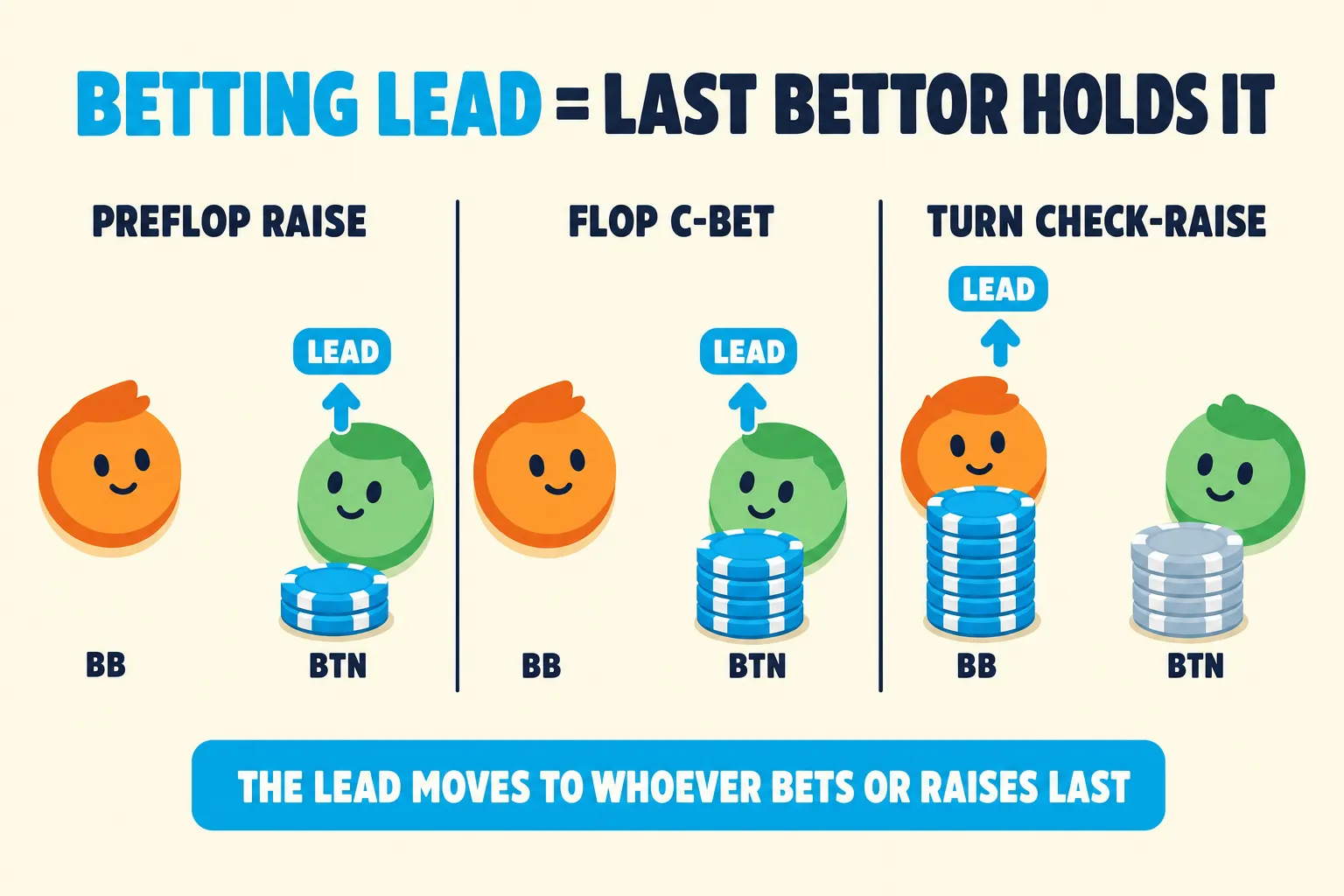
The betting lead is the role held by the player whose bet or raise stands as the most recent live action. The leader has already pushed chips forward; everyone else has to react. On the very next bet or raise, the lead transfers to that new aggressor. The preflop raiser arrives at the flop with the lead. A continuation bet keeps it. A check-raise takes it. The lead is a property of the line, not of a single street, and it shapes who is asking the questions and who is answering them.
A useful mental shortcut:
- The leader is whoever bet or raised last.
- The leader stays the leader until somebody bets or raises over them.
- Holding the lead means you are pricing the hand; everyone else is paying the price you set.
Related terms
Lead bet vs. betting lead vs. initiative vs. aggressor
These four terms travel together in poker conversation, but they are not the same word.
| Term | What it names | Scope |
|---|---|---|
| Lead bet | The action of betting first into a round instead of checking | Single street |
| Betting lead | The role of being the most recent bettor or raiser | Travels across streets until somebody raises over you |
| Initiative | A near-synonym for the betting lead, often used to stress the strategic role rather than the action | Same scope as the lead |
| Aggressor | The player currently holding the lead; “preflop aggressor” specifically names the person who took the lead preflop | Sticks to whoever bet or raised last |
Two lessons fall out of this. First, a lead bet is one way to seize the betting lead, but it is not the only way: a check-raise also seizes it, and a 3-bet seizes the preflop lead from the opener. Second, “preflop aggressor” and “current aggressor” can be different people by the river. A bet on the turn or a check-raise on the flop reassigns the role, even though the original preflop story does not change.
When the betting lead matters most
Holding the lead is most load-bearing in spots where the next decision is yours to set:
- Heads-up pots with real fold equity. When one opponent has to find continues against your range, the lead lets you keep asking the question they would rather not answer.
- Range-advantage spots on the flop. If your preflop range hits the board harder than your opponent’s, a c-bet uses the lead to convert that structural edge into pressure.
- Dry, static boards. Few draws, few combinations to defend; the leader prints by repeating the question on later streets.
- Spots where you want to deny equity. Making opponents pay or fold their live outs requires being the one whose bet they are reacting to.
The lead matters less, and is sometimes worth giving up, in spots where the structural edge sits with the other player:
- Multiway flops where two or three opponents will continue often enough that fold equity collapses.
- Wet boards that connect harder with the caller’s range than with yours.
- Against opponents who attack any sign of weakness; checking with strong hands lets you protect the checking range and induce action.
- Tournament short-stack spots where stack-to-pot ratios make every bet a commitment decision rather than a pressure bet.
The mistake is treating the betting lead as a thing to keep at all costs. The right question is whether you can ask another credible question on this street, on this board, against this player. If the answer is no, the lead is a less profitable possession than a check that keeps your range intact.
Example: who holds the lead, street by street
Single-raised pot, 6-max, 100bb effective. Hero opens to 2.5bb on the button with K♠ Q♠. The big blind calls. The small blind and everyone else folds.
Preflop. Hero raised. Hero holds the betting lead going into the flop.
Flop: K♥ 7♣ 4♦. The big blind checks. Hero c-bets 2bb into the 5.5bb pot. The big blind calls.
Hero made the only bet on the street, so Hero still holds the lead going into the turn. The c-bet was Hero using the preflop lead to keep asking the question on a board that favors Hero’s range.
Turn: 2♠. The big blind checks. Hero bets 5bb into 9.5bb. The big blind check-raises to 16bb.
The lead has now transferred. The big blind made the most recent aggressive action, so the big blind holds the lead going into the river. Hero is no longer the aggressor; Hero has to decide whether to call, fold, or 3-bet the turn.
River: Hero calls. The 6♥ peels. The big blind bets 28bb into 41.5bb.
The big blind kept the lead from the turn raise and is now firing again as the leader. Hero is reacting, not setting prices.
The story across the hand is the lead moving once. The preflop raiser carried it through preflop, flop, and the front of the turn. The check-raise reassigned it. The river bet restated it. At showdown, the role disappears; equity at showdown decides the pot. Until then, the leader is whoever bet last, and that is the player setting the question for the rest of the table.
Common mistakes
1) Treating preflop initiative as automatic postflop control
The preflop raiser starts the flop with the lead, but the lead does not freeze there. A flop check-raise from the big blind seizes it. A river donk from the caller restates the same idea. Players who plan as if the preflop role is permanent miss the moments where the line has rearranged itself underneath them.
2) Betting just to “keep the lead” with no plan
Firing because you do not want to give up the role is a tell that the bet has no other job. A leader without value, fold equity, or denial is a leader handing money to whoever calls. The lead is a tool for asking better questions, not a streak to defend.
3) Surrendering the lead by checking range-advantage spots
The opposite leak. On boards that favor the preflop raiser’s range, declining to use the lead lets the caller realize their equity for free. Checking back as a default behavior is how good preflop work gets canceled out postflop.
4) Forgetting that multiway pots dilute the lead
In a three-way or four-way flop, fold equity drops fast because someone almost always continues. The lead still exists, but it produces fewer folds per bet, so the c-bet that prints heads-up does not print multiway. Treat the lead as a weaker tool the wider the pot.
5) Reading “the lead” as a single bet instead of a property of the line
A common slip is calling each bet a “lead.” That collapses the action and the role into one word. The c-bet uses the lead; the lead is what made the c-bet a credible question in the first place. Keeping these separate makes the harder spots easier to read.
FAQ
Does the betting lead transfer when somebody calls?
No. A call answers the leader’s question without re-asking. The leader still has the lead; the caller has only kept their seat. The lead moves only when somebody bets first on a new street or raises over the current bet.
Is the betting lead the same as initiative?
In practice, yes. Most poker writing uses “initiative” and “the lead” interchangeably for postflop, with “preflop initiative” specifically meaning the preflop raiser’s role. “Having the lead” and “holding the initiative” point at the same role: you bet or raised last, the table is reacting to you, and the next decision is the one you set.
Should you always c-bet to keep the lead?
No. The c-bet is the standard way to use the preflop lead, but it is not automatic. Check back when the board favors the caller’s range, when the pot is multiway and folds are harder to find, or against an opponent who attacks every flop bet. Giving up the lead consciously is part of using it well.
Who has the betting lead going into showdown?
Whoever made the last bet or raise on the river. After the call, both players turn over their hands and the role of leader stops mattering — equity at showdown decides the pot. Until that moment, the river leader is the one whose price the caller decided to pay.