


Full Ring
Full ring is No-Limit Hold'em played nine- or ten-handed - the opposite of 6-max. More seats mean tighter early ranges, slower blinds, and more multiway pots.
Every extra player in a pot is one more chance that someone holds a better hand.
Full Ring: 9- and 10-Handed No-Limit Hold’em
What full ring is and why the format matters
Full ring is No-Limit Hold’em played at a nine- or ten-handed table, the usual seating in a live cardroom and the online cash-game default before 6-max took over. More seats change three things at once: opening ranges from early seats get tighter, the blinds cycle more slowly and multiway pots happen more often. Each of those shifts the math at every street.
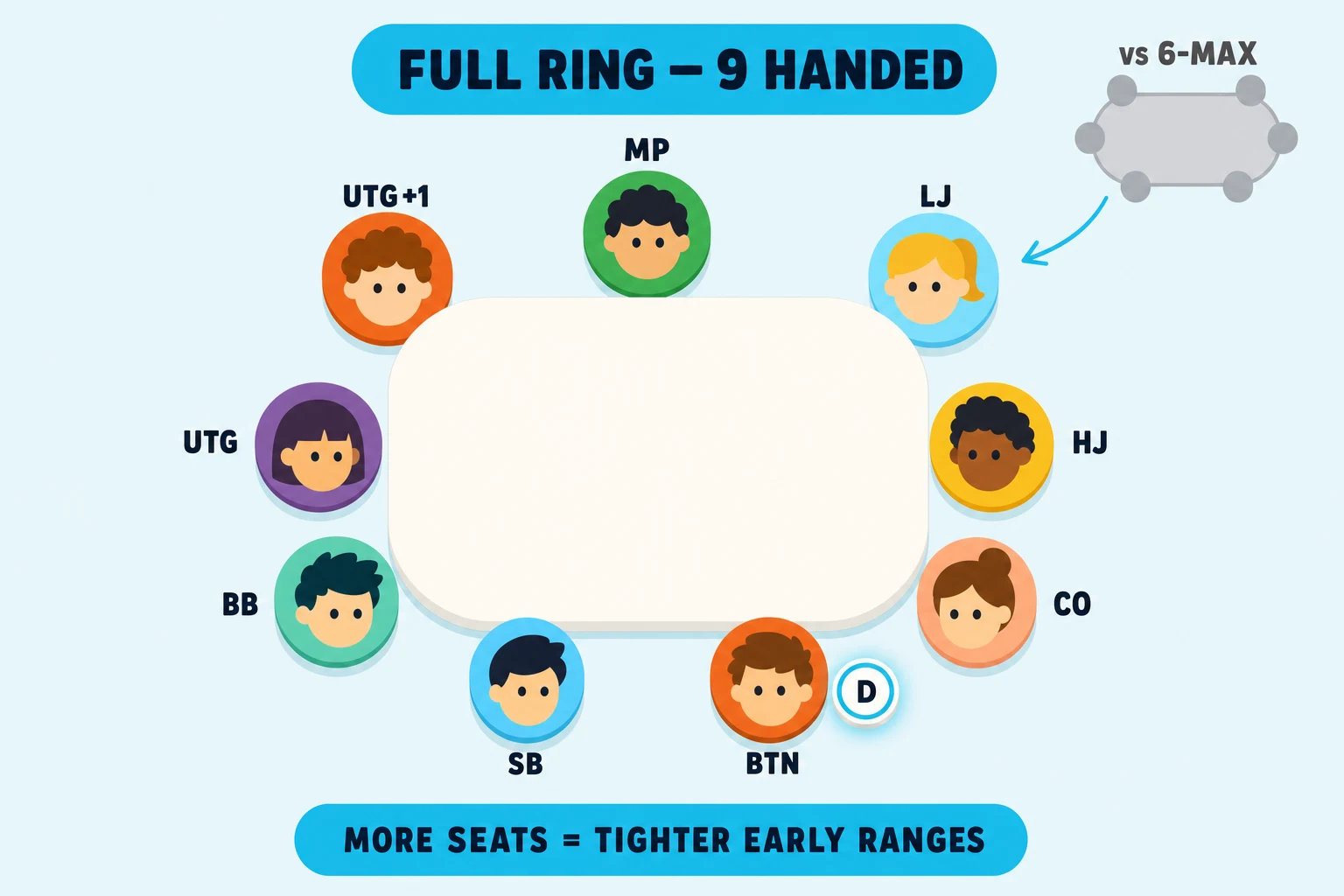
A full ring lineup, clockwise from the first seat to act after the blinds, is UTG, UTG+1, UTG+2 (sometimes labeled MP), Lojack, Hijack, Cutoff, Button, Small Blind, Big Blind. That leaves eight players to act behind UTG, three more than at the six-seat table where Poker Skill teaches under-the-gun opens. A 10-handed table inserts one more seat in the early band. The button and the blinds work the same as at 6-max; the difference is everything in between.
Related terms
- 6-max: the short-handed contrast format
- short-handed: the umbrella for non-full-ring tables
- position: where you sit relative to the button
- utg: full ring’s tightest seat
- hijack: the late-middle seat unique to longer lineups
- cutoff: one seat before the button
- button: last to act postflop
- opening-range: which hands you raise first in
Full ring vs 6-max vs heads-up
The three NLHE formats sit on a single axis: more seats means tighter ranges, slower pace and more multiway flops.
| Format | Seats | UTG opening range | Blind cycle | Multiway flops |
|---|---|---|---|---|
| Heads-up | 2 | Wide; the SB is the only opener | Every hand | Never |
| 6-max | 6 | Tight, about 14% of hands | Every 6 hands | Sometimes |
| Full ring (9-max) | 9 | Very tight, about 11% of hands | Every 9 hands | Often |
| Full ring (10-max) | 10 | Tightest | Every 10 hands | Most often |
Each step from heads-up toward 10-max strips opening hands out of early position and pushes value over bluffs in the average flop spot.
When this matters most
- Picking a format. Full ring rewards patience and value lines, and 6-max rewards aggression and pressure.
- Reading lobby filters. Online sites filter cash tables by seat count, and “9-max” and “Full Ring” are the same filter. Live cardrooms seat nine or ten.
- Soft-game hunting. Full ring tables tend to draw more recreational players who want to see a lot of flops cheaply. The pool is often looser-passive than a 6-max pool of the same stake; that flips the optimal balance toward more value bets and fewer thin bluffs.
- Translating ranges. A 6-max chart is not a full ring chart. JTs shows the translation on the preflop charts: it sits inside the 6-max under-the-gun range and outside the nine-handed early-position one. UTG at 9-max is three seats earlier than UTG at 6-max, so a hand at the edge of the 6-max UTG range is a fold from UTG at full ring.
Example: opening UTG at full ring
You are 100 big blinds (bb) deep in a $1/$2 No-Limit Hold’em cash game, nine-handed. You are first to act preflop with J♠ T♠.
At 6-max, with five players behind you, JTs is a standard open from under the gun. At full ring, eight players are still to act behind you, so the chance that one of them wakes up with a hand that 3-bets you is materially higher, and JTs is out of position against every caller except the blinds.
Decision: fold J♠ T♠ from UTG at full ring. The same hand is a routine open from the cutoff or the button, where suited broadways open easily: in Poker Skill’s Cutoff: Raise or Fold lesson, Q♥ T♥ is a first-in raise.
From the cutoff only the button and the blinds are left to act, which is why a hand that folds under the gun becomes a raise there.
Common mistakes at full ring
- Treating UTG+1 like UTG at 6-max. UTG+1 at full ring is still early position. Seven players are behind you. Add the small pairs and suited connectors a 6-max under-the-gun range carries, such as 22 to 66 and T9s, and you are paying off the regs in 3-bet pots.
- Opening offsuit broadways from early position. KJo, QJo and KTo flop top pair into ranges that include better top-pair hands. They are folds from early position at a 9-handed table; they belong on the cutoff and button.
- Auto-c-betting into multiple opponents. A flop with three or four players in the pot plays differently from a flop heads-up. Top pair / top kicker is much less likely to be the best hand in a four-way pot, so a continuation bet has to clear a higher value-bluff bar than at 6-max.
- Waiting too tight for “premium” hands. Tightening early position is correct, but folding AJo from the cutoff is too tight. Late position at full ring still opens wide, and the gap between your worst seat and your best seat is bigger here than at 6-max.
- Ignoring the slower blind cycle. At 6-max you post one set of blinds every six hands; at 9-max it is every nine. Each blind hurts less per hour, which means there is less urgency to “make something happen” and more room to wait for spots that pay.
FAQ
What is full ring poker?
Full ring is No-Limit Hold’em (or any other variant) played at a 9- or 10-handed table. It is the standard live cash-game format and was the online default before 6-max became the more popular online cash format.
How is full ring different from 6-max?
Full ring has more seats, which means more players left to act behind you in any preflop spot. That drives three concrete changes: opening ranges from early seats get tighter, the blinds cycle more slowly (so the per-hour cost of waiting for hands drops) and multiway flops happen more often. Late-position ranges at full ring (cutoff, button) are still wide, and the gap between full ring and 6-max lives almost entirely in the early seats.
Is 9-max the same as full ring?
Yes. “9-max” is the modern online lobby label for a nine-seat table; “full ring” is the older live-cardroom name and covers 9- or 10-handed tables equally. When you filter an online cash lobby by “9-max,” that is full ring. The terms are interchangeable in practice.