


Initiative
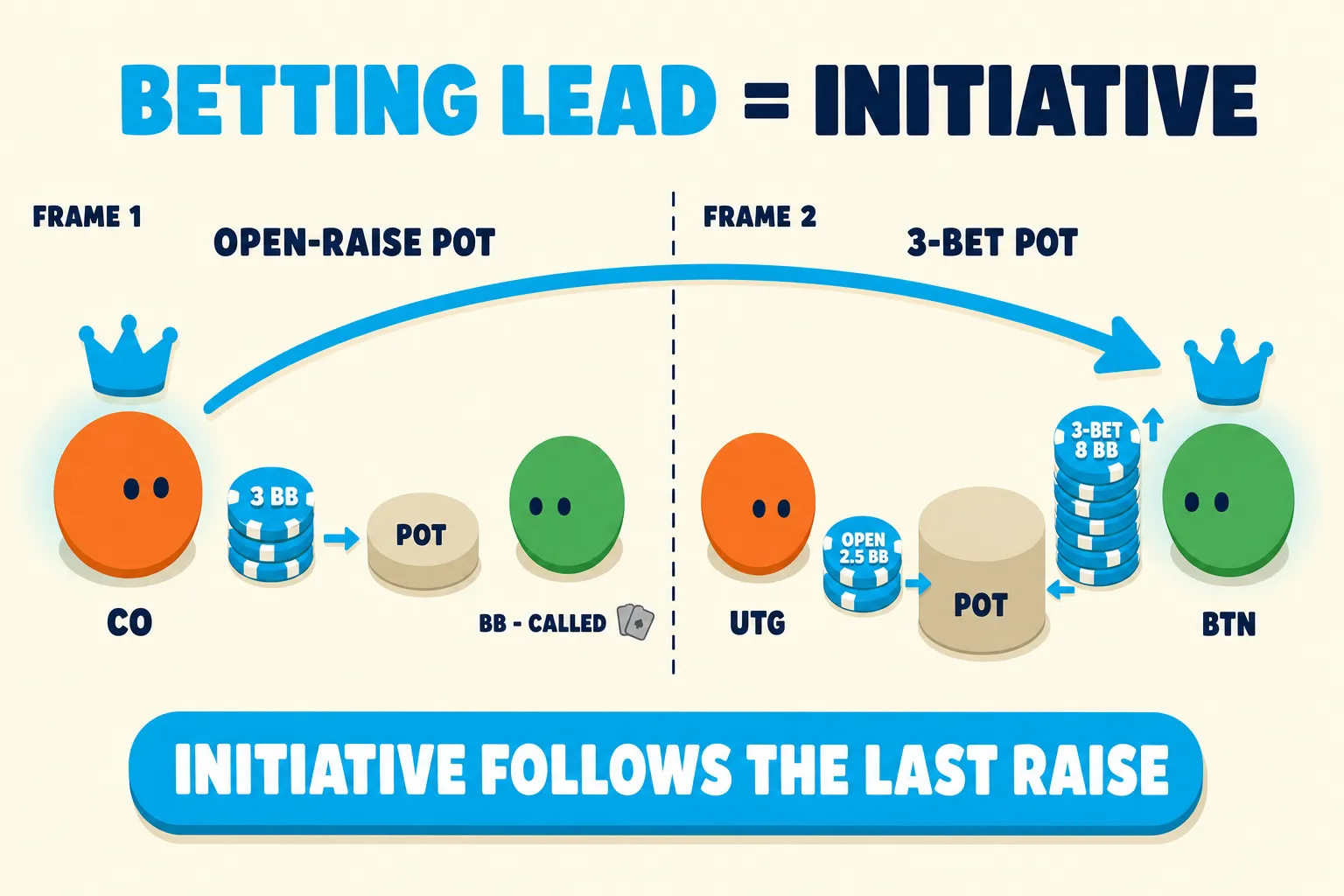
Initiative is the betting lead in a hand. It belongs to whoever made the last aggressive action - usually the preflop raiser - and shapes who is expected to bet the flop.
Practice this in Poker Skill. With the lead from a preflop raise, the flop lessons have A♣ 5♣ bet K♣ 4♣ 2♥ with a nut flush draw behind it, while 7♣ 6♣ checks and gives up the lead on K♦ Q♥ J♥, a board that misses it.
Get the free appInitiative: who has the betting lead and why it matters
What initiative means in a hand
Initiative is the betting lead. It belongs to whoever made the last aggressive action and tells the table who is expected to bet next. In most hands the preflop raiser carries it into the flop, which is why the preflop raiser is also the player who usually fires a c-bet. Lose the lead and you lose the script — the other player now sets the pace, and you become the one reacting.
Related terms
- Preflop raiser: the seat that almost always opens with initiative.
- C-bet: the flop bet that converts initiative into pressure.
- Range advantage: the structural reason initiative is valuable on most boards.
- Lead bet: a postflop bet from the player without initiative, often called a donk.
- Barrel: the multi-street follow-through that keeps initiative alive on later streets.
- Give-up node: the spot where giving the lead back is honest, not weak.
Who carries the initiative on each street
Initiative travels with the most recent raise. Calls and checks do not move it; only an aggressive action does.
| Action | Who carries initiative going forward | Why |
|---|---|---|
| Open-raise preflop, all others fold or call | The opener | Last aggressive action was the open. |
| Open, then 3-bet, then call | The 3-bettor | The 3-bet is the last raise before the flop. |
| 3-bet pot, flop check, turn check-raise | The check-raiser | A check-raise resets the lead on that street. |
| Single-raised pot, flop checks through | The original preflop raiser | No new raise has happened. |
| Open-raise, BB calls, BB leads the flop | The BB (the leader) | The lead bet is the new aggressive action. |
Two practical reads: the 3-bet usually owns the flop in a 3-bet pot, not the original opener. And a check-raise is the cleanest way an out-of-position caller can take the lead away from the player who raised.
When initiative matters most
- Heads-up pots on high-card boards. This is where the preflop raiser’s range advantage is largest, so the initiative-holder gets to c-bet small and frequently with very little risk. Ace-high and king-high dry boards are the canonical case.
- 3-bet pots out of position for the caller. The 3-bettor carries the lead, and the caller is squeezed into a passive role on a tight, capped range. The initiative-holder names the price; the caller pays it or folds.
- Spots where you are deciding whether to fire a barrel. Holding the lead lowers the equity bar for a turn or river bluff, because your range still credibly threatens strong hands. Without the lead, the same bluff looks like a story nobody believes.
When initiative matters less:
- Multi-way pots. With three or four players, somebody has connected with most flops, and the assumption that the preflop raiser is strongest stops holding. Cut your c-bet frequency and play more honestly.
- Very wet, low-card flops in single-raised pots. Boards like 8♠7♠6♥ or 9♣8♣7♦ favor the caller’s range, not the opener’s. The initiative still belongs to the raiser, but the range advantage does not, so betting just because you have the lead burns chips.
- Deep-stack rivers. With a full pot and 100bb behind, the river is decided by hand strength and blockers, not by who raised four streets ago.
Worked examples
Single-raised pot, ace-high dry flop
CO opens to 2.5bb, BTN folds, SB folds, BB calls. The pot is 5.5bb. Flop comes K♠ 7♦ 2♣.
CO has initiative — they made the last raise — and the board is friendly to a high-card opening range. A small c-bet around a third of the pot is the natural play here. The BB’s calling range is mostly middling pairs, suited gappers, and broadway misses, and almost none of those want to continue against a credible representation of a king. CO bets 1.8bb, BB folds most of the time, and CO wins a small pot without showing a hand.
If CO checks the flop instead, two things happen. The lead transfers to the BB, who can now stab any turn that misses both ranges, and CO has signaled that the king-high board missed them. The c-bet does not need to be heroic; it just needs to keep the script intact.
3-bet pot, transferred initiative
UTG opens to 2.5bb, BTN 3-bets to 8bb, UTG calls. Pot is roughly 17.5bb. Flop comes A♥ K♣ 5♦.
The lead is now with BTN, not UTG. A♥K♣x flops are the cleanest range-advantage spot in the game for the 3-bettor: the 3-betting range is ace-king, ace-queen, pocket pairs, and a balanced bluff frame, while the UTG flat-call range is heavy on broadway pairs and suited connectors that whiff. BTN bets about a third of the pot — say 5.5bb into 17.5bb — and prints across most of UTG’s continuing range.
If BTN had checked back this flop, the same range-advantage edge that made the 3-bet profitable preflop sits idle. The bet is not optional; it is the payoff for the preflop aggression.
Common mistakes with the initiative
1) Treating the c-bet as automatic
The most common leak is firing the flop every time you opened preflop. Solid 6-max defaults run closer to a 65% c-bet frequency, not 100%, and the higher you push that number against a thinking opponent, the more often a check-raise punishes you. Initiative is a license to lead, not a contract to bet every flop.
2) Checking back too often when you should fire
The opposite leak. Some players raise preflop, then check the flop in spots where the board favors them, hoping to “trap” or “control the pot.” Most of the time that is just handing the lead back. If the board hits your range, the bet is the bet — there is no value in saving the chips for later when later usually means the other player took over.
3) Ignoring multi-way dynamics
Initiative is a heads-up concept. With two or three callers, the assumption that the preflop raiser still has the strongest range collapses fast. Cut your c-bet frequency hard, and use give-up nodes as the default rather than the exception in multi-way pots.
4) Assuming a donk lead is always a trap
When the BB flat-calls preflop and then bets the flop into you, the natural reaction is to assume strength. The lead bet population skews toward middling made hands, draws, and underprotected ranges that are uncomfortable check-calling. Folding too much to a flop lead is a slow leak; raising or floating with the right hands is part of taking the lead back.
FAQ
Who has the initiative after a 3-bet preflop?
The 3-bettor. Initiative follows the last aggressive action, and the 3-bet is the most recent raise. Even though the original opener also raised, the 3-bet supersedes them. After the 3-bet gets called, the 3-bettor is the player expected to c-bet the flop.
Does calling a bet take the initiative?
No. Calls and checks do not move initiative; only a raise does. The hand stays in the hands of whoever raised last, even if every later street is a call from one side and a bet from the other. To take the lead, the caller has to raise — a flop check-raise, a turn donk lead, a river check-raise — anything that adds aggression rather than matching it.
Is having initiative the same as having range advantage?
No. They often line up, especially on high-card boards in single-raised pots, but they are different ideas. Initiative is who took the last aggressive action. Range advantage is whose range fares better on the actual board. If you hold initiative on a board that favors your opponent (say, you open UTG and the flop comes 7♣6♠5♥), you have the lead but not the equity, so a low-frequency, smaller c-bet (or a check) is the right answer.